Why Mexico is a Global Manufacturing Hotspot
Understanding the cost to manufacture in Mexico has become critical for companies seeking to optimize their global supply chains. Here’s what you need to know:
Key Manufacturing Cost Factors in Mexico:
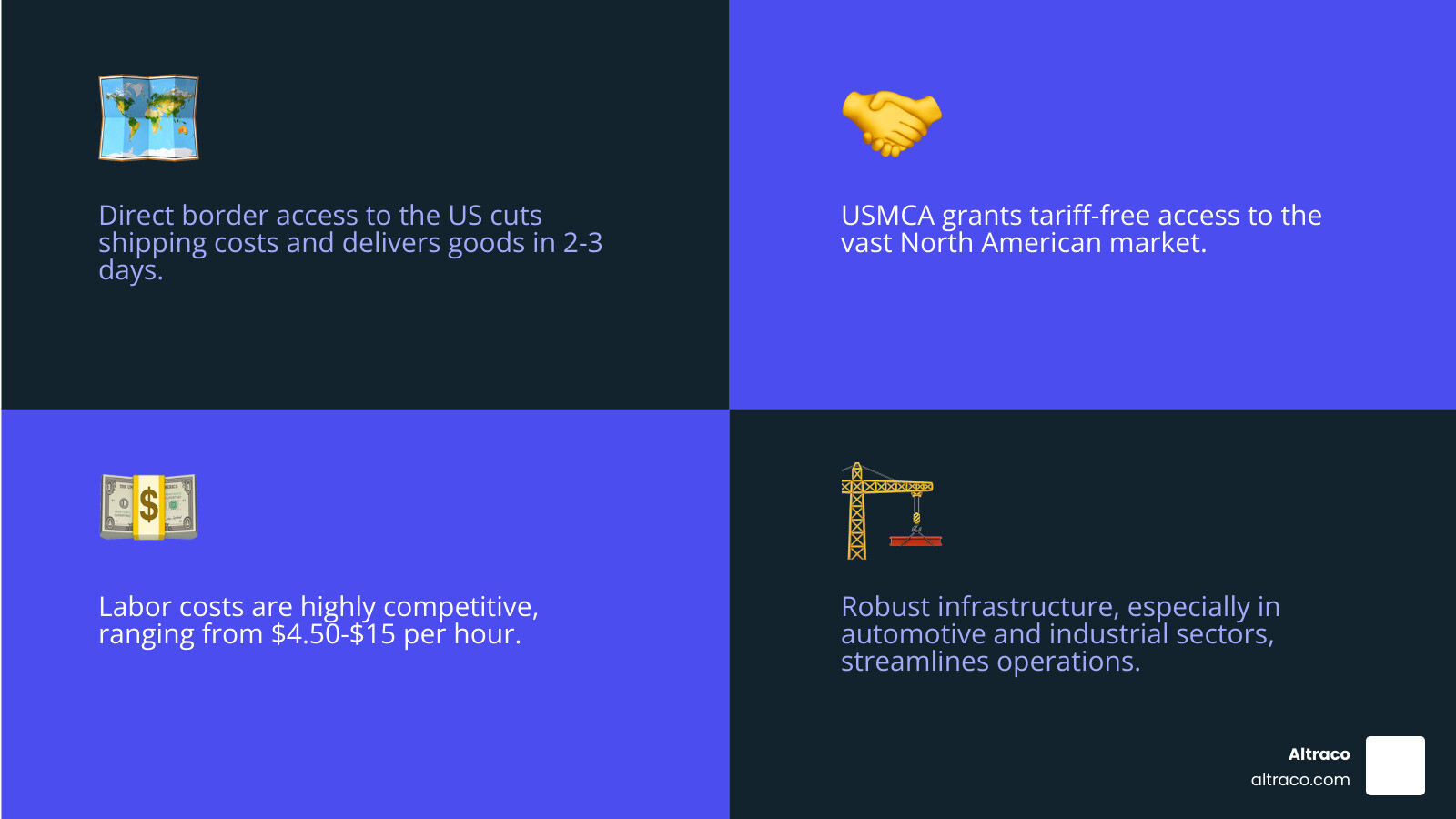
- Labor Costs: $4.50-$15/hour depending on skill level (vs. $23/hour in the US)
- Industrial Real Estate: $0.52-$0.70 per square foot monthly
- Electricity: $0.11-$0.18 per kWh
- Shipping to US: ~$2,700 for a 40-foot container (2-3 days delivery)
- Corporate Tax: 30%, but IMMEX program offers duty-free imports
- Total Savings: Up to 36% per unit compared to China for many products
Mexico has emerged as a manufacturing powerhouse, driven by nearshoring trends and significant disruptions in global supply chains. The combination of US-China trade tensions, escalating tariffs, and the need for supply chain resilience has pushed companies to reconsider where they manufacture.
The numbers tell a compelling story. Mexico’s exports to the US reached a record $475 billion in 2023, surpassing China as America’s largest trading partner. Manufacturing foreign direct investment in Mexico has risen by an average of 20% annually since 2019.
But cost-effectiveness goes deeper than labor savings. Mexico offers something China can’t: a 2,000-mile border with the United States, membership in the USMCA trade agreement providing tariff-free access to North American markets, and shipping times measured in days rather than weeks.
The recent Supreme Court decisions on tariffs have only accelerated this shift. Companies manufacturing automotive parts, sporting goods, home improvement products, and outdoor equipment are finding that Mexico offers not just lower costs, but strategic advantages that protect against trade policy volatility.
I’m Albert Brenner, and over 40 years of helping Fortune 500 companies steer the complexities of offshore manufacturing, I’ve seen the cost to manufacture in Mexico evolve from a simple labor arbitrage play into a sophisticated strategic decision. At Altraco, we’ve built deep expertise in contract manufacturing across Mexico, China, and Vietnam, helping companies achieve quality, on-time delivery, and significant cost savings while managing the regulatory and logistical challenges that come with global production.
A Detailed Breakdown of the Cost to Manufacture in Mexico
When we talk about the cost to manufacture in Mexico, we’re looking at a mosaic of factors that collectively paint a picture of opportunity. The primary cost drivers that capture our attention are labor, industrial real estate, utilities, and logistics. Each of these components contributes significantly to the overall operational expenses, and understanding their nuances is key to a successful manufacturing strategy.

Labor Costs: A Strategic Advantage, Not Just a Number
One of Mexico’s most compelling advantages is its competitive labor market. However, look beyond the simple hourly wage and consider the “fully burdened” labor rate. This includes not just the base salary but also mandatory benefits like vacation premium, profit sharing, social security, and other employer contributions mandated by Mexican labor law. When we factor these in, a clearer picture emerges.
For instance, a fully burdened, semi-skilled worker in Mexico costs approximately $5.30 per hour USD. This stands in stark contrast to the United States, where a comparable worker might cost around $23 per hour USD. For production workers, average wages hover around $4.50 to $6.00 per hour, while skilled technicians and engineers can earn between $8 to $15 per hour. Even for unskilled labor, rates range from $2 to $4.90 per hour.
Mexico’s standard work week is 48 hours, compared to the 40-hour workweek typical in the U.S. This extended work week, coupled with productivity gains, often helps offset wage increases, making the workforce highly efficient.
When we compare Mexico to other major manufacturing hubs, the savings are significant. In 2025, Mexico’s average manufacturing wage is projected to be $4.90 per hour, which is about 25% lower than China’s $6.50 per hour. Similarly, direct hourly unskilled manufacturing labor in Mexico averages CAN $6.27, compared to CAN $20.75 in Canada. For production supervisors, the difference is also notable: CAN $21.66 per hour in Mexico versus CAN $36.14 in Canada. These figures highlight why Mexico is changing global supply chains. To learn more about this shift, consider exploring Why Mexico Manufacturing Is Changing Global Supply Chains.
Here’s a quick comparison of hourly manufacturing wages:
| Skill Level | Mexico (USD/hour) | USA (USD/hour) | China (USD/hour, 2025 est.) | Canada (CAN/hour) |
|---|---|---|---|---|
| Unskilled Labor | $2.00 – $4.90 | $20.00+ | – | $6.27 |
| Semi-Skilled / Assembler | $4.50 – $6.00 ($5.30 fully burdened) | $23.00 | $6.50 | $7.94 |
| Skilled Technicians/Engineers | $8.00 – $15.00 | – | – | $9.46 (Machine Operators) |
| Production Supervisors | – | – | – | $21.66 |
Industrial Real Estate and Facility Costs
Finding the right space is paramount, and Mexico’s industrial real estate market offers competitive rates, though they vary by region and property class. For Class A industrial buildings, lease rates can range from $0.52 to $0.70 USD per square foot per month in many industrial parks. Annually, this typically translates to $4 to $8 per square foot.
Regional variations are quite pronounced. For example, in Tijuana, average industrial real estate leasing rates are $0.48 – $0.52 USD per square foot. Mexicali offers rates between $0.34 – $0.42 USD per square foot, while Ciudad Juárez sees rates around $0.40 – $0.42 USD per square foot. In a major hub like Monterrey, Class A industrial rent is approximately $7.17/m² per month (roughly $0.66 per square foot).
Vacancy rates in northern Mexican industrial markets generally range from a tight 1% to 6%, indicating high demand. It’s also worth noting that some industrial parks may offer incentives such as free months’ rent or tenant improvement (TI) allowances, which can further reduce initial facility costs.

Utility and Operational Expenses
Utility costs are another critical component of the cost to manufacture in Mexico. While generally favorable compared to the U.S., it’s important to have a clear understanding of what to expect.
Electricity costs in Mexico average around $0.11 to $0.18 per kWh, though some sources cite figures up to $0.192/kWh. This can be higher than China’s $0.09/kWh, but still competitive against some regions in Canada which can go up to $0.38/kWh. For energy-intensive operations, strategic energy management becomes crucial.
Natural gas costs average around $0.034 per kWh USD, offering an advantage, particularly for processes requiring heat. Water and sewer costs are typically around $0.007 USD per gallon, which is quite low. Internet costs average $20 USD per 8 Mbps monthly line, and phone costs are around $20 per month for a primary line.
However, it’s important to acknowledge that Mexico’s infrastructure, particularly in the energy sector, can experience strain. Electricity costs, for example, average 18 cents per kilowatt-hour, which is roughly double those in the U.S. and China, partly due to underinvestment. Water scarcity is also a growing concern in some northern industrial states. These factors necessitate careful planning and, at times, investment in resilient operational systems.
Logistics and Transportation: The Proximity Payoff
This is where Mexico truly shines, especially for companies serving the North American market. The geographical proximity to the United States offers unparalleled advantages in logistics and transportation, significantly reducing the cost to manufacture in Mexico compared to distant alternatives.
Consider this: shipping a 40-foot container from Mexico to the U.S. costs approximately $2,700 and takes a mere 2-3 days. Now, compare that to shipping the same container from China to the U.S., which can cost upwards of $4,000 to $8,000 and take several weeks (15-20 days or more). This difference in both cost and time is a game-changer for supply chain efficiency and responsiveness.
For our clients manufacturing automotive parts, sporting goods, and home improvement items, this proximity means faster time-to-market, reduced inventory holding costs, and greater flexibility to respond to demand fluctuations. Cross-border freight, while involving customs brokerage fees, is a well-established and efficient process, particularly at key entry points along the U.S.-Mexico border. This dramatically cuts down on transit times and associated expenses.
At Altraco, our expertise in global supply chains, including robust operations in Mexico, allows us to simplify these complex logistics for our clients. For a deeper dive into how we leverage these advantages, visit our main page on Mexico Manufacturing.
Navigating the Financial & Regulatory Landscape
Beyond the direct operational costs, understanding Mexico’s financial and regulatory environment is paramount. This includes navigating tariffs, leveraging trade agreements, managing various taxes, ensuring compliance, and utilizing programs like IMMEX. These elements can significantly impact the overall cost to manufacture in Mexico and your profitability.
Understanding the Tax and Regulatory Costs of Manufacturing in Mexico
Setting up and operating a manufacturing facility in Mexico involves a clear understanding of its tax and regulatory framework. Mexico’s corporate income tax stands at approximately 30 percent. Additionally, state payroll taxes vary between 1.8 to 2.9 percent, and real estate taxes typically range from 0.1 to 0.5 percent.
A significant consideration is the 16-percent Value-Added Tax (VAT) on materials and equipment imported into Mexico. However, this is where strategic planning comes into play. For firms registered with the IMMEX (Manufacturing, Maquiladora, and Export Services Industry) program and holding an IVA (Value Added Tax) Certification, this VAT expense can often be bypassed. The IMMEX program is a cornerstone for foreign manufacturers, allowing for the temporary, duty-free import of raw materials, components, and machinery for goods that will be processed and exported. It essentially provides an existing framework with the required registrations and certifications already in place, streamlining the setup process and reducing initial costs. For more details on this, check out A quick guide to the IMMEX program in Mexico.
Beyond taxes, there are incorporation fees, various permits (customs and operational), and ongoing compliance requirements that need to be budgeted for. Navigating this intricate web requires local expertise, which we provide to ensure our clients operate smoothly and efficiently.
How Trade Agreements Like USMCA Lower Your Overall Costs
Trade agreements are powerful tools that can significantly reduce the cost to manufacture in Mexico. The United States-Mexico-Canada Agreement (USMCA), which replaced NAFTA, is a prime example. This agreement facilitates tariff-free exports for qualifying goods across North America, offering a massive competitive edge, particularly for automotive parts, sporting goods, and home improvement products destined for the U.S. and Canadian markets.
The USMCA’s rules of origin are designed to encourage regional content, meaning that products manufactured in Mexico using a certain percentage of North American components can enter the U.S. and Canada without tariffs. This is a critical factor for many of our clients, especially those looking to avoid the hefty tariffs imposed on goods from other regions.
For instance, the U.S. has imposed tariffs on Chinese goods, with some averaging 124.1% and a massive 55% tariff on certain imports. This starkly contrasts with the tariff-free access Mexico enjoys under USMCA. This tariff advantage alone can translate into substantial savings, making Mexico a far more attractive manufacturing base for companies serving the North American market. The USMCA is a complex but highly beneficial agreement, and understanding its nuances is crucial for maximizing cost savings. You can explore the agreement further here: United States-Mexico-Canada Agreement (USMCA). For companies in California looking to leverage these benefits, our insights on Mexico Manufacturing California offer valuable guidance.
Beyond the Spreadsheet: Hidden Costs and Future Trends
While the immediate benefits of manufacturing in Mexico are clear, a comprehensive strategy requires looking beyond the obvious. There are potential hidden costs and evolving trends that can impact long-term viability and profitability. A thorough risk assessment and strategic planning are essential to ensure the success of your manufacturing operations.
Uncovering the Hidden Costs of Manufacturing in Mexico
No manufacturing destination is without its complexities, and Mexico is no exception. While the advantages are numerous, it’s wise to be aware of potential hidden or additional costs that can arise:
- Security Measures: In certain regions, investing in improved security measures or insurance may be necessary to protect assets and personnel. This can add to operational overhead.
- Infrastructure Strain: We’ve touched on this, but it bears repeating. Strain on the power grid can lead to higher electricity costs (averaging 18 cents/kWh, double that of the U.S. and China) or require investments in backup power. Water scarcity is also a growing concern in some northern industrial states, necessitating careful planning for water-intensive operations.
- Supply Chain Reshuffling Costs: The transition from one manufacturing location to Mexico can involve costs related to contract renegotiation with new suppliers, qualifying new vendors, and potential delays during the transition phase.
- Cultural and Communication Gaps: Overlooking cultural differences and communication styles can lead to inefficiencies. Investing in local management, bilingual staff, or strong cross-cultural training is crucial to bridge these gaps.
- Labor Attrition Rates: While Mexico boasts a young and growing workforce, some factories have reported blue-collar worker attrition rates approaching 60%. High attrition can lead to increased recruitment and training costs.
- Customs Compliance: Navigating the intricacies of cross-border compliance, especially for specialized goods, requires expertise and can incur additional fees for customs brokerage and regulatory adherence.
These factors underscore the need for a seasoned partner like Altraco, who can help anticipate and mitigate these hidden costs, ensuring a smoother and more predictable manufacturing journey.
Future Outlook: Projecting Cost Trends
The manufacturing landscape in Mexico is dynamic, and understanding projected cost trends is vital for long-term planning.
- Rising Labor Costs: Mexico’s national minimum wage has climbed by an annual average of 20% since 2019. Furthermore, proposed labor reforms could potentially increase Mexican manufacturing labor costs by another 10% to 20%. While still significantly lower than the U.S., this trend necessitates continuous monitoring and strategies for productivity improvement.
- Increasing Demand for Real Estate: With growing foreign direct investment and nearshoring trends, demand for industrial real estate remains high, particularly in northern Mexico where vacancy rates are already tight (1-3%). This sustained demand could lead to continued increases in lease rates.
- Continued Foreign Direct Investment (FDI): Manufacturing FDI in Mexico has risen by an average of 20% annually since 2019. This influx of investment, while positive for economic growth, can also contribute to rising costs for resources, services, and specialized labor.
- Currency Fluctuations: The exchange rate between the U.S. Dollar and the Mexican Peso can impact the overall cost structure. While a favorable exchange rate can increase purchasing power for foreign companies, fluctuations introduce an element of financial risk that needs to be managed.
Despite these potential increases, Mexico’s strategic advantages, bolstered by trade agreements and a developing infrastructure, are expected to maintain its position as a highly competitive manufacturing hub. For insights into how companies are successfully navigating these trends, you might find our resources on Mexico Manufacturing Companies California particularly useful.
Frequently Asked Questions about Manufacturing Costs in Mexico
We often get asked specific questions about the cost to manufacture in Mexico. Here are some of the most common ones we encounter:
Is it cheaper to manufacture in Mexico than in China?
For many U.S.-bound goods, the answer is a resounding “yes.” When you factor in labor, shipping, and tariffs, Mexico often presents a more cost-effective solution. For example, in a sample product cost calculation, Mexico saved approximately 36% per unit compared to China.
While China’s labor costs are currently higher than Mexico’s (projected $6.50/hr vs. $4.90/hr in 2025), the real differentiator lies in logistics and tariffs. Shipping a 40-foot container from Mexico to the U.S. costs around $2,700 and takes 2-3 days, whereas from China, it can cost $4,000 to $8,000 and take 15-20 days. Furthermore, the U.S. has imposed significant tariffs on Chinese goods (some averaging 124.1%, or a 55% tariff on specific items), which are largely avoided when manufacturing in Mexico under the USMCA agreement. Industrial rent in Mexico is also reported to be 52% cheaper than in China, although electricity costs in Mexico ($0.192/kWh) are higher than in China ($0.09/kWh).
What is the average hourly labor cost for manufacturing in Mexico?
The average hourly labor cost for manufacturing in Mexico varies depending on the skill level, region, and whether it’s a fully burdened rate.
- Fully Burdened Semi-Skilled Worker: Approximately $5.30 per hour USD. This includes wages, benefits, and accounts for a 48-hour work week.
- Production Workers: Typically range from $4.50 to $6.00 per hour.
- Unskilled Labor: Can be as low as $2.00 to $4.90 per hour.
- Skilled Technicians and Engineers: Command higher wages, usually between $8.00 and $15.00 per hour.
- Production Supervisors: Average around CAN $21.66 per hour (approximately $16 USD/hour).
These figures reflect a significant cost advantage compared to manufacturing in the United States, where similar roles can cost upwards of $20-$23 per hour.
What are the main tax benefits for manufacturing in Mexico?
Mexico offers several compelling tax benefits that can significantly reduce the overall cost to manufacture in Mexico:
- IMMEX Program: This is arguably the most significant benefit. The IMMEX program allows companies to temporarily import raw materials, components, and machinery into Mexico for manufacturing processes without paying import duties or VAT, provided the finished goods are subsequently exported.
- IVA (VAT) Certification: As an extension of the IMMEX program, obtaining an IVA Certification enables companies to bypass the 16% Value-Added Tax on temporarily imported materials and equipment, further reducing upfront costs.
- USMCA Agreement: For goods that meet the rules of origin under the United States-Mexico-Canada Agreement, manufacturers can export their products to the U.S. and Canada free of tariffs. This is a massive advantage for companies targeting the North American market, particularly for automotive parts, sporting goods, and home improvement products.
- Tax Incentives: Mexico also offers various tax incentives within specific economic zones, which can include reduced corporate taxes and exemptions on machinery imports, potentially leading to savings of up to 20% on initial setup costs.
These programs and agreements are designed to make Mexico an attractive and cost-efficient destination for foreign manufacturers.
Conclusion: Making the Right Move for Your Supply Chain
The journey of understanding the cost to manufacture in Mexico reveals a landscape rich with strategic advantages, particularly for companies seeking to optimize their supply chains for the North American market. From competitive labor rates and favorable real estate costs to the undeniable logistics benefits of proximity, Mexico presents a compelling case. However, like any strategic move, it requires a holistic cost analysis, a keen eye for potential hidden expenses, and a forward-looking perspective on evolving trends.
Navigating the complexities of Mexico’s regulatory framework, maximizing the benefits of trade agreements like USMCA, and mitigating potential risks such as infrastructure strain or cultural gaps, demands expertise. This is where a seasoned partner becomes invaluable.
At Altraco, we specialize in simplifying global supply chains through expert contract manufacturing. Based in Thousand Oaks, CA, we leverage decades of experience, trusted factory relationships, and deep expertise in tariff navigation to deliver quality, on-time products with significant cost savings for our clients. Whether you’re manufacturing home improvement products, sporting goods, automotive parts, or outdoor equipment, our team is equipped to help you harness Mexico’s potential. We don’t just find manufacturers; we forge strategic partnerships that drive efficiency and growth.
Don’t let the complexities deter you from exploring Mexico’s manufacturing advantages. Let us help you open up the full potential of your supply chain. For personalized guidance and to begin your strategic exploration, Let us help you navigate your Mexico Manufacturing strategy.