Why Quality Control in Manufacturing is the Foundation of Business Success
Quality control in manufacturing is the systematic process of monitoring, testing, and inspecting products throughout production to ensure they meet specified requirements and standards. It involves catching defects early, reducing waste, maintaining consistency, and protecting your brand reputation.
Quick Answer: What is Quality Control in Manufacturing?
- Definition: A set of procedures to verify products meet quality standards through inspection, testing, and measurement
- Purpose: Identify and correct defects before products reach customers
- Key Activities: Raw material inspection, in-process checks, final product testing, and documentation
- Main Goal: Deliver consistent, safe, reliable products that meet customer expectations and regulatory requirements
- Core Methods: Six Sigma, Statistical Process Control (SPC), Total Quality Management (TQM), and Lean Manufacturing
As John Ruskin famously stated, “Quality is never an accident. It is always the result of intelligent effort.” This is especially true today, where a single defect can trigger costly recalls and damage brand trust. In 2023, US product recalls surged by 11%, with fines totaling $55.3 million—a stark reminder that quality control isn’t optional.
For companies manufacturing automotive parts, home improvement products, sporting goods, and outdoor equipment, quality control becomes even more critical. These products often involve safety considerations, regulatory compliance, and performance standards that leave no room for error. When navigating the complexities of offshore manufacturing in countries like Mexico, China, or Vietnam, maintaining consistent quality across time zones and cultural differences adds another layer of challenge.
The stakes are high for Fortune 500 companies managing global supply chains. Recent tariff changes and disruptions have forced many to rethink their strategies, but one constant remains: quality cannot be compromised. Whether producing precision automotive components or durable outdoor gear, customers expect excellence, and your brand depends on it.
I’m Albert Brenner, and as co-owner of a contract manufacturing company with over 40 years of experience, I’ve seen how effective quality control in manufacturing separates successful global operations from costly failures, particularly when producing automotive parts, home improvement products, and sporting goods across multiple countries. My firm has helped Fortune 500 companies steer offshore production complexities and maintain the highest quality standards amid changing tariffs and regulations.
The Fundamentals: QC, QA, and Core Benefits
At the heart of every successful manufacturing operation lies a robust quality management system composed of two pillars: Quality Control (QC) and Quality Assurance (QA). While often used interchangeably, understanding their unique roles is crucial for manufacturing excellence.
Quality management isn’t just about catching mistakes; it’s about building a system that prevents them. For our clients in overseas manufacturing of automotive parts or sporting goods, clear QC and QA distinctions are paramount. This allows us to apply the right strategies at the right time, minimizing costs and ensuring products meet exacting specifications. We often share our Proven Tips to Improve Quality in Overseas Manufacturing to help partners steer these complexities.

Quality Control (QC) vs. Quality Assurance (QA): A Critical Distinction
While both quality control in manufacturing and quality assurance aim for product excellence, their approaches differ. Think of it this way: QA is about preventing fires, while QC is about putting them out.
Quality Assurance (QA) is proactive and process-oriented. It focuses on setting up the right systems to ensure quality requirements are met from the outset. QA happens before and during production, aiming to prevent defects through robust system design, clear procedures, and training. It’s about building quality into the product lifecycle.
Quality Control (QC), on the other hand, is reactive and product-oriented. It focuses on inspecting and testing products to identify and rectify defects. QC takes place during the operational phase, ensuring the finished product meets defined quality standards. It involves detecting flaws and taking immediate corrective action.
Here’s a breakdown to highlight their differences:
| Feature | Quality Control (QC) | Quality Assurance (QA) |
|---|---|---|
| Approach | Reactive | Proactive |
| Focus | Product-focused | Process-focused |
| Goal | Defect detection | Defect prevention |
| Timing | During & after production (operational phase) | Before & during production (system design) |
| Responsibility | Testing team, inspectors | Entire team, management |
| Action | Corrective action | Preventive action |
For us, managing contract manufacturing overseas, this distinction is key to comprehensive quality management. We ensure partners have strong QA systems to prevent issues and rigorous QC checks to catch deviations, whether for home improvement items or complex automotive components.
Why Quality Control in Manufacturing is Non-Negotiable
Effective quality control in manufacturing is a business imperative. As the last line of defense before a product reaches the market, it safeguards consumers, your reputation, and your bottom line.
- Product Safety and Reliability: For industries like automotive parts and sporting goods, safety is paramount. A defective brake component or a faulty piece of outdoor equipment can have life-threatening consequences. QC ensures products meet strict safety standards, verifying material composition, durability, and performance.
- Cost Reduction: Poor quality is expensive, leading to increased scrap, rework, warranty claims, and potential litigation. By identifying defects early, robust QC processes significantly reduce production costs and the financial risks of recalls.
- Brand Integrity and Customer Loyalty: Consistent quality builds trust. When customers purchase your home improvement products or outdoor equipment, they expect reliability. Meeting these expectations fosters loyalty and strengthens your brand’s reputation. Our Strong Supplier Relationships are crucial for maintaining this consistency across global supply chains.
- Regulatory Compliance: Many products, especially automotive parts, are subject to stringent government regulations. QC ensures every product adheres to these requirements, preventing costly penalties, legal issues, and market access restrictions.
Core Benefits of a Robust QC System
A strong quality control in manufacturing system offers benefits beyond just avoiding defects:
- Improved Product Consistency: QC ensures every product leaving the factory meets the same high standards, which is vital for customer satisfaction.
- Increased Operational Efficiency: By minimizing scrap, rework, and delays, QC streamlines manufacturing, leading to higher efficiency. For instance, middle managers often waste weeks on low-value work due to unclear workflows—a problem robust QC and QA can mitigate.
- Improved Compliance: A well-defined QC system ensures adherence to strict standards set by regulatory bodies like ISO, which is critical for products with safety implications.
- Reduced Liability Risk: Proactive quality checks reduce the likelihood of product failures that could lead to recalls, lawsuits, and significant financial liability.
- Data-Driven Decision Making: QC generates valuable data on defect rates and process variations. This data is critical for identifying trends and making informed decisions for continuous improvement.
- Better Supplier Relationships: By setting clear quality expectations and monitoring incoming materials, QC fosters transparent and productive supplier relationships. This is especially true in offshore manufacturing, where strong communication with our partners in Mexico, China, and Vietnam is key.
Key Methodologies and Tools for Effective Quality Control
Effective quality control in manufacturing relies on methodologies and tools to identify problems, find root causes, and drive improvement. These data-driven approaches ensure every automotive part, piece of outdoor gear, or home improvement product meets precise specifications. For those in global supply chains, Understanding Manufacturing Terminology in the Global Supply Chain is a great starting point.
Popular Quality Control Methodologies
Modern manufacturing employs several well-established methodologies to embed quality into every process:
- Six Sigma: This data-driven approach minimizes waste and reduces process variation. Aiming for near-perfection (3.4 defects per million opportunities), Six Sigma follows the DMAIC framework: Define, Measure, Analyze, Improve, and Control. It’s highly effective for complex processes like automotive parts manufacturing, where precision is key.
- Total Quality Management (TQM): TQM is a management philosophy that involves every function and employee in ensuring quality. It emphasizes continuous improvement, customer satisfaction, and a company-wide culture of quality.
- Statistical Process Control (SPC): SPC is a data-driven method using statistical techniques, like control charts, to monitor and control processes. By analyzing metrics in real-time, SPC helps detect variations before they lead to defects, ensuring processes remain stable.
- Lean Manufacturing: While focused on eliminating waste, Lean inherently supports quality control in manufacturing. By streamlining processes, reducing inventory, and implementing checks at each stage, Lean minimizes defect opportunities. The 5S framework (Sort, Set in order, Shine, Standardize, Sustain) is a common Lean tool for an organized, quality-focused workspace.
Often, the most robust systems integrate elements from these methodologies for a custom approach.
Essential Quality Control Tools and Techniques
Specific tools are indispensable for daily quality control in manufacturing:
- The 7 Basic Quality Tools: These are fundamental for data collection, analysis, and problem-solving:
- Control Charts: Graphical tools to monitor process stability over time.
- Histograms: Bar graphs showing data frequency distribution.
- Pareto Charts: Bar graphs ranking problems by frequency to prioritize efforts (80/20 rule).
- Cause-and-Effect Diagrams (Fishbone or Ishikawa Diagrams): Visual tools for brainstorming potential causes of a problem.
- Check Sheets: Simple forms for systematic data collection.
- Scatter Diagrams: Graphs showing the relationship between two variables.
- Flowcharts: Diagrams illustrating process steps to identify bottlenecks.
- 5 Whys Root Cause Analysis: This technique involves repeatedly asking “Why?” to uncover a problem’s fundamental root cause, a crucial step in managing Proven Tips to Manage Quality Issues in Manufacturing.
- Checklists: Standardized lists of items or steps to be verified, ensuring consistency and preventing omissions.
- Advanced Measurement Equipment:
- Coordinate Measuring Machines (CMMs): Highly precise devices for measuring an object’s physical geometry.
- Calipers and Micrometers: Essential tools for accurate dimension measurement.
- Vision Systems / Automated Optical Inspection (AOI): Automated cameras and software for inspecting products for defects.
These tools provide the data needed to maintain high quality in home improvement components and intricate outdoor products.
Building and Implementing Your Quality Control Program
An effective quality control in manufacturing program requires strategic planning, documentation, and team involvement. It’s an ongoing commitment, not a one-time setup. As a contract manufacturing partner, we help clients Maintain Quality Control Program across diverse global operations.
Step 1: Defining Quality Standards and Specifications
Clearly defined quality standards are the foundation of any QC program.
- Customer Requirements: We start by understanding client and end-user expectations, including critical functional, aesthetic, and performance requirements for their automotive parts or sporting goods.
- Regulatory Compliance: We identify all applicable industry and government standards. For example, specific certifications for automotive parts are non-negotiable. The ISO 9000 standards series is a globally recognized benchmark for quality management.
- Measurable Attributes and Variables: Quality standards must be objectively measurable, defining specific attributes and variables (e.g., dimensions, material strength). We work with our partners in Mexico, China, and Vietnam to create precise, actionable specifications, a critical part of our Contract Manufacturing Services Complete Guide that ensures clarity.
Step 2: Creating and Documenting the Process
Once standards are set, we develop a comprehensive quality control plan:
- Developing a QC Plan: This plan outlines the inspections, tests, and measurements for each production stage, detailing what will be checked, when, how, and by whom.
- Identifying Critical Control Points (CCPs): These are stages where a quality failure could lead to significant defects or safety issues. For home improvement products, a CCP might be the curing time for an adhesive.
- Inspection and Testing Protocols: We establish detailed procedures for each check, including sampling methods (e.g., Acceptance Sampling), equipment calibration, and acceptance criteria.
- Non-Conformance Reporting and CAPA: When a defect is found, a non-conformance report triggers Corrective and Preventive Actions (CAPA) to identify the root cause and prevent recurrence. This framework is key to any effective Quality Control Program.
- Documentation: Thorough documentation of all procedures, results, and corrective actions is vital for auditing, troubleshooting, and consistency.
Step 3: The Human Element – Training and Engagement
Technology and processes are powerful, but people are the ultimate drivers of quality.
- Importance of Training: Our teams and partners must be thoroughly trained on QC principles, specific methodologies, equipment operation, and their role in maintaining quality.
- Creating a Culture of Quality: Quality is a mindset. We foster a culture where everyone, from engineers to line workers, feels responsible for quality. This involves open communication, feedback, and celebrating successes.
- Employee Empowerment: Empowering employees to proactively address quality concerns is crucial. They are closest to the production line and can spot issues first. Giving them authority to stop a process if a defect is found can prevent significant waste.
- Communication and Skill Development: Regular communication about quality performance keeps everyone engaged. Investing in ongoing skill development ensures our teams have the latest knowledge, which is vital for Overseas production where collaboration is key.
The Modern Approach to Quality Control in Manufacturing
The quality control in manufacturing landscape is evolving with technology and complex global supply chains. At Altraco, integrating cutting-edge tech and navigating trade dynamics are key to delivering quality automotive parts or outdoor products. Our Integrated Supply Chain Services are designed to address these modern challenges.
Leveraging Technology: AI, IoT, and Automation
The advent of Industry 4.0 has revolutionized quality, moving from reactive inspection to proactive, predictive control.
- AI for Predictive Quality: AI and Machine Learning (ML) algorithms analyze production data to predict quality issues before they occur. This allows for proactive process adjustments to prevent defects. For example, AI can predict component failure from machine data, enabling preemptive maintenance.
- IoT Sensors for Real-Time Monitoring: The Internet of Things (IoT) enables continuous, real-time monitoring of manufacturing processes with embedded sensors. This immediate feedback allows operators to detect deviations and make corrections instantly, ensuring consistent quality, especially for sensitive electronics contract manufacturing.
- Automated Optical Inspection (AOI) and Robotics: Automation improves inspection accuracy and speed. AOI systems rapidly inspect products for defects, far surpassing human capabilities. Robotics can perform repetitive, high-precision tests on sporting goods or automotive parts with unwavering accuracy.
- Digital Twins: A digital twin is a virtual replica of a physical product or process. By feeding real-time IoT data into the twin, manufacturers can simulate performance, identify quality issues, and optimize processes virtually before implementing physical changes. This is useful for complex product development and continuous improvement.
These technologies improve the precision and predictive capabilities of quality control in manufacturing. For more on how technology transforms production, our Electronics Contract Manufacturing Complete Guide offers a deeper dive.
Overcoming Common Challenges and Measuring ROI
Even with advanced technology, quality control in manufacturing faces challenges, especially globally. However, strategic solutions make them surmountable, and quality investments yield significant returns.
Common Challenges:
- Process Variation: Managing inherent variability from materials, equipment, or operators to stay within specifications is a continuous challenge.
- Resource Allocation: Balancing the investment in skilled personnel, equipment, and technology with budget constraints can be tricky.
- Supplier Quality Management: Ensuring consistent quality from global suppliers, especially for offshore manufacturing, is complex.
- Data Overload and Analysis: The challenge is to translate vast amounts of data into actionable insights.
Effective Solutions:
- Standardized Procedures and Training: Clear SOPs and comprehensive training are fundamental to reducing variation and human error.
- Technology Integration: AI, IoT, and automation are powerful tools for monitoring, predicting, and automating quality checks.
- Robust Supplier Management: Strong supplier qualification, regular audits, and clear quality agreements are crucial. Tools like our Supplier Scorecards Complete Guide help improve supplier relationships.
- Continuous Improvement Frameworks: Methodologies like Lean and Six Sigma provide structured approaches to solve quality problems.
Measuring Return on Investment (ROI) for QC Initiatives:
Calculating the ROI of quality control in manufacturing means quantifying benefits against the investment, which is essential for justifying resources.
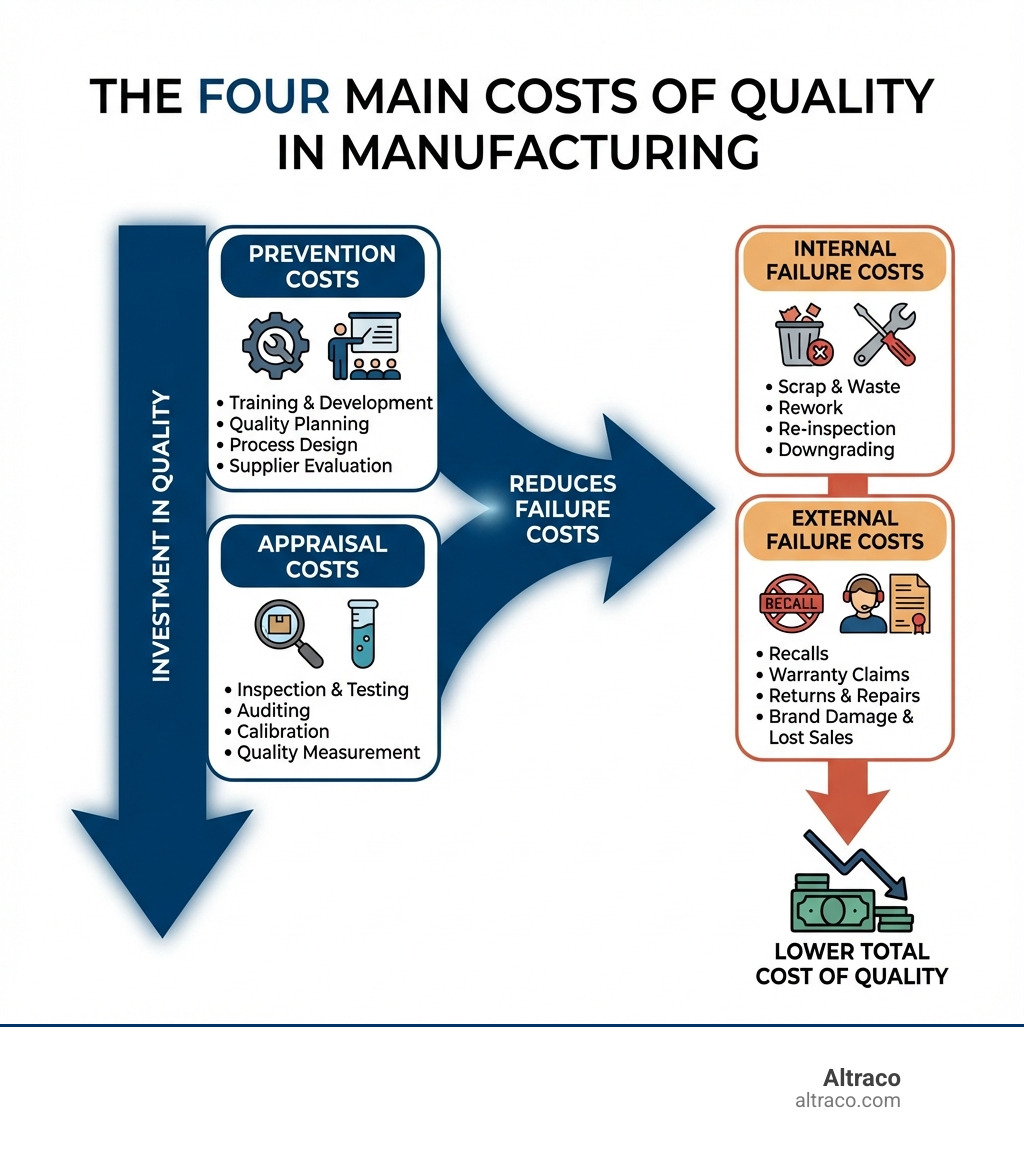
- Cost of Quality (COQ): This framework categorizes costs into four areas:
- Prevention Costs: Investments to prevent defects (e.g., training).
- Appraisal Costs: Costs of inspecting and testing (e.g., audits).
- Internal Failure Costs: Costs of defects found before reaching the customer (e.g., scrap, rework).
- External Failure Costs: Costs of defects found after reaching the customer (e.g., recalls, warranty claims).
Reducing failure costs through prevention and appraisal demonstrates a positive ROI.
- Key Performance Indicators (KPIs): Tracking metrics provides quantifiable evidence of QC effectiveness:
- Defect Rates: Reduction in defective products.
- First Pass Yield (FPY): Percentage of products passing all checks the first time.
- Customer Complaint Rates: A decrease indicates improved satisfaction.
- Scrap and Rework Rates: Direct cost savings from reduced waste.
- Warranty Costs: Lower costs indicate higher product reliability.
Diligently tracking these metrics clearly demonstrates how QC investments lead to tangible financial benefits and a stronger market position.
Conclusion: Building a Future-Proof Quality Strategy
In summary, quality control in manufacturing is the strategic backbone of a successful operation. It ensures safety for automotive parts and durability for outdoor products. We’ve covered the QC/QA distinction, key methodologies like Six Sigma, essential tools, and the steps for building a comprehensive QC program.
The modern landscape, shaped by Industry 4.0 tech like AI and IoT, is moving quality control toward predictive capabilities. Challenges like process variation and supplier management are addressable through strategy and technology. Investing in quality yields a clear return by reducing costs, enhancing brand reputation, and fostering customer loyalty.
Looking ahead, the future of quality control in manufacturing will involve more digital change, automation, and AI integration. The focus will remain on defect prevention, process optimization, and adapting to market demands.
At Altraco, we simplify global supply chains. We know manufacturing automotive parts, home improvement products, sporting goods, and outdoor products overseas demands an unwavering commitment to quality. Our expertise in offshore manufacturing in Mexico, China, and Vietnam, plus our skill in navigating complex logistics and tariffs, ensures your products exceed expectations. We leverage decades of experience and trusted factory relationships to deliver quality, on-time products with significant cost savings.
Let us help you build a future-proof quality strategy that positions your business for long-term success.
Partner with Altraco to ensure your manufacturing meets the highest quality control standards