An Unprecedented Trade Standoff Reshaping Global Manufacturing
China retaliates against trump’s tariffs with counter-tariffs on us goods in what has become the most significant trade conflict of the 21st century. Here’s what you need to know:
Key Facts:
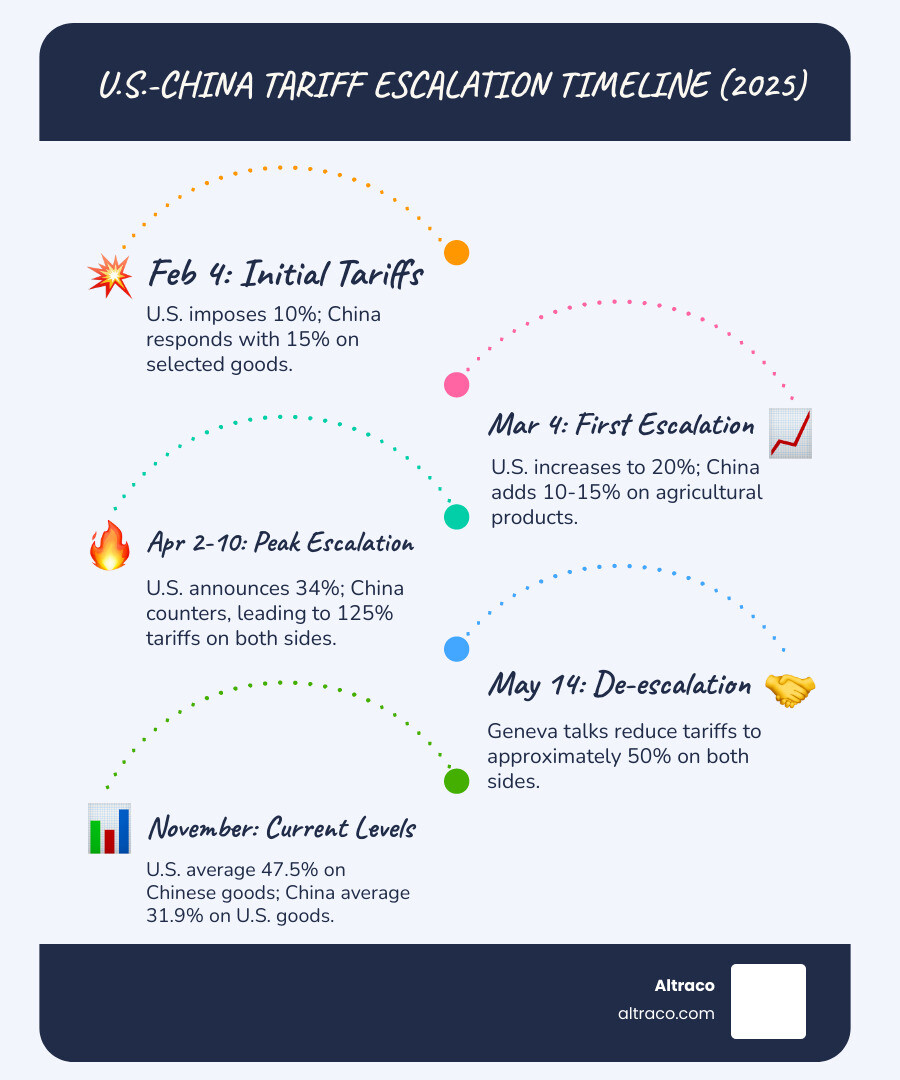
- Current tariff levels: U.S. tariffs on Chinese goods average 47.5%, while Chinese tariffs on U.S. goods average 31.9%
- Peak escalation: Tariffs reached 127.2% (U.S.) and 147.6% (China) in April 2025
- Timeline: Started with 10% tariffs in February 2025, escalated to 125% by April 2025
- Targeted U.S. products: Soybeans, pork, corn, crude oil, LNG, automotive parts, agricultural machinery, sporting goods
- Beyond tariffs: China added 27 U.S. companies to restricted entity lists and imposed export controls on rare earth elements
What began as a 10% tariff in early 2025 exploded into a full-scale trade war. The U.S. imposed tariffs citing unfair trade practices and intellectual property theft. China responded with matching tariffs, calling the U.S. actions “economic bullying.”
By April 2025, the situation reached crisis levels. China jumped its counter-tariffs from 34% to 84%, then to 125%. The U.S. matched each increase. This tit-for-tat escalation disrupted global supply chains and sent shockwaves through manufacturing sectors worldwide.
The impact hit American manufacturers particularly hard. Companies that relied on Chinese industrial inputs faced massive cost increases. Ford expected to lose $1.5 billion in pretax earnings. U.S. factories that depended on Chinese parts and components faced shutdowns and layoffs.
China didn’t stop at tariffs. They deployed a multi-faceted strategy including:
- Export controls on critical minerals like tungsten and rare earth elements
- Unreliable Entity Lists banning U.S. companies from Chinese markets
- Antidumping investigations on medical equipment
- Import suspensions on agricultural products
The trade war forced both nations into multiple rounds of negotiations. By May 2025, after talks in Geneva, tariffs were reduced but remained significantly higher than pre-2025 levels.
For businesses that manufacture home improvement products, sporting goods, automotive parts, and outdoor products, this trade conflict created urgent challenges. Supply chains built over decades became unreliable overnight. Costs skyrocketed. Lead times extended.
I’m Albert Brenner, and over my 40+ years in contract manufacturing, I’ve steered multiple trade disruptions, but nothing matches the scale of how china retaliates against trump’s tariffs with counter-tariffs on us goods today. My experience helping Fortune 500 companies adapt their manufacturing strategies during tariff crises has shown me that businesses need flexible, diversified supply chains now more than ever.
The numbers tell a stark story. Average U.S. tariffs on imports from China increased from 3.1% in January 2018 to 47.5% today—more than 15 times higher. China’s counter-tariffs rose from 8% to 31.9% over the same period. These aren’t just statistics. They represent fundamental shifts in how global manufacturing works.
Must-know china retaliates against trump’s tariffs with counter-tariffs on us goods terms:
The Spark: Understanding the U.S. Tariffs and China’s Stated Grievances
The current trade conflict didn’t just appear out of nowhere; it ignited from a series of U.S. actions, primarily driven by the Trump administration’s “America First” agenda. The initial U.S. tariffs that prompted China’s retaliation were rooted in long-standing complaints about what the U.S. viewed as unfair trade practices, intellectual property theft, and forced technology transfers. These concerns had simmered for years, but President Trump chose to address them head-on, initiating a Section 301 investigation into China’s trade policies.
This investigation, authorized under the Trade Act of 1974, concluded that China’s practices were indeed “unreasonable and discriminatory,” harming U.S. businesses and workers. This provided the legal basis for the imposition of tariffs. The stated reason from the U.S. for imposing these initial tariffs was to pressure China into reforming its trade policies, opening its markets, and protecting American intellectual property.
China, however, quickly labeled these actions as “unilateralism, protectionism and economic bullying.” Beijing’s official response emphasized defending its national interests and sovereignty, viewing the U.S. tariffs as an attack on its economic development model. China consistently filed formal complaints with the World Trade Organization (WTO), challenging the legality of the U.S. tariffs under international trade rules. This historical context of U.S.-China trade disputes and tariff escalations traces back years, with the “phase one agreement” in 2020 attempting to de-escalate tensions, though ultimately failing to prevent further strife.
The U.S. Rationale for Tariffs
The U.S. rationale for initiating the trade war was multifaceted. A primary concern was the persistent trade deficit with China, which the Trump administration viewed as evidence of unfair trade advantages enjoyed by Beijing. National security concerns also played a role, with tariffs being imposed on certain goods under the guise of protecting vital U.S. industries. The International Emergency Economic Powers Act (IEEPA) was notably invoked to impose tariffs, such as the initial 10% fentanyl IEEPA tariff on Chinese goods in February 2025, which was later increased to 20% in March 2025.
A significant development was President Donald Trump’s Executive Order (EO) 14257, issued on April 2, 2025. This order imposed a country-specific reciprocal tariff regime, designed to make tariffs “reciprocal” and “fair.” The overarching goal was to rebalance trade relations, compelling China to reduce its own tariffs and non-tariff barriers on U.S. goods. This strategy, as detailed in The President’s 2025 Trade Policy Agenda, aimed to level the playing field for American businesses and farmers.
However, some analysts argue that the real damage to America’s economy was what the U.S. tariffs on China were doing to American manufacturing. Many U.S. factories couldn’t run without Chinese parts and components. The damage wasn’t caused by Chinese retaliation so much as it stemmed directly from the U.S. tariffs themselves, making critical Chinese industrial inputs “sky-high expensive.” This perspective suggests that the U.S. tariffs ultimately harmed its own political base, especially manufacturing sector and working-class voters.
China’s Position on “Economic Bullying”
From Beijing’s perspective, the U.S. tariffs were an act of “economic bullying” and a direct challenge to its sovereignty and dignity. China repeatedly stated that it firmly opposes and would never accept such “hegemonic and bullying practices.” Its official position was one of defending free trade and multilateralism against what it saw as a unilateral assault on the global trading system.
China’s stated reason for imposing retaliatory tariffs was to counteract the U.S. measures and protect its own industries and economic interests. Beijing consistently called for dialogue and negotiation, but only on the basis of equality, respect, and mutual benefit. They believed that if the U.S. genuinely wanted to resolve issues, it needed to adopt an attitude of cooperation rather than confrontation. This stance highlighted China’s broader geopolitical goal of positioning itself as a defender of the global trading order, in contrast to the U.S.’s protectionist approach. For a deeper dive into the intricacies of China’s trade policies and our insights, explore A complete guide to China tariffs.
Escalation: How China Retaliates Against Trump’s Tariffs with Counter-Tariffs on US Goods

The narrative of the U.S.-China trade war is essentially a story of escalating retaliation, a tit-for-tat exchange of tariffs that quickly spiraled out of control. It began with the U.S. imposing duties, and then china retaliates against trump’s tariffs with counter-tariffs on us goods, leading to further U.S. responses, and so on.
The most intense period of this escalation occurred in April 2025. China, in response to Trump’s April 2 decision to levy reciprocal tariffs, initially stated it would counter with a 34% duty on U.S. imports. However, this quickly intensified. After President Trump’s import duties on Chinese goods went into effect at a rate of 104%, China announced it was raising its tariffs on U.S. products to 84%, up from its previously announced 34%. This was a significant jump, signaling China’s determination not to back down.
But the story didn’t end there. In response to China’s 84% retaliatory tariffs, President Trump increased the reciprocal tariffs on China to 125%, effective April 10, 2025. Not to be outdone, the Chinese government announced on April 11, 2025, that it raised its retaliatory tariffs on goods of U.S. origin from 84% to 125%, effective April 12, 2025. This rapid cycle of escalation pushed tariff rates to unprecedented levels, creating immense uncertainty for businesses globally. Navigating these turbulent waters requires a deep understanding of Navigating Section 301 Tariffs.
What U.S. Products Are Targeted by China’s Retaliation?
When china retaliates against trump’s tariffs with counter-tariffs on us goods, it carefully selects products designed to inflict maximum economic pain on key American industries and constituencies. The targeted U.S. products were broad and strategic, hitting sectors critical to the American economy.
Here’s a list of key U.S. exports that were targeted by Chinese tariffs:
- Agricultural Products: This was a major focus, specifically impacting U.S. farmers. China imposed an additional 15% duty on products like chicken, wheat, corn, and cotton. A broader list, including soybeans, sorghum, pork, beef, seafood, fruit, vegetables, and dairy, saw an additional 10% tariff, covering more than 700 tariff lines. These measures took effect on March 10, 2025.
- Energy Sector: China imposed additional duties of 15% on U.S. coal and LNG (Liquefied Natural Gas) products, and 10% on crude oil, effective February 10, 2025.
- Automotive Parts and Machinery: Various types of large vehicles and trailers, as well as agricultural machinery, were subjected to an additional 10% tariff.
- Other Industrial Goods: With China applying an additional 34% tariff on all goods imported from the U.S., effective April 10, 2025, a vast array of manufactured goods were impacted. This includes items relevant to our clients in automotive parts, home improvement, sporting goods, and outdoor products. For example, components for automotive systems, raw materials for durable outdoor gear, or specialized tools for home renovation projects would all fall under these broad tariffs.
These targeted tariffs were designed not just for economic impact but also to exert political pressure, particularly on agricultural states that form a significant part of the U.S. political base.
Analyzing the Numbers: A Comparison of Tariff Rates
The numbers tell a stark story of mutual escalation and economic friction. The tariff war saw both sides push duties to historical highs, significantly altering the cost of doing business across the Pacific.
Here’s a comparison of average tariff rates:
| Timeline/Event | U.S. Average Tariffs on Chinese Exports | China’s Average Tariffs on U.S. Exports | Coverage |
|---|---|---|---|
| Pre-2018 Trade War | ~3.0% | ~8.0% | Partial |
| February 2020 (Phase One) | 19.3% | 21.0% | Partial |
| Mid-April 2025 (Peak) | 127.2% | 147.6% | 100% |
| Early May 2025 (Post-Geneva) | 51.8% | 31.9% | 100% |
| Current Average (November 2025) | 47.5% | 31.9% | 100% |
Note: These figures represent average tariff rates and the peak rates observed during the most intense periods of escalation. “Coverage” indicates the percentage of all goods subject to tariffs.
As you can see, the average U.S. tariffs on Chinese exports now stand at 47.5%, covering 100% of all goods, a more than 15-fold increase since the trade war began in 2018. China’s average tariffs on U.S. exports are at 31.9%, also covering 100% of goods.
The peaks were truly remarkable. Average U.S. tariffs on imports from China surged to 127.2% in early May 2025, while average Chinese tariffs on imports from the U.S. peaked even higher at 147.6% in mid-April 2025. These astronomical rates meant that for many goods, trade effectively came to a standstill, leading to what some described as “full-on decoupling.”
Following meetings in Geneva and Korea, there was a significant de-escalation, with average U.S. tariffs falling to 51.8% and China’s to 31.9%. While lower than the peak, these rates remain substantially higher than pre-trade war levels, fundamentally reshaping global trade dynamics. Understanding these shifts is key to navigating the complexities of tariffs.
Beyond Tariffs: China’s Multi-Faceted Strategic Response
While tariffs were the most visible weapon in China’s arsenal, Beijing’s response to the U.S. trade pressure extended far beyond simple duties. China deployed a multi-faceted strategic response, incorporating non-tariff barriers, export controls, and regulatory investigations to counter U.S. actions and “Trump-proof” its economy. This comprehensive approach aimed to reduce China’s reliance on the U.S. and strengthen its own position in global manufacturing. After all, China’s manufacturing dominance is undeniable, controlling about 35% of the world’s manufacturing compared to 12% for the U.S. They weren’t going to let that go easily.
China’s long-term strategy involves nationalizing supply chains and expanding its export markets to developing nations, lessening its reliance on the U.S. This pivot is a clear signal of Beijing’s intent to insulate its economy from future U.S. trade pressures.
The Unreliable Entity and Export Control Lists

One of China’s most potent non-tariff measures has been the creation and expansion of its Unreliable Entity List and Export Control List. These lists are designed to target specific U.S. companies and entities, effectively cutting them off from the Chinese market or restricting their access to critical Chinese components.
- Export Control List: China designated 12 additional U.S. entities under its Export Control List, effective April 10, 2025, prohibiting the export of dual-use items (products with both civil and military applications) to these companies. This expanded on previous actions in March 2025, which added 15 U.S. defense-related companies to similar restrictions. The entities targeted include aerospace contractors, logistics firms, defense suppliers, and manufacturers of dual-use items, significantly impacting U.S. defense and technology sectors. In an earlier round, 16 U.S. entities were added to this list on April 4, 2025, with any ongoing related exports required to cease immediately.
- Unreliable Entity List: China also added six U.S. entities to its Unreliable Entity List, effective April 10, 2025. Companies on this list are banned from engaging in import/export activities with China or making new investments in the country. This followed a March 2025 action adding 10 U.S. companies and an April 4, 2025, announcement adding 11 U.S. companies, including several U.S.-based drone and defense technology firms. The designations cited conduct deemed harmful to the legitimate interests of Chinese enterprises. You can find more details on China’s Unreliable Entity List.
These lists serve as a powerful tool for China to retaliate against U.S. pressure, moving beyond tariffs to directly impact the operations and market access of American businesses.
How China Retaliates Against Trump’s Tariffs with Counter-Tariffs on US Goods Through Supply Chain Control
Beyond tariffs and entity lists, China’s strategic response heavily leverages its control over critical global supply chains and its regulatory power. This approach directly impacts businesses relying on Chinese inputs or selling to the Chinese market.
- Export Licensing for Rare Earth Elements and Critical Minerals: China expanded its export control regime to cover a broader range of critical minerals, effective February 4, 2025. New licensing restrictions were introduced on exports of materials such as tungsten, tellurium, bismuth, molybdenum, and indium – all key inputs for advanced electronics and high-tech manufacturing, including components for automotive parts and specialized equipment for home improvement. Additionally, China introduced new export licensing requirements for seven types of medium and heavy rare earth elements (samarium, gadolinium, terbium, dysprosium, lutetium, scandium, and yttrium) and their associated compounds, oxides, alloys, mixtures, and products. These elements are vital for various advanced industries, from defense systems to electric vehicles and renewable energy. By controlling their export, China gains significant leverage over global manufacturing.
- Antidumping Investigations: On April 4, 2025, China’s Ministry of Commerce initiated an antidumping investigation into imports of certain X-ray tube assemblies and tube inserts used in medical computed tomography (CT) scanners originating from the U.S. and India. This move, following a petition from a Chinese medical device manufacturer, illustrates China’s use of trade enforcement mechanisms to protect its domestic industries and retaliate against foreign competitors.
- Import Suspensions for Agricultural Products: China Customs suspended import qualifications for three U.S. soybean exporters and suspended imports of U.S. logs due to alleged contaminants such as ergot and seed treatment residues in soybeans, and harmful forestry pests in logs. Similar actions were taken in March 2025, suspending U.S. poultry shipments for residues of banned veterinary drugs and suspending sorghum and poultry bone meal imports due to excessive levels of zearalenone, mold, and salmonella contamination. These actions, while framed as food safety or biosecurity measures, are often seen as strategic responses in the broader trade conflict.
These measures demonstrate a sophisticated approach to trade disputes, allowing China to exert pressure through its dominant position in global supply chains and its regulatory authority. For businesses, managing these complexities requires robust Integrated Supply Chain Services and a proactive strategy to mitigate risks.
The Ripple Effect: Global Economic and Geopolitical Consequences
The trade war between the U.S. and China has sent shockwaves far beyond their borders, triggering significant global economic and geopolitical consequences. Economists warned of a U.S. and global recession due to the escalating tariffs, and indeed, the ripple effects have been tangible.
The economic impact on both the U.S. and China has been substantial. In the U.S., the tariffs made critical Chinese industrial inputs “sky-high expensive,” crippling American manufacturing. Many U.S. factories, especially those producing automotive parts, home improvement goods, or components for sporting and outdoor products, found they couldn’t run without affordable Chinese parts. This led to increased input costs, which were often passed on to American consumers in the form of higher prices for goods like electronics and clothing. Ford, for instance, projected a $1.5 billion hit to its adjusted pretax earnings due to tariff-related costs.
For China, while the U.S. tariffs were damaging, their economy showed resilience through diversification. Exports contributed 20% to 50% of China’s growth since the Covid pandemic, and Beijing has actively expanded its exports to other countries, particularly developing nations, to lessen its reliance on the U.S. However, the trade war still shrunk already razor-thin profit margins for many Chinese exporters, and tariffs above 35% could effectively wipe out profits.
The geopolitical implications are equally profound. What started as a trade war has threatened to escalate into broader tensions, potentially impacting alliances like NATO and reducing security cooperation. The European Union, caught in the crossfire, also announced retaliatory measures against the U.S., imposing tariffs on over $22 billion in U.S. products, with European markets seeing drops in indices like the FTSE 100 and Germany’s Dax. The EU’s actions underscored the global dissatisfaction with unilateral trade policies. This highlights why International Sourcing Services Are Critical in today’s interconnected yet volatile world.
The Impact on U.S. Businesses and Supply Chains
U.S. businesses, particularly those in manufacturing, found themselves in a precarious position. Industries like automotive parts, sporting goods, outdoor products, and home improvement materials faced increased input costs due to tariffs on Chinese components. This directly impacted their profitability and competitiveness. The Brookings Paper highlighted the hidden U.S. supply chain reliance on Chinese parts and components, revealing how deeply integrated the two economies had become.
The tariffs forced many American companies to re-evaluate their supply chains, leading to a critical need for diversification. Businesses began exploring alternative manufacturing locations to mitigate tariff risks and maintain cost-effectiveness. This shift accelerated trends towards nearshoring and friend-shoring, with countries like Mexico and Vietnam emerging as attractive alternatives. Our experience at Altraco, with our strong manufacturing partnerships in Mexico, has shown us how Why Mexico Manufacturing Is Changing Global Supply Chains is more relevant than ever for U.S. companies.
How China Retaliates Against Trump’s Tariffs with Counter-Tariffs on US Goods and What It Means for Global Trade
The ongoing trade conflict, where china retaliates against trump’s tariffs with counter-tariffs on us goods, has triggered significant shifts in global trade patterns. China’s strategic pivot to developing nations for its exports, aiming to reduce its reliance on the U.S., is a clear indication of a more fragmented global economy. This “Trump-proofing” of its economy has involved not only finding new markets but also nationalizing supply chains where possible.
The concept of “decoupling” – the idea of separating the U.S. and Chinese economies – became a stark reality for many. Tariffs reaching 104% were described by some as signifying “full-on decoupling” and a complete standstill in trade for affected goods. This uncertainty has created immense challenges for Global Sourcing strategies, as companies grapple with unpredictable trade policies and fragmented markets.
The long-term consequences for multilateralism are also concerning. China’s appeals for “global unity” against what it terms “trade tyranny” reflect a broader challenge to the existing international trade order. The conflict has highlighted the vulnerabilities of highly interconnected supply chains and pushed nations to reconsider their dependencies, potentially leading to a more regionalized and less globally integrated trading system.
Conclusion: Navigating the New Era of Global Trade
The saga of china retaliates against trump’s tariffs with counter-tariffs on us goods has undeniably ushered in a new, more volatile era of global trade. We’ve witnessed a rapid escalation from simple tariffs to a complex array of strategic non-tariff barriers, including export controls on critical minerals, the naming of “unreliable entities,” and targeted import suspensions. This multi-faceted approach from Beijing underscores a long-term strategy to insulate its economy and exert its influence on the global stage.
For businesses, especially those in home improvement, sporting goods, automotive parts, and outdoor products, the critical takeaway is the urgent need for resilient and diversified supply chains. Relying heavily on a single region, particularly one embroiled in geopolitical tensions, is no longer a viable strategy. The economic shocks, increased costs, and logistical nightmares of the past few years have made this abundantly clear.
At Altraco, we understand these challenges intimately. Our expertise lies in helping companies steer these complex trade environments by providing robust Contract Manufacturing Services. We specialize in diversifying manufacturing operations, establishing trusted partnerships in countries like Mexico and Vietnam, and leveraging our global network to ensure continuity and cost-effectiveness. Our team, based in Thousand Oaks, CA, has decades of experience in setting up and managing offshore manufacturing, helping our clients, including Fortune 500s, maintain quality and deliver products on time, even amidst trade wars.
The trade landscape is constantly shifting, and proactive adaptation is key to survival and growth. For expert guidance on managing the impact of these tariffs on your manufacturing operations, explore our comprehensive resources on Tariffs on China California. We’re here to help you turn these challenges into opportunities for strategic growth and supply chain resilience.

Al is an entrepreneur, founder, and owner of multiple businesses, including Altraco, an outsourcing and contract manufacturing company. Working across multiple continents and trusted by Fortune 500 companies, Al finds innovative solutions to traditional supply chain challenges. He is a member of Vistage Worldwide.