What a Mexico Manufacturing Consultant Actually Does (And Why It Matters)
A Mexico manufacturing consultant helps companies plan, launch, and optimize production operations in Mexico — handling everything from legal setup and site selection to supplier sourcing, HR, customs compliance, and ongoing operations management.
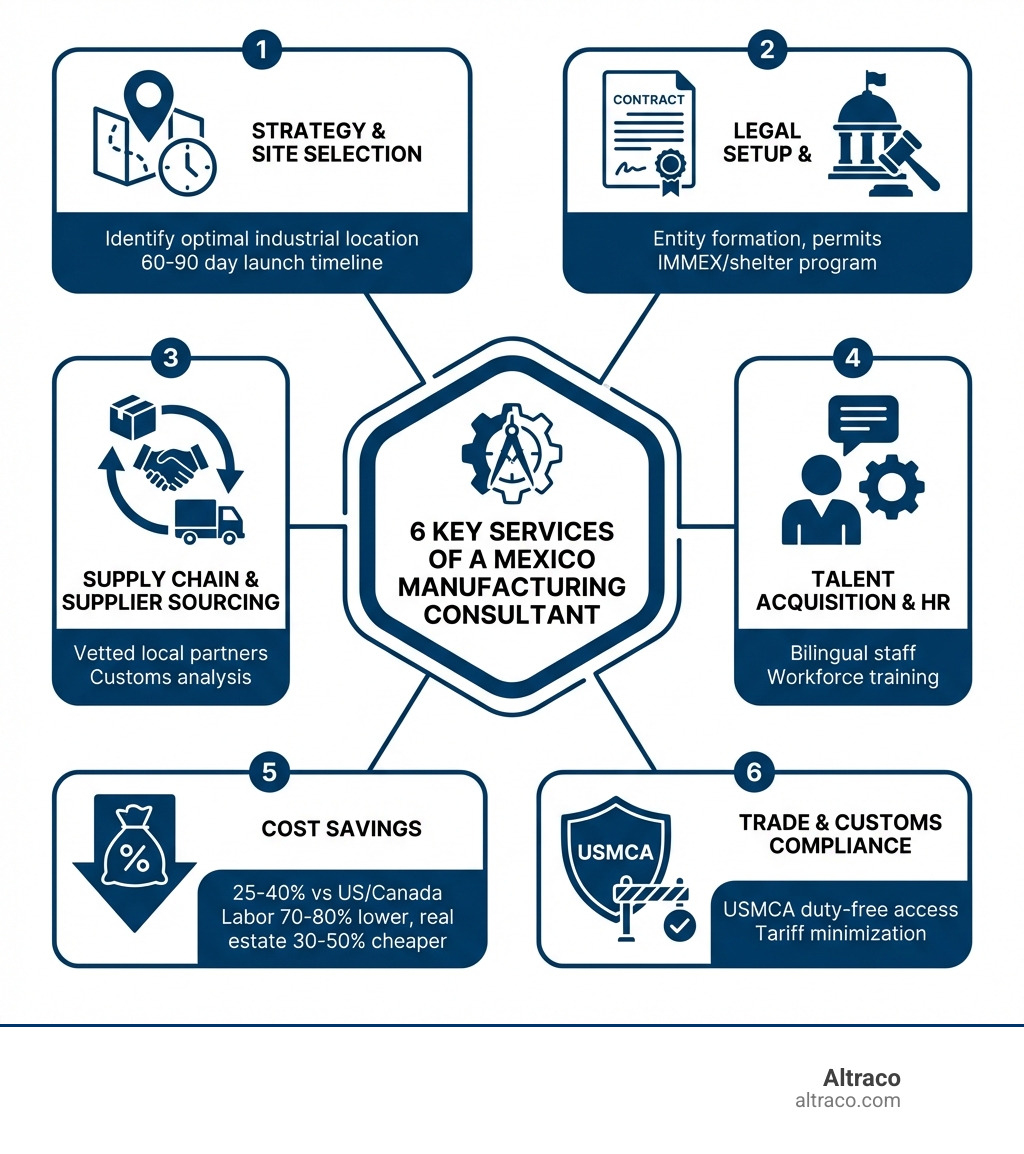
Here’s a quick breakdown of what they typically do:
- Strategy & Planning — Build your Mexico expansion roadmap, including location, legal structure, budget, and timeline
- Legal Setup & Compliance — Handle entity formation, permits, tax registration, and regulatory requirements
- Site Selection — Identify the right industrial location based on labor markets, infrastructure, and costs
- Supply Chain Development — Source and vet local suppliers and logistics partners
- Talent Acquisition — Recruit and onboard bilingual, skilled local workers
- Shelter Program Navigation — Help you decide between the IMMEX/shelter model or standalone operations
- Customs & Trade Compliance — Maximize USMCA benefits and minimize duties
- Ongoing Operations Support — Manage performance, quality, and continuous improvement on the ground
The payoff? Companies that use experienced consultants typically achieve 25–40% cost savings compared to U.S. or Canadian operations, launch 60% faster than self-managed expansions, and report a 94% project success rate for on-time, on-budget delivery.
Setting up manufacturing in Mexico without local expertise is one of the most expensive mistakes a company can make. The regulatory landscape is complex, the business culture is different, and the Mexican legal system can make recovering from early mistakes slow and costly. Yet the opportunity is undeniable: Mexico is now the USA’s largest trading partner, with over $40 billion in new foreign investment flowing in as companies shift supply chains away from Asia.
Whether you’re moving an automotive parts line, scaling up sporting goods production, or relocating outdoor product manufacturing closer to the U.S. market, the difference between a smooth launch and a costly failure often comes down to who’s guiding you on the ground.
I’m Albert Brenner, co-owner of Altraco, a contract manufacturing firm with over 40 years of experience helping Fortune 500 companies produce home improvement, sporting goods, automotive, and outdoor products in Mexico and beyond — which gives me a front-row view of exactly where companies stumble without a qualified Mexico manufacturing consultant in their corner. In the sections ahead, we’ll walk through every dimension of what these consultants do and how to choose the right one.
Why Your Business Needs a Mexico Manufacturing Consultant for Nearshoring
The term “nearshoring” has become a buzzword, but for us at Altraco, it represents a fundamental shift in how we simplify global supply chains. Moving production from a distant continent to our neighbors in the south isn’t just about shorter shipping lanes; it’s about agility. However, the “DIY” approach to Mexico often leads to a “death by a thousand cuts” scenario—unexpected permit delays, cultural misunderstandings, and logistics bottlenecks.
A Mexico manufacturing consultant acts as your “eyes and ears” on the ground. Research shows that projects managed by experts have a 94% success rate for being completed on time and within budget. Without this guidance, companies often face a 12-month slog to become operational. With professional support, basic setups can be running in as little as 60-90 days.
Beyond speed, the financial incentive is massive. We’ve seen clients achieve a 25-40% cost reduction compared to their U.S. or Canadian operations. This isn’t just about lower wages; it’s about the total cost of ownership, including Mexico manufacturing efficiencies that reduce lead times and inventory carrying costs. Furthermore, as Why Mexico manufacturing is changing global supply chains explains, the proximity allows for real-time quality control that is nearly impossible when your factory is 7,000 miles away.
For a deeper dive into the mechanics of this transition, you can Explore the Manufacturing in Mexico Guide, which distills decades of nearshoring research into actionable steps.
Navigating Trade Agreements and Tariffs
One of the most critical roles we play is helping you navigate the legislative maze. The USMCA (United States-Mexico-Canada Agreement) provides duty-free access to the North American market for qualified products, but “qualified” is the operative word. Consultants perform rigorous customs analyses to ensure your goods are classified correctly, preventing expensive disputes with authorities.
Recent geopolitical shifts and United States Supreme Court decisions regarding tariffs have made Mexico an even more attractive “safe haven.” While Section 301 tariffs continue to plague imports from China, products manufactured in Mexico often bypass these hurdles entirely. For a full breakdown of how to leverage these benefits, check out our Mexico manufacturing companies complete guide.
Mitigating Operational Risks in a New Market
Risk isn’t just about money; it’s about compliance and reputation. Mexico has strict labor regulations and Environmental, Health, and Safety (EHS) standards that differ significantly from U.S. law. A consultant ensures you aren’t just “compliant” on paper but are actually following local best practices.
Cultural alignment is another often-overlooked risk. Managing a workforce in Querétaro requires a different leadership style than managing one in California. We help bridge this gap by implementing cultural training and establishing security protocols within vetted industrial parks, ensuring your facility and your people remain safe.
The Financial Impact: Cost Savings and Budgeting
When we sit down with a new client at Altraco, the first question is always: “What’s the bottom line?” The data is compelling. Mexico offers a cost-competitive environment where labor costs are typically 70-80% lower than in the U.S., and real estate or utility expenses are 30-50% less expensive.
This financial landscape is why we’ve seen a 30% increase in US-Mexico trade, making Mexico the USA’s largest trading partner. With over $40 billion in new foreign investment, the infrastructure is rapidly modernizing to support high-tech production. However, before you sign a lease, you must determine if your specific item is a fit. We recommend Deciding if your Product is Right for Manufacturing in Mexico as a starting point for your feasibility study.
How a Mexico Manufacturing Consultant Estimates Operational Costs
We don’t guess at budgets; we use real-time data. A reliable consultant uses current daily statistics from active operations to build financial models. This includes:
- Hidden Costs: Factoring in “aguinaldo” (annual bonuses), social security contributions, and local permit fees.
- Tax Registration: Navigating the VAT (IVA) refund process, which can significantly impact cash flow.
- Go/No-Go Analysis: Providing the data needed to decide if the cost-to-manufacture-in-mexico truly aligns with your long-term goals.
Achieving Lean Excellence and Quality Control
Consulting isn’t just about the setup; it’s about the “turnaround.” We’ve seen electronics and automotive factories increase sales by 75% and reduce inventory by 80% after 18 months of intensive lean consulting. By implementing “poka-yoke” (mistake-proofing) and Six Sigma processes on-site, consultants transform struggling plants into models of efficiency. This hands-on approach ensures that quality climbs to the top of your division’s rankings.
Core Services Provided by a Mexico Manufacturing Consultant
Think of a consultant as a general contractor for your business expansion. We handle the heavy lifting so you can focus on product design and sales.
Our core services include:
- Legal Entity Formation: Setting up the proper corporate structure to protect your IP.
- Supplier Sourcing: Vetting local providers for raw materials to further reduce logistics costs.
- Workforce Training: Not just hiring, but training staff in specialized technical skills.
- Logistics Management: Coordinating the cross-border movement of goods to avoid customs delays.
For those specifically looking for California-based expertise to bridge the gap, our mexico-manufacturing-california-554251 resource explains how we manage these operations from our Thousand Oaks headquarters.
Strategic Site Selection and Facility Setup
Location is everything. Mexico is home to diverse industrial clusters—automotive hubs in the Bajío region, aerospace in Chihuahua, and electronics in Jalisco. A Mexico manufacturing consultant performs a fact-based needs analysis to match your project with the right region. We look at:
- Infrastructure Quality: Reliability of the local power grid and water supply.
- Transportation Access: Proximity to major highways and ports.
- Sustainability: Availability of resources that meet your corporate ESG goals.
The Shelter Program vs. Standalone Operations
One of the most common questions we hear is about the Shelter Program. This is a modality under the IMMEX program that allows foreign companies to operate in Mexico without officially incorporating.
- The Shelter Model: The consultant acts as the legal entity of record, handling all administrative, HR, and legal tasks. This provides a “soft landing” and reduces your legal liability.
- Standalone: For larger, permanent operations, you might choose to incorporate directly.
While the shelter program is excellent for a fast start, some consultants (ourselves included) will advise medium-to-large operations on when it might be more cost-effective to move toward a standalone model to avoid long-term administrative fees.
Choosing the Right Partner for Your Industry
Not all consultants are created equal. You need a partner who understands the specific “DNA” of your industry. At Altraco, we specialize in hard goods—specifically home improvement, sporting goods, automotive parts, and outdoor products. We don’t do clothing or food; we focus on technical manufacturing where precision and durability are paramount.
Evaluating Consultant Expertise and Track Record
When vetting a Mexico manufacturing consultant, look for these three pillars:
- Strategy AND Implementation: Many firms can write a pretty report, but can they actually hire 200 workers and install an assembly line? You need a partner who stays on-site.
- Bilingual Leadership: Communication is the most common point of failure. Your consultant should be fluent in both the language and the business culture of both countries.
- Decades of Experience: Look for firms with 30+ years of experience. The Mexican market has changed significantly since the NAFTA days; you need someone who has lived through those transitions.
Which industries benefit most from a Mexico manufacturing consultant?
While many industries thrive in Mexico, those requiring high-skill labor and complex supply chains benefit most from expert guidance. This includes:
- Automotive: Tier 1 and Tier 2 suppliers moving parts closer to Detroit or Tesla’s Giga Texas.
- Sporting Goods & Outdoor Products: Items that are bulky to ship from Asia but fit perfectly in a truck crossing the border at Laredo.
- Home Improvement: Hardware and fixtures that benefit from the duty-free USMCA status.
Frequently Asked Questions about Mexico Manufacturing
How long does it typically take to set up operations in Mexico?
With an expert consultant, basic operations can be live in 60-90 days. More complex manufacturing setups typically take 3-4 months. Without local help, the industry average is 9-12 months, often plagued by “hidden” bureaucratic delays.
What are the main differences between manufacturing in Mexico vs. China?
The primary differences are proximity and tariffs. Mexico offers significantly lower logistics costs and much faster lead times (days vs. weeks). Additionally, Mexico’s IP protection laws are more aligned with North American standards, and the USMCA offers duty-free advantages that China simply cannot match under current trade tensions.
Do I need to speak Spanish to manage my Mexico operations?
Technically, no—but your consultant must. Most high-level business professionals in Mexican manufacturing hubs are bilingual, but the “shop floor” and local government offices operate in Spanish. A good consultant bridges this gap, recruiting bilingual management for your facility so you can communicate seamlessly.
Conclusion
The decision to move manufacturing to Mexico is a strategic power move, but it shouldn’t be a gamble. By partnering with a Mexico manufacturing consultant, you aren’t just buying advice; you’re buying a proven roadmap that protects your budget and your sanity.
At Altraco, we pride ourselves on being more than just advisors. We are your contract manufacturing partners, leveraging our locations in Thousand Oaks, Los Angeles, and Long Beach to simplify global supply chains. Whether you are looking to manufacture automotive parts, home improvement tools, sporting goods, or outdoor products, we bring decades of experience and trusted factory relationships to the table. We specialize in navigating the complexities of Mexico, China, and Vietnam to deliver quality products on time.
Ready to see how much you could save? Contact a Mexico manufacturing expert at Altraco today for a free consultation and let us help you build a more resilient, cost-effective supply chain.

Al is an entrepreneur, founder, and owner of multiple businesses, including Altraco, an outsourcing and contract manufacturing company. Working across multiple continents and trusted by Fortune 500 companies, Al finds innovative solutions to traditional supply chain challenges. He is a member of Vistage Worldwide.