Why the China Average Tariff Rate Matters for Importers in 2026
The china average tariff rate is one of the most important numbers for any company sourcing products overseas — and right now, it tells two very different stories depending on how you measure it.
Quick answer: China’s current tariff rates at a glance (2026)
| Measure | Rate | Source |
|---|---|---|
| Simple average MFN applied (all products) | 7.5% | WTO, 2025/2026 |
| Trade-weighted average (all products) | 3.0–3.3% | WTO/World Bank, 2025/2026 |
| Trade-weighted average (non-agricultural) | 2.3% | WTO, 2025/2026 |
| Trade-weighted average (agricultural) | 13.8% | WTO, 2025/2026 |
| Simple average bound tariff (WTO ceiling) | 10.0% | WTO |
| US effective tariff rate on Chinese imports | 34.7% | PWBM, Jan 2026 |
Those two numbers — 7.5% and 3.0% — are both correct. They just measure different things. The simple average treats every product the same. The trade-weighted average reflects what China actually imports, which skews heavily toward low-tariff goods like electronics.
For Fortune 500 companies managing global supply chains, the gap between these figures has real consequences for landed cost calculations, sourcing decisions, and risk planning.
I’m Albert Brenner, co-owner of Altraco, a contract manufacturing firm with over 40 years of experience helping brands navigate the china average tariff rate and its impact on offshore production of products like automotive parts, home improvement goods, and sporting goods. In the sections below, I’ll break down exactly what these numbers mean for manufacturers sourcing from China today.
Understanding the China Average Tariff Rate in 2026
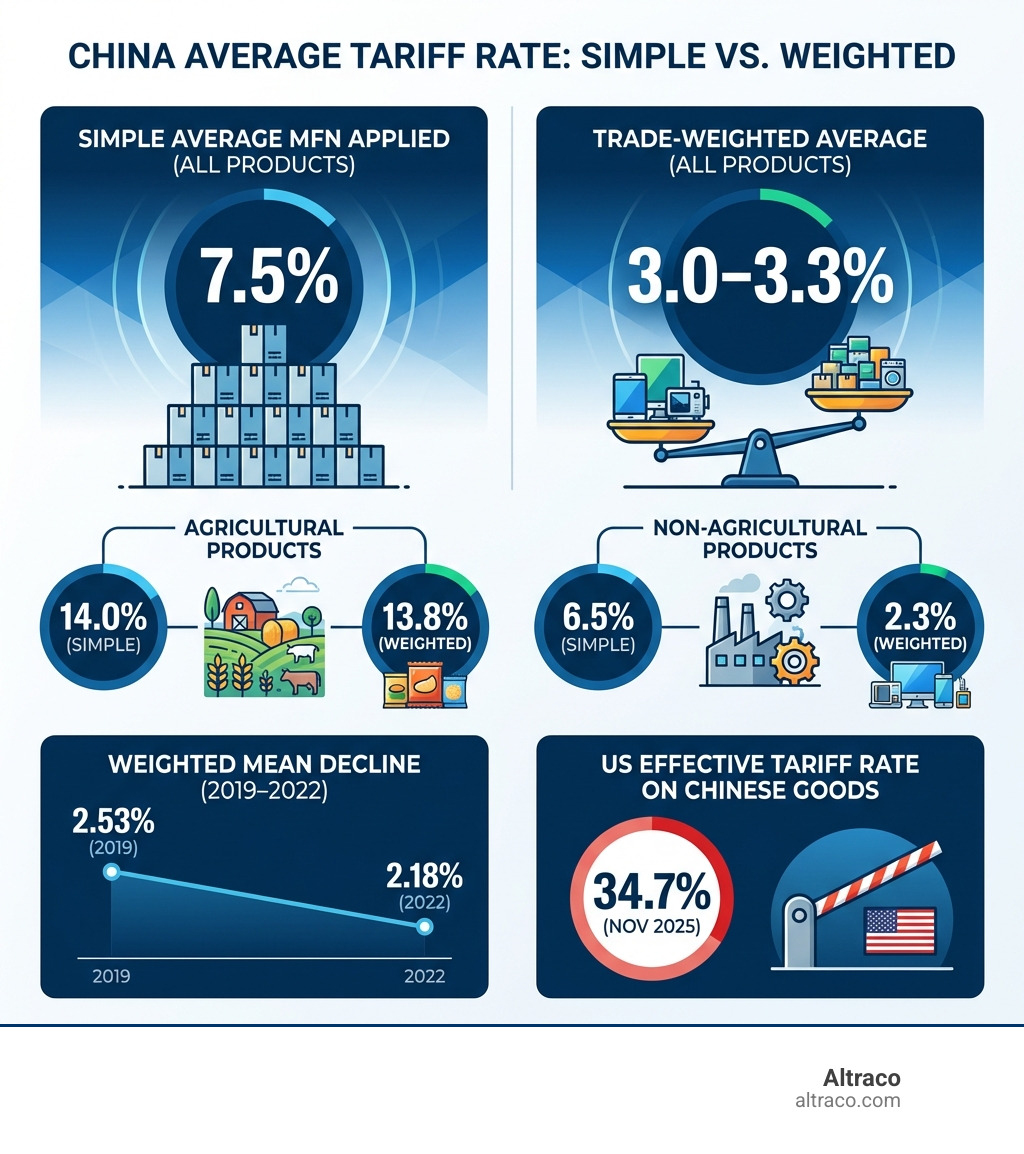
When we look at the china average tariff rate, we have to distinguish between what is written in the law books and what actually happens at the port. In 2026, China’s trade-weighted average MFN (Most Favored Nation) tariff rate sits at approximately 3.0%. This is significantly lower than the simple MFN average of 7.5%.
Why the discrepancy? It’s all about the “weight.” China imports a massive volume of high-value, low-tariff items—think electronic integrated circuits and specialized machinery. Because these items make up such a huge portion of the total import value, they pull the “weighted” average down. If you are importing automotive parts or home improvement hardware into China, you might see rates closer to the 6.5% non-agricultural simple average.
From 2022 to 2026, we’ve seen these rates remain relatively stable following a period of gradual decline. For instance, the World Bank Tariff Data showed a weighted mean of 2.18% in 2022. The slight uptick to the 3.0–3.3% range in more recent WTO reports reflects shifts in the mix of goods China is buying from the world. Understanding these complexities of tariffs is essential for any business trying to calculate the true cost of global trade.
Comparing Agricultural and Non-Agricultural Sectors
China’s tariff landscape is a tale of two sectors. If you’re moving agricultural staples, you’re in for a shock; if you’re moving outdoor products or sporting goods components, the water is much warmer.
Agricultural products face a simple average MFN applied rate of 14.0%. China protects its domestic farmers quite aggressively, and the trade-weighted average for agriculture remains high at 13.8%. In contrast, non-agricultural products (which include the automotive parts and home improvement goods we specialize in at Altraco) enjoy a much lower simple average of 6.5% and an even lower trade-weighted average of 2.3%.
| Product Category | Simple Average MFN (2025) | Trade-Weighted Average (2025) | Final Bound (WTO Ceiling) |
|---|---|---|---|
| All Products | 7.5% | 3.3% | 10.0% |
| Agricultural | 14.0% | 13.8% | 15.7% |
| Non-Agricultural | 6.5% | 2.3% | 9.1% |
Historical Shifts in the China Average Tariff Rate
Historically, the china average tariff rate has been on a downward trend since China joined the WTO in 2001. We saw the weighted mean decline from 2.53% in 2019 to a low of 2.18% in 2022. This decline wasn’t necessarily because China was slashing rates across the board, but rather because of “import concentration.”
China’s appetite for high-tech components, which often carry 0% or very low duties to fuel their own manufacturing engine, heavily outweighs their imports of finished consumer goods. However, as global trade tensions have risen, the “effective” rates—the ones businesses actually pay after accounting for retaliatory duties and special safeguards—have become much more volatile. You can find the latest research on effective tariff rates through the Penn Wharton Budget Model, which tracks how these numbers have spiked recently due to US-China trade policy shifts.
Applied vs. Bound Tariffs and WTO Indicators
To understand China’s future policy flexibility, we have to look at “Bound” vs. “Applied” rates.
- Applied Rate: What you pay today (Simple average 7.5%).
- Bound Rate: The maximum China is allowed to charge under WTO rules (Simple average 10.0%).
China has 100% “binding coverage,” meaning they have agreed to a ceiling for every single product category. Because their applied rates are currently lower than their bound rates, China technically has the “policy space” to raise tariffs up to that 10.0% average without violating WTO commitments.
Another key indicator is the “duty-free share.” In 2023, roughly 56.2% of the value of all goods entering China did so duty-free. This is a staggering number that surprises many of our clients. It highlights that while some sectors face maximum duties as high as 227%, the vast majority of industrial trade is relatively open. We provide a complete guide to China tariffs that dives deeper into how these percentages affect specific manufacturing categories.
Key Indicators of the China Average Tariff Rate for Imports
Beyond the averages, professional importers look at “tariff dispersion.” This measures how much the rates vary across different products. China has a moderate coefficient of variation, meaning while most things are around 7%, there are significant “tariff peaks” in sectors like luxury consumer goods and certain agricultural staples.
Additionally, China utilizes tariff quotas and special safeguards, particularly for agricultural goods. For manufacturers of outdoor products or automotive components, the main things to watch are the MFN applied rates and any temporary “provisional” rates that the Chinese government might implement to encourage the import of specific raw materials. The World Tariff Profiles 2026 provides the most granular look at these indicators for those who really want to get into the weeds.
Global Comparisons and the Impact of US Trade Policy

How does the china average tariff rate stack up against the rest of the world?
- China: 3.1% (Weighted)
- USA: 1.5% (Weighted – Historically)
- EU: 1.4% (Weighted)
- India: 11.5% (Weighted)
On paper, China appears to be a relatively open economy, especially compared to developing peers like India. However, the “on paper” numbers are currently being overshadowed by the US-China trade war.
While China’s import tariffs remain low, the tariffs faced by Chinese exports to the US have skyrocketed. As of early 2026, the US effective tariff rate on imports from China reached a whopping 34.7%. This is a massive leap from the 2.3% average we saw in 2025. This surge is largely due to the aggressive use of Section 301 tariffs and the expiration of various exclusions.
Recent legal developments, including a high-profile Supreme Court ruling regarding the International Emergency Economic Powers Act (IEEPA), have created even more uncertainty. If the administration’s use of IEEPA is restricted, they may pivot to other authorities like Section 122 (which allows a 15% across-the-board tariff for 150 days) or even the long-dormant Section 338 of the Smoot-Hawley Act. You can track these shifting sands using the latest USITC trade and tariff data.
Navigating the China Average Tariff Rate for Manufacturers
For our clients at Altraco, the goal isn’t just to know the rate—it’s to navigate it. If you are manufacturing automotive parts, home improvement goods, or sporting goods, the 34.7% US effective rate on Chinese imports is likely your biggest headache.
We help companies mitigate these costs through several strategies:
- Tariff Engineering: Modifying product designs or classifications to fall under lower-duty codes.
- Sourcing Shifts: Moving production of high-tariff components to countries like Mexico or Vietnam.
- Duty Drawback: Reclaiming duties paid on items that are eventually re-exported.
Our tariff tracker for 2026 is designed to help manufacturers stay ahead of these changes. We also maintain a specific guide to China Section 301 Tariffs in 2026 to help you understand if your specific HTS codes are currently in the crosshairs.
Strategic Sourcing and Future Projections
With the china average tariff rate for exports to the US hitting record highs, “China Plus One” is no longer just a buzzword—it’s a survival strategy. At Altraco, we’ve spent decades building relationships not just in China, but also in Mexico and Vietnam.
Mexico, in particular, has become a powerhouse for automotive parts and home improvement manufacturing. By leveraging the USMCA, many of our clients are able to achieve nearly 89% duty-free status on their imports into the US. This is a massive competitive advantage compared to the 34.7% hit they would take sourcing the same parts from China.
However, moving production isn’t as simple as flipping a switch. You have to weigh the pros and cons of tariffs against labor costs, shipping times, and infrastructure quality. Vietnam offers lower labor costs than China for many sporting goods and outdoor products, but the “effective” tariff rates there can also change if the US decides to initiate Section 301 investigations into currency or labor practices.
Uncertainties in Future Trade Dynamics
The future of the china average tariff rate is shrouded in “behavioral revenue effects.” This is a fancy way of saying that when tariffs go up, importers change their behavior. In 2026, the US government expects to collect billions more in revenue, but significant portions often go uncollected because importers accelerate their purchases (“front-running”) or switched to North American partners to claim USMCA exemptions.
There is also the looming threat of Section 338 (the “nuclear option” of the Smoot-Hawley Act), which could allow a President to impose a 50% tariff on any country that discriminates against US commerce. This would be a seismic shift in global trade. For a detailed breakdown of how these legal authorities might be used, see this analysis of the Supreme Court ruling on IEEPA.
Frequently Asked Questions about China Tariffs
What is the difference between China’s simple and weighted average tariff?
The simple average (7.5%) adds up every tariff line and divides by the total number of lines. The weighted average (3.0%) accounts for how much of each product is actually imported. Since China imports huge amounts of low-tariff electronics, the weighted average is much lower.
How do China’s tariff rates compare to India and the EU?
China is middle-of-the-pack. Its weighted average of 3.1% is higher than the EU (1.4%) and the US (1.5%), but significantly lower than India (11.5%) or Brazil. This makes China relatively open for industrial imports compared to other major developing nations.
What are the current US effective tariff rates on Chinese goods?
As of early 2026, the effective rate—the actual percentage of value paid in duties—is approximately 34.7%. This includes the standard MFN rates plus the additional Section 301 duties that have been applied to the vast majority of Chinese exports.
Conclusion: Partnering with Altraco for Tariff Navigation
Navigating the china average tariff rate requires more than just a calculator; it requires a global strategy. At Altraco, we don’t just find you a factory; we find you a path through the regulatory jungle. Whether you are looking for contract manufacturing for automotive parts in Mexico, sporting goods in Vietnam, or home improvement products in China, we leverage our 40+ years of experience to protect your bottom line.
The trade landscape of 2026 is volatile, but it also presents opportunities for those who can pivot quickly. By diversifying your supply chain and understanding the “effective” costs of production, you can maintain your margins even in a high-tariff environment.
If you’re ready to optimize your offshore production and stop overpaying on duties, check out our Manufacturer’s Guide to United States Tariffs or reach out to us in Thousand Oaks, CA, to discuss your specific sourcing needs. We’re here to make global manufacturing simple, reliable, and—most importantly—cost-effective.