
How the World’s Best Companies Source Smarter (And What You Can Learn From Them)
Strategic sourcing examples from leading global companies show a clear pattern: the best supply chains aren’t built on finding the cheapest price — they’re built on finding the right suppliers, relationships, and processes for long-term value.
Here’s a quick look at how top companies do it:
| Company | Strategic Sourcing Approach | Key Outcome |
|---|---|---|
| Toyota | Just-in-time (JIT) + long-term supplier partnerships | Supply chain resilience during disruptions |
| Dell | Direct sourcing, eliminated distributors | Cost savings + faster market adaptation |
| Apple | Innovation-led sourcing + strict supplier standards | Competitive edge + social responsibility |
| PepsiCo | ESG-integrated supplier audits + site visits | ESG compliance jumped from 36% to 77% |
| P&G | 40+ year supplier diversity program | Trained 1,000+ women entrepreneurs in 5 years |
| Samsung | AI-driven supplier relationship management | Real-time risk monitoring + smarter decisions |
| Patagonia | Radical supply chain transparency + sustainability | Consumer trust + $100M invested in sustainable projects |
These aren’t just feel-good stories. They’re proven blueprints that reduce cost, manage risk, and build resilient supply chains — even when global disruptions hit.
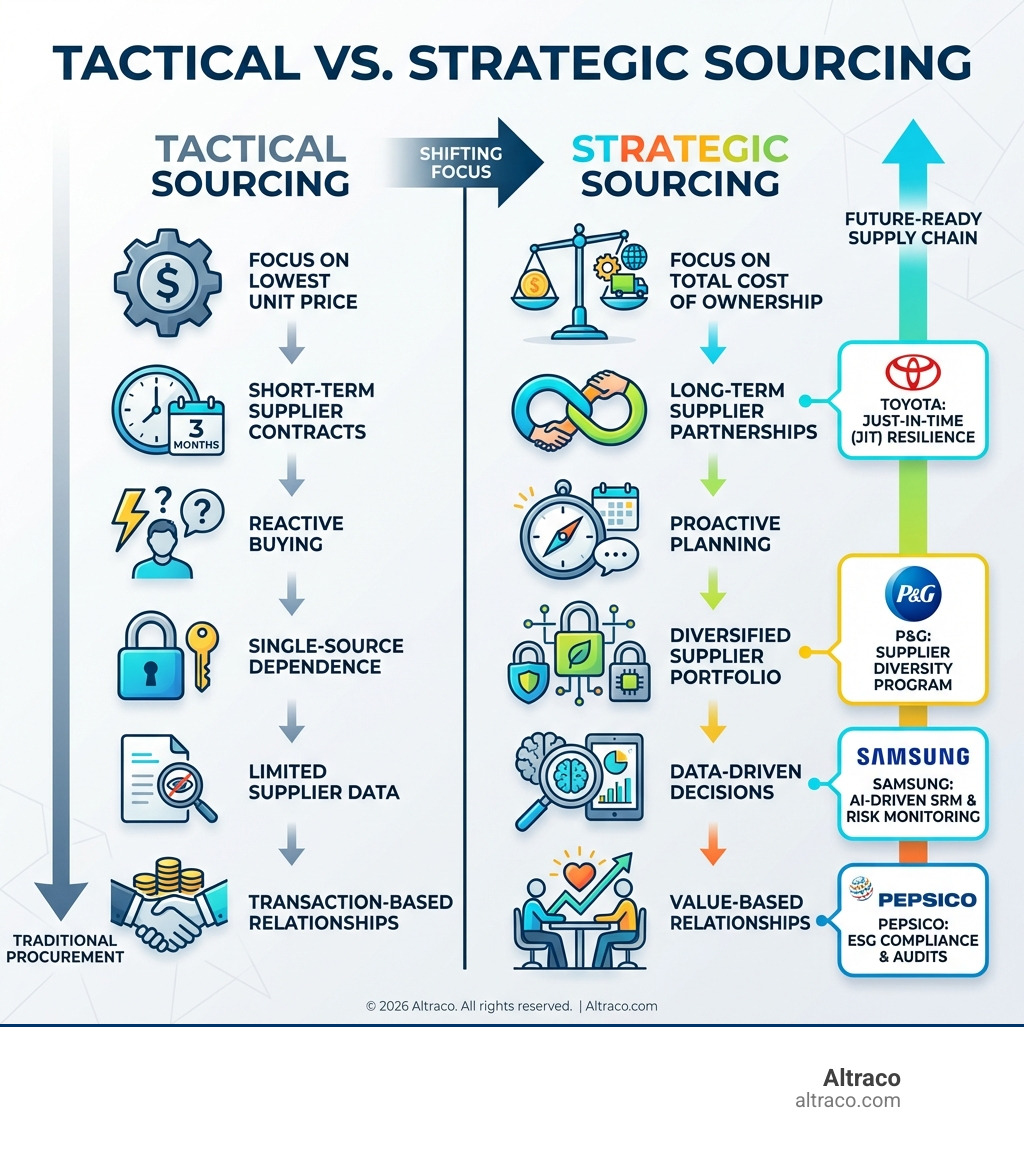
Traditional procurement asks: “Who has the lowest price?”
Strategic sourcing asks: “Which supplier delivers the most value over time — considering quality, risk, total cost, and long-term partnership potential?”
That shift in thinking is what separates companies that thrive from those that scramble every time a tariff changes or a supplier goes dark.
I’m Albert Brenner, co-owner of Altraco, a contract manufacturing firm with over 40 years of experience helping Fortune 500 companies source home improvement, sporting goods, automotive, and outdoor products across Mexico, China, Vietnam, and beyond — and strategic sourcing examples like the ones in this article have directly shaped how we guide our clients. If you’re navigating offshore manufacturing complexity, you’ll find this breakdown practical and immediately actionable.
Basic strategic sourcing examples vocab:
What is Strategic Sourcing and Why Does It Matter?
At its heart, strategic sourcing is the practice of aligning your supplier selection and management with your long-term business goals. It isn’t just a fancy way of saying “shopping.” It involves a deep dive into data to understand how every dollar spent contributes to the company’s health.
One of the most critical concepts here is the Total Cost of Ownership (TCO). If we buy a batch of automotive parts from a factory just because they have the lowest unit price, but 10% of those parts arrive defective or late, our “cheap” deal just became very expensive. TCO factors in maintenance, logistics, disposal, and even the cost of a stalled production line.
When we look at strategic sourcing examples, we see that value creation goes far beyond the invoice. It’s about quality assurance, operational efficiency, and gaining a competitive advantage. In a world of geopolitical shifts and raw material shortages, having a sourcing strategy is what allows us to keep the lights on while others are waiting for a shipment that may never come.
The 7-Phase Strategic Sourcing Process
How do the pros do it? They follow a structured roadmap. While every company puts its own spin on things, the classic 7-phase process is a gold standard for turning chaos into a “control system.”
- Analyze Spend: We start by looking at 12 to 24 months of purchase orders and invoices. We want to find “maverick buys”—those off-contract purchases that leak money.
- Category Profiling: This is where we define what we’re buying. Are we looking for specialized outdoor product components or high-volume home improvement hardware?
- Market Research: We look at the supplier landscape. Who are the big players? Who are the innovators in Mexico or Vietnam?
- Sourcing Strategy: Based on our research, we decide how to buy. Should we use a single source for a strategic partnership or a multi-supplier approach to mitigate risk?
- Supplier Portfolio & RFx: We generate a list of potential partners and launch the Request for Proposal (RFP) or Request for Quote (RFQ).
- Negotiation & Selection: We don’t just negotiate price; we negotiate service levels, compliance, and risk-sharing.
- Relationship Management: The work doesn’t end once the contract is signed. We continuously monitor performance and look for ways to improve together.
| Phase | Core Goal | Real-World Activity |
|---|---|---|
| 1. Spend Analysis | Identify leakage | Consolidating 20 different hardware vendors into 3 |
| 2. Category Profiling | Understand needs | Defining exact tolerances for automotive stampings |
| 3. Market Research | Find opportunities | Scouting new casting factories in Vietnam |
| 4. Sourcing Strategy | Choose the path | Deciding to near-shore production to Mexico |
| 5. RFx Process | Get competitive bids | Using Amazon Business RFQ to save an average of 17% |
| 6. Selection | Pick the partner | Choosing a supplier based on ESG and TCO |
| 7. Management | Ensure results | Conducting quarterly audits and site visits |
Essential Frameworks for Strategic Sourcing Examples
To make these decisions, we use frameworks that help us see through the noise.
- Kraljic Matrix for supplier segmentation: This is a lifesaver. It categorizes suppliers into four quadrants: leverage, strategic, bottleneck, and non-critical. If you’re sourcing a unique, patented component for a sporting goods product, that’s a strategic item. If you’re buying standard screws, that’s non-critical. You shouldn’t spend the same amount of time managing both.
- Porter’s Five Forces for market dynamics: We use this to evaluate how much power our suppliers have versus how much we have. If there are only two factories in the world that can make your specific outdoor gear, they have the power.
- SWOT Analysis for supplier negotiations: Before we sit at the table, we map out the Strengths, Weaknesses, Opportunities, and Threats of the deal.
- Vested and Performance-Based Models: These move away from “us vs. them” and toward “win-win.” If the supplier helps us reduce costs through better engineering, they share in the savings.
Real-World Case Studies from Industry Leaders
Let’s look at some heavy hitters who have mastered the art of the deal.
Toyota: The JIT Pioneers
Toyota’s lean manufacturing and JIT is perhaps the most famous of all strategic sourcing examples. By keeping inventory levels low and relying on a highly synchronized supplier network, they reduce waste and respond instantly to market changes. Their focus on long-term relationships means that when a crisis hits, their suppliers go the extra mile to keep Toyota running.
Dell Technologies: Cutting Out the Middleman
Dell Technologies’ direct sourcing model revolutionized the PC industry. By eliminating distributors and sourcing components directly, they gained massive cost savings and real-time data on what customers actually wanted. This allowed them to pivot their manufacturing almost overnight.
Apple: Innovation-Led Sourcing
Apple’s innovation-led sourcing is legendary. They don’t just buy parts; they often invest in the machinery inside their suppliers’ factories to ensure they have exclusive access to the latest technology. It’s a bold, high-stakes strategy that keeps them years ahead of the competition.
GE: The Power of Analytics
GE’s advanced analytics programs identify “should-cost” models. They use data to determine exactly what a part should cost to manufacture, giving their procurement teams a massive advantage during negotiations.
Samsung: AI-Driven Strategic Sourcing Examples
Samsung Electronics is leading the charge into the future with an AI-driven SRM solution. By using AI to monitor their global supplier network in real-time, they can spot a potential disruption—like a factory fire or a logistics bottleneck—before it even hits their bottom line. This digital procurement approach provides real-time insights that manual spreadsheets just can’t match.
Lessons from Global Strategic Sourcing Examples
- Amazon: Their Amazon Business RFQ capability often saves an average of 17% on large planned purchases by inviting competitive bids in as little as 48 hours.
- BMW: BMW’s long-term supplier relationships focus on supply chain efficiency. They treat their suppliers as extensions of their own engineering teams.
- Coca-Cola: Coca-Cola’s supply chain stability is maintained through rigorous standards that ensure the same quality whether you’re in Thousand Oaks, CA or Tokyo.
- Walmart: Walmart’s scale and efficiency allow them to leverage their massive buying power to keep prices low while simultaneously pushing for sustainability targets.
Modernizing the Supply Chain: Tech, Risk, and Sustainability
The world is changing, and sourcing has to keep up. One of the most shocking statistics we’ve seen is that 92% of respondents in a Harvard Business Review report felt their sourcing technology was less than “best-in-class” during the shift to remote work.
We are seeing a major shift toward AI and automation. Tools like “supply chain control towers” provide end-to-end visibility, allowing us to forecast disruptions.
Sustainability and ESG (Environmental, Social, and Governance) are no longer optional. PepsiCo is a great example here; their regular site visits helped ensure that 77% of their suppliers meet ESG standards, up from just 36% a few years ago.
Diversity also drives innovation. Organizations like the NMSDC and supplier diversity programs help companies find minority-owned businesses that often offer more agility and fresh perspectives. In 2015 alone, NMSDC-certified businesses contributed $400 billion to the U.S. economy.
Finally, we have to talk about deglobalization. Many of our clients are moving toward near-sourcing (like manufacturing in Mexico) or vertical integration to reduce dependence on volatile global shipping lanes.
Building an Effective Sourcing Strategy and Stakeholder Alignment
You can have the best data in the world, but if your internal teams aren’t on board, your strategy will fail. We recommend following Gartner’s guiding principles for supplier selection:
- Define Your Baseline: You can’t improve what you don’t measure. Know your current spend and performance metrics.
- Cross-Functional Buy-In: Get finance, engineering, and operations in the same room. If engineering wants a specific material but finance wants a 10% cut, you need to find the middle ground early.
- Set SMART Goals: “Save money” isn’t a goal. “Reduce TCO by 12% on automotive components within 18 months” is a goal.
- Pilot Programs: Don’t flip the switch on your entire supply chain at once. Test a new sourcing strategy with a single product line or region.
- Continuous Improvement: Sourcing is a living process. Regularly refresh your data and your relationships.
Frequently Asked Questions about Strategic Sourcing
What is the difference between strategic sourcing and traditional procurement?
Traditional procurement is tactical and transactional—it’s about getting the goods today at the lowest price. Strategic sourcing is a long-term, data-driven approach that looks at the total cost of ownership, supplier risk, and alignment with business goals.
How does strategic sourcing improve supply chain resilience?
By diversifying your supplier portfolio and building deep relationships, you aren’t left stranded if one factory or region has an issue. Strategic sourcing also uses tools like the Kraljic Matrix to identify which items are “bottlenecks” and require backup plans.
What role does technology play in modern sourcing strategies?
Technology is the “force multiplier.” AI and automation handle the boring stuff—like tagging thousands of line items—so that humans can focus on high-level strategy and negotiation. It also provides real-time visibility into global risks.
Conclusion
Navigating offshore manufacturing can feel like a game of high-stakes chess. Between fluctuating material costs and the ever-present shadow of tariffs—including the recent United States Supreme Court decision regarding tariffs—you need more than just a list of factories. You need a partner who understands strategic sourcing examples and knows how to apply them to your specific needs.
At Altraco, we specialize in helping companies source high-quality home improvement, sporting goods, automotive parts, and outdoor products. Whether you are looking to establish a new manufacturing hub in Mexico, optimize your production in China, or explore the growing opportunities in Vietnam, we bring four decades of experience to the table. We don’t just find you a factory; we help you build a resilient, cost-effective supply chain that can weather any storm.
Ready to move from reactive buying to a truly strategic approach? Learn more about our international sourcing services and let’s build something great together.