For more than 40 years, Altraco has helped B2B buyers and Fortune 500 companies manufacture hard goods overseas, with established factory relationships in both China and Vietnam. One question comes up more than any other: which country is the right fit for my product?
For decades, the default answer was China. Today, Vietnam has become a first-choice option for a growing number of hard goods buyers, not just a backup plan. The right decision depends on what you make, what it’s made from, how much you need, and what your total landed cost looks like in each country. Here’s how to think it through.
Start With the Product, Not the Country
The most common mistake in choosing a manufacturing location is starting with the map. A better starting point is your product’s requirements:
- Materials and components: What goes into the product, and where do those inputs come from?
- Manufacturing processes: Does it require casting, molding, precision machining, metal fabrication, or multi-component assembly?
- Volume: Are you running a pilot order, steady production, or a high-volume program?
- Quality standards: What tolerances, certifications, or testing does the product need to meet?
- Tariff exposure: How is your product classified, and what duties apply from each country?
Once those answers are clear, the country decision becomes much easier to make.
Where China Leads
China remains the largest manufacturing economy in the world, and its advantages run deep. Production capability, supplier networks, raw material access, and export infrastructure are all built at a scale few countries can match.
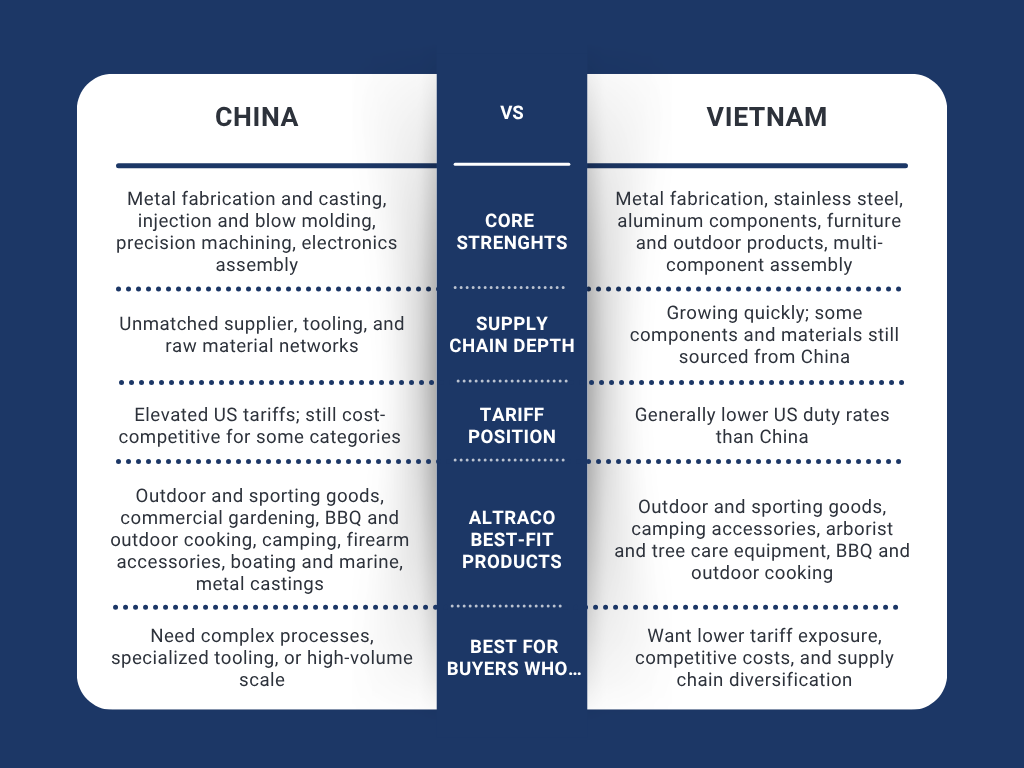
For hard goods, China’s core strengths include:
- Metal fabrication and casting
- Injection and blow molding
- Precision machining
- Electronics assembly
- Durable consumer and commercial products that combine multiple processes
Region matters, too. Guangdong in the south is concentrated in consumer goods, plastics, and electronics. Zhejiang and Jiangsu in the east are hubs for metal fabrication, hardware, and specialty hard goods. Shandong in the north is strong in metal castings and heavy industrial components. Matching your product to the right industrial cluster is a key part of getting results in China.
Altraco manufactures outdoor and sporting goods, commercial gardening equipment, BBQ and outdoor cooking products, camping accessories, firearm accessories, boating and marine hardware, and metal castings in China. These are categories where decades of tooling expertise and process knowledge give China a distinct edge.
Where Vietnam Leads
Vietnam’s rise as a manufacturing destination reflects a long-term shift in global supply chains, one that has been building for more than a decade and gained speed with US-China trade tensions. Competitive labor costs, improving infrastructure, favorable trade agreements, and a strategic location make Vietnam a natural complement or alternative to China.
Vietnam’s manufacturing strengths include:
- Metal fabrication
- Stainless steel products
- Aluminum components
- Furniture and outdoor products
- Sporting goods
- Multi-component hard goods assembly
Factories in the industrial zones around Ho Chi Minh City and Hanoi have grown quickly in sophistication, and more facilities now carry ISO certifications and meet international quality standards.
Altraco manufactures outdoor and sporting goods, camping accessories, arborist and tree care equipment, and BBQ and outdoor cooking products in Vietnam, where the country’s metalworking capabilities and cost structure align well with buyer requirements.
Tariffs and Total Landed Cost
Tariffs have reshaped the cost picture for US buyers. Products made in Vietnam and shipped to the US are generally subject to significantly lower duty rates than comparable products made in China, which makes Vietnam’s tariff position a material factor in any comparison.
That doesn’t mean every product should move. For some categories, China still delivers the best total cost even with elevated tariffs. For others, Vietnam or a dual-sourcing approach makes more financial sense. The right call comes from a disciplined analysis of total landed cost, HTS code classification, and the actual tariff environment for your specific product category, not from general trade headlines.
Quality Control in Both Countries
In either country, the outcome depends on which factories you work with and how quality is managed once production begins. Problems that go unchecked can build quietly until product is already on a ship or sitting in a warehouse.
China’s manufacturing base is broad and experienced, but access to the best factories isn’t uniform. Vietnam’s sector has matured quickly, though the gap between its strongest and weakest manufacturers is significant.
Altraco manages quality the same way in both markets:
- Factory audits
- First article inspection
- In-process checks at defined production stages
- Pre-shipment verification
- Third-party inspection, built into the production timeline as standard practice
Logistics and Lead Times
China’s export infrastructure is mature and well established. Vietnam has closed the gap considerably. Its main ports, Cat Lai in Ho Chi Minh City and Haiphong in the north, handle substantial export volume to the US West Coast, with transit times comparable to China. Container availability and freight rates have also normalized well below pandemic-era peaks.
Altraco manages the full logistics layer in both countries, coordinating freight, customs documentation, and delivery from the factory floor to your distribution center or warehouse.
IP Protection
Protecting intellectual property overseas takes deliberate structure. Altraco operates every client engagement under NDA and manages factory agreements with clear terms for IP ownership, tooling ownership, and confidentiality. Four decades of factory relationships also mean we know which manufacturing partners honor those obligations, and which to avoid.
It Doesn’t Have to Be Either/Or
Many Altraco clients make some products in China and others in Vietnam as part of a deliberate China-plus-one strategy. Splitting production reduces single-country dependency, manages tariff exposure across a product portfolio, and keeps options open as conditions change.
With factory relationships in both markets, Altraco coordinates production, quality, and logistics across multiple manufacturing origins, so a dual-country strategy runs as smoothly as a single one.
Find the Right Fit for Your Product
Altraco gives buyers a straightforward assessment based on category-specific data: the right country, the right region, the right factories, and the right production approach for your product, volume, and timeline. With 99.6% on-time delivery and a track record serving Fortune 500 companies and growing brands, Altraco keeps your products moving from decision to delivery.
Ready to compare China and Vietnam for your product? Contact Altraco to reach an expert.
Frequently Asked Questions
Is it cheaper to manufacture in Vietnam or China?
It depends on the product. Vietnam often offers lower labor costs and generally lower US duty rates than China, which can reduce total landed cost. However, China’s supply chain depth, raw material access, and process expertise can still make it the lower-cost option for certain categories, even with tariffs. Altraco builds a total landed cost analysis for your specific product, including HTS classification and applicable duties, so you can compare both countries accurately.
What products are best suited for manufacturing in Vietnam?
Vietnam is especially strong in metal fabrication, stainless steel products, aluminum components, furniture and outdoor products, sporting goods, and multi-component assembly. Altraco manufactures outdoor and sporting goods, camping accessories, arborist and tree care equipment, and BBQ and outdoor cooking products in Vietnam. Products that rely on complex tooling, specialized castings, or a dense local supplier network may still be a better fit for China.
Can I manufacture in both China and Vietnam?
Yes. A China-plus-one strategy, making some products in China and others in Vietnam, is a common approach among Altraco clients. It reduces reliance on a single country, spreads tariff exposure across your product portfolio, and gives you flexibility as trade conditions shift. Altraco manages factory relationships, quality control, and logistics in both countries to keep dual-country production running smoothly.