

Why Advanced Inventory Management Is Critical for Global Manufacturers
Advanced inventory management uses data-driven strategies, predictive analytics, and integrated technology to optimize stock levels, automate replenishment, and gain real-time visibility across your entire supply chain. It replaces reactive, manual processes with intelligent systems that help you make faster, smarter decisions about what to stock, where to stock it, and when to reorder.
This approach delivers significant benefits:
- Reduced Costs: Minimize carrying costs and free up capital tied in excess stock.
- Fewer Stockouts: Maintain optimal stock levels to meet customer demand without delays.
- Real-Time Visibility: Track inventory across multiple locations and suppliers simultaneously.
- Predictive Forecasting: Use AI and machine learning to anticipate demand and market shifts.
- Supply Chain Resilience: Build flexibility to respond quickly to disruptions, tariffs, and global events.
- Automated Workflows: Eliminate manual errors and free up your team for strategic work.
The numbers tell a stark story. Combined stockouts and excess holding costs cost global retailers $1.7 trillion in 2024. Meanwhile, only 69% of companies track inventory accuracy, and the average rate is just 83%. For companies managing offshore manufacturing in countries like Mexico, China, and Vietnam, these gaps are not just inefficient—they’re dangerous.
Traditional inventory methods can’t keep pace with today’s reality of volatile shipping costs, surging e-commerce, and complex international tariffs. The stakes are especially high for manufacturers of home improvement products, sporting goods, and automotive parts, where a 5% to 7% annual revenue decline from poor inventory management can mean millions in lost profit.
Modern advanced inventory management systems use real-time data and predictive algorithms to turn inventory from a liability into a competitive advantage. These platforms help you steer tariff changes, optimize safety stock across countries, and respond instantly to supply chain disruptions.
I’m Albert Brenner, and with over 40 years of experience helping companies manufacture overseas, I’ve seen how advanced inventory management separates industry leaders from those constantly fighting fires. At Altraco, we help brands build resilient supply chains by combining our factory relationships in Mexico, China, and Vietnam with the technology and expertise needed for total visibility and control.
Basic advanced inventory management vocab:
From Spreadsheets to Strategy: What is Advanced Inventory Management?
At its heart, advanced inventory management is about moving beyond guesswork and reactive decision-making to a proactive, data-driven strategy. It’s the difference between using a paper map and a real-time GPS that predicts traffic and suggests better routes.
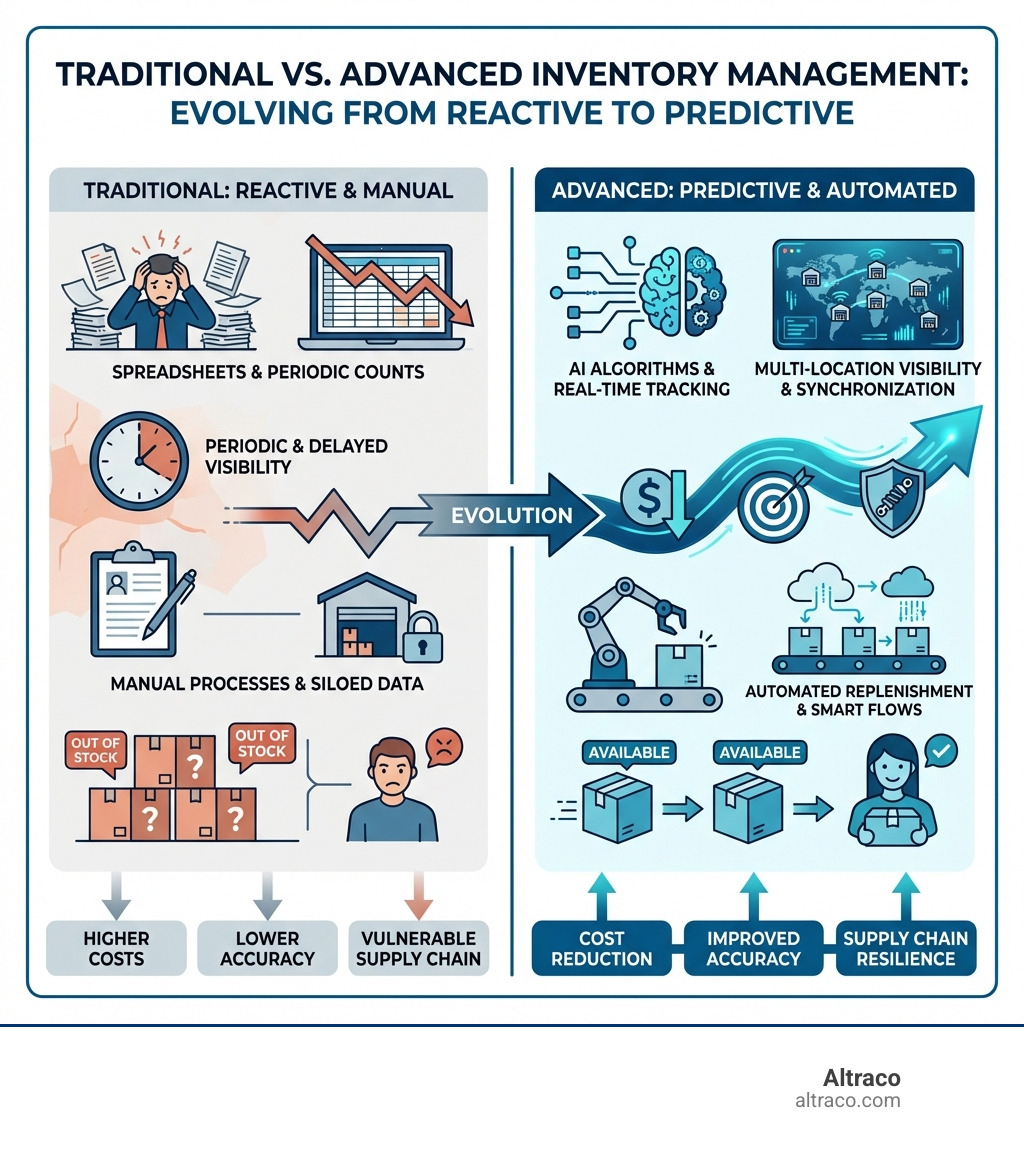
Traditional inventory methods, often reliant on manual counts and spreadsheets, are reactive. They tell you what has happened, not what will happen. For a global supply chain with inventory in transit from China or in production in Mexico, this outdated information is a significant liability.
Advanced inventory management, by contrast, leverages technology for real-time insights and predictive power. It uses data to make smarter decisions about inventory levels, forecast demand, reduce excess stock, and optimize the flow of materials. The goal is to replace spreadsheet-centric work with integrated, real-time platforms that coordinate your entire operation. This strategic approach is crucial for building a robust Inventory Management Playbook for modern manufacturing.
Key Differences from Basic Inventory Control
While often used interchangeably, “inventory control” and “inventory management” are different. Inventory control is tactical, focusing on tracking goods within a single location. Advanced inventory management is strategic, encompassing planning, forecasting, and optimization across the entire supply chain—from raw materials to the end customer.
Here’s a quick comparison:
- Data: Basic control relies on periodic counts. Advanced management uses real-time data from systems like barcode scanners and RFID for a continuously accurate view.
- Forecasting: Traditional methods use guesswork and past sales. Advanced systems employ AI and machine learning to analyze thousands of variables for highly accurate demand predictions.
- Visibility: Basic control often results in siloed information. Advanced management provides a unified, end-to-end view across all locations, enabling smarter stock allocation.
- Goal: Basic control tracks what you have. Advanced management optimizes what, where, and when you need inventory to minimize costs and maximize service.
The shift to advanced inventory management turns inventory from an operational headache into a strategic asset. For a deeper dive into how we integrate these services, explore our integrated supply chain services. For more on the fundamentals of inventory control, check out Inventory Control Defined: Best Practices, Systems, & Management .
The Technology Stack: Core Features of an Advanced System
The power of advanced inventory management lies in its technology—a sophisticated ecosystem of tools providing unparalleled visibility, precision, and automation.

At its core is a centralized platform that integrates with critical business systems like Enterprise Resource Planning (ERP) and Warehouse Management Systems (WMS). This ensures data consistency, from a sales order in California to a shipment from a factory in China. A scalable system is also key, allowing it to grow with your business. For more on essential features, see this guide on Must-Have Inventory Management System Features, Requirements & Modules.
Data-Driven Demand Forecasting and Optimization
Accurate demand forecasting is the bedrock of advanced inventory management. Instead of relying on guesswork, this approach leverages:
- Predictive Analytics: Uses historical sales data, promotions, economic conditions, and even weather patterns to generate reliable demand predictions.
- AI and Machine Learning (ML): Analyzes thousands of variables to spot hidden patterns, refine forecasts, and improve planning accuracy for products like home improvement items or sporting goods.
- Demand Sensing: Detects and responds to real-time market signals, allowing for immediate adjustments rather than waiting for periodic reports.
- Seasonality and Trend Analysis: Dynamically factors in seasonal demand and broader market trends to anticipate shifts in consumer preferences for automotive parts or outdoor gear.
These tools translate predictions into actionable requirements for ordering and capacity planning, significantly improving our Logistics Management Activities.
Real-Time Tracking and End-to-End Visibility
Knowing the exact location and status of every item—whether in a warehouse, on a production line in Mexico, or in transit from Vietnam—is a cornerstone of advanced inventory management.
- Barcode Scanning & RFID: These technologies automate data capture, eliminate manual entry errors, and provide instant, accurate updates on inventory movement.
- IoT Sensors: Embedded sensors provide continuous status updates on conditions like temperature, humidity, and location, helping to prevent spoilage or damage.
- Multi-location Management: Aggregates data from all plants, distribution centers, and consignment locations into a unified platform for smarter stock allocation.
- Batch and Serial Tracking: Links items to production lots for quality control, recall management, and compliance—invaluable for products like automotive parts.
At Altraco, we understand the importance of precise tracking. That’s why we emphasize solutions like Barcoding Inventory Management Software to give our clients clear visibility into their global supply chains.
Automation and Intelligent Replenishment
Advanced inventory management automates repetitive tasks, allowing your team to focus on strategy.
- Automated Reordering: The system automatically generates purchase orders when stock hits a predefined threshold, preventing stockouts.
- Dynamic Reorder Points: Reorder points are adjusted dynamically based on real-time data, lead times, and demand variability.
- Safety Stock Calculation: Calculates optimal safety stock levels by considering demand variability and lead times, creating a buffer against unexpected events.
- Just-in-Time (JIT) Principles: While not a one-size-fits-all solution, advanced systems can support JIT by enabling close supplier coordination and real-time visibility. For critical parts, a balanced approach with strategic safety stock is often more prudent.
These automated processes ensure inventory flows smoothly without constant manual intervention. Learn more about Advanced strategies and technologies in inventory replenishment.
Building a Resilient Global Supply Chain with Advanced Inventory Management
In today’s turbulent world, a resilient supply chain is a necessity, not a luxury. For manufacturers using offshore production in places like Mexico, China, and Vietnam, advanced inventory management is your shield against volatility.

Global supply chains face constant challenges, from geopolitical events and trade wars to natural disasters. At Altraco, our expertise in Global Sourcing and navigating tariffs helps build robust supply chains that can weather these storms.
Mitigating Disruptions in a Volatile Marketplace
The goal is to build a supply chain that can absorb shocks and adapt quickly. Advanced inventory management helps by:
- Optimizing Buffer Stock: Instead of just holding excess inventory, predictive analytics determine the optimal buffer stock for critical components, covering potential delays without tying up unnecessary capital.
- Enabling Supplier Diversification: Over-reliance on a single region is risky. We help clients diversify their supplier base, establishing relationships with trusted factories in Mexico, Vietnam, and other regions. This multi-sourcing strategy builds resilience. Learn more about Why Mexico Manufacturing Is Changing Global Supply Chains and our Vietnam Manufacturing Complete Guide.
- Providing Early Warnings: Systems can integrate with global supply chain intelligence to monitor for potential disruptions, allowing for proactive adjustments.
- Navigating Geopolitical Instability and Tariffs: Shifting trade policies can dramatically impact costs. Our expertise in tariff navigation helps clients adjust sourcing strategies and optimize inventory locations to mitigate financial risks.
The Critical Role of Data Quality and Governance
An advanced system is only as good as its data. Accurate, real-time information is the foundation for intelligent decision-making.
- Data Accuracy: We implement rigorous processes and technologies like barcode scanning and RFID to ensure inventory records reflect reality.
- System Integration: Seamlessly connecting your inventory system with ERP and WMS platforms eliminates data silos and provides a complete operational picture.
- Standardized Procedures: Clear, consistent procedures for all inventory-related tasks minimize human error and ensure reliable data across all locations.
- Cycle Counting: Regular, targeted inventory counts are more effective than annual physicals, helping to maintain high accuracy with minimal disruption.
- Data Governance: Establishing clear rules for data management ensures consistency and reliability, a crucial part of maintaining Industrial Quality Control.
Enhancing Supplier Collaboration and Performance
Advanced inventory management fosters transparent supplier relationships that benefit everyone.
- Vendor-Managed Inventory (VMI): In a VMI model, your supplier manages and replenishes your inventory for specific items, reducing your administrative burden and improving inventory turns.
- Real-time Data Sharing: Sharing sales forecasts and inventory levels with key suppliers allows them to plan production more effectively, reducing lead times and stockouts.
- Supplier Scorecards: We use data-driven Supplier Scorecards to measure performance on metrics like on-time delivery and quality. This helps us build Strong Supplier Relationships based on mutual trust and data.
A Practical Guide to Implementing Your Strategy
Adopting advanced inventory management is a strategic journey. With a clear roadmap and the right partners, it’s a journey that yields substantial returns. Here’s a simplified, three-step approach.
Step 1: Assess Your Needs and Define Your Goals
Before choosing a system, understand your current state and set clear goals. This involves:
- Inventory Maturity Assessment: Evaluate your current processes. Are you using spreadsheets or do you have some automation? This helps identify key areas for improvement.
- Defining KPIs: Establish Key Performance Indicators (KPIs) to track progress. Critical metrics include Inventory Turnover Ratio (ITR), Days Sales of Inventory (DSI), stockout rate, and holding costs.
- Setting Objectives: Define specific, measurable goals, such as reducing carrying costs by 15% or improving on-time delivery by 10%. These goals will guide your strategy.
These insights form the basis of a Balanced Scorecard for Supply Chain that aligns inventory with business objectives.
Step 2: Choosing the Right Technology and Partners
Selecting the right system and partners is critical for success, especially when manufacturing home improvement, sporting goods, or automotive parts.
- System Requirements: Define your needs, such as real-time tracking, multi-location management, or AI-powered forecasting. The system must be scalable and integrate with your existing ERP and WMS.
- Total Cost of Ownership: Look beyond the initial price. Consider implementation, training, hardware, and maintenance costs to understand the long-term value.
- Selecting a Manufacturing Partner: For offshore manufacturing, your partner is as important as your software. As your Manufacturing Partner, Altraco brings decades of experience and trusted factory relationships in Mexico, China, and Vietnam to execute your inventory strategy flawlessly. We offer a Contract Manufacturing Services Complete Guide to support your needs.
Step 3: Phased Rollout and Continuous Improvement
Effective change management is key to a successful implementation.
- Phased Implementation: Start with a pilot program to minimize disruption, gather feedback, and allow your team to adapt before a full rollout.
- Team Training & Buy-in: Ensure your team is trained and understands the benefits. Gaining buy-in from all stakeholders, from the warehouse to the C-suite, is crucial.
- Continuous Improvement: Advanced inventory management is an ongoing process. Regularly review KPIs, analyze issues, and refine your processes. This iterative approach, often using principles like Six Sigma in Supply Chain Management, ensures your system evolves with your business.
The Future of Inventory: Emerging Trends and Technologies
The world of advanced inventory management is constantly evolving. Staying ahead of the curve means embracing emerging technologies that promise even greater efficiency, resilience, and responsiveness.
The future of inventory will be shaped by the continued integration of AI and machine learning for hyper-accurate demand forecasting, increasingly sophisticated cloud-based systems offering unprecedented global visibility, and the rise of automation and robotics in warehouse operations. These trends will lead to hyper-automation, greater agility, and improved personalization in how products are managed and delivered.
The Rise of AI, Digital Twins, and Autonomous Systems
These technologies are changing the very fabric of how we manage inventory:
- Digital Twin Technology: Imagine creating a virtual replica of your entire supply chain, from raw material suppliers in China to your distribution centers in California. Digital twins allow us to simulate different scenarios—like a port delay or a sudden demand spike for outdoor products—without disrupting real-world operations. This enables prescriptive analytics, helping us determine the best course of action before problems arise.
- Autonomous Mobile Robots (AMRs) and Warehouse Drones: These intelligent machines are revolutionizing warehouse operations. AMRs can transport goods, while drones can perform rapid inventory counts and inspections, accelerating scanning, count verification, and pallet moving. This reduces labor costs, improves accuracy, and frees up human workers for more complex tasks.
- Prescriptive Analytics: Moving beyond simply predicting what will happen, prescriptive analytics recommends what should be done. Powered by AI and real-time data, it suggests optimal reorder quantities, ideal buffer stock levels, and even alternative sourcing strategies in the face of disruptions.
Sustainability and the Green Supply Chain
Environmental concerns are no longer “nice-to-haves”; they are business imperatives. Advanced inventory management plays a crucial role in building greener supply chains.
- Optimizing Transportation Routes: AI-powered logistics planning can optimize transportation routes, reducing fuel consumption and carbon emissions for shipments of home improvement or sporting goods.
- Reducing Waste: Precise forecasting and inventory optimization minimize overstocking, which in turn reduces waste from obsolescence or spoilage. This is particularly relevant for products with limited shelf lives or rapidly changing trends.
- Circular Economy Principles: Advanced systems can help track and manage reverse logistics, facilitating the return, repair, reuse, and recycling of products and materials, aligning with circular economy goals.
- Carbon Footprint Tracking: Monitoring the environmental impact of your supply chain, from manufacturing in Vietnam to final delivery, allows for data-driven decisions to reduce your overall carbon footprint.
The Push for Omnichannel and Mass Customization
Today’s customers expect seamless experiences and personalized products. Advanced inventory management is essential for meeting these evolving demands.
- Omnichannel Fulfillment: Whether a customer buys online and picks up in-store, or returns an online purchase to a physical location, advanced inventory management ensures inventory is visible and accessible across all channels. This requires real-time allocation and flexible fulfillment options for home improvement, sporting goods, automotive parts, and outdoor products.
- Responsive Supply Networks: The ability to quickly adapt to individual customer preferences or sudden market shifts demands highly responsive supply networks. Advanced inventory management provides the agility to reconfigure production, reallocate stock, and even leverage New Product Introduction processes to meet these demands.
- Real-time Allocation: Intelligent systems can dynamically allocate available stock to fulfill orders across different channels, optimizing for speed, cost, and customer satisfaction.
Conclusion
In today’s complex global marketplace, advanced inventory management is no longer an upgrade—it’s a strategic necessity. It’s the key to changing your supply chain into a source of efficiency, resilience, and profitability.
By embracing data-driven strategies and integrated systems, manufacturers of home improvement, sporting goods, automotive parts, and outdoor equipment can reduce costs, eliminate stockouts, and improve customer satisfaction. This means turning inventory from a liability into a competitive advantage.
Navigating the complexities of offshore manufacturing, fluctuating tariffs, and supplier networks in countries like Mexico, China, and Vietnam requires deep expertise. At Altraco, we simplify global supply chains by combining our decades of experience and proven factory relationships with the technological know-how to build a robust inventory strategy.
Ready to transform your inventory from a challenge into a strategic asset? Let us help you build a smarter, more resilient supply chain. Explore our Offshore Manufacturing and Supply Chain Support and our comprehensive Integrated Supply Chain Services.

Al is an entrepreneur, founder, and owner of multiple businesses, including Altraco, an outsourcing and contract manufacturing company. Working across multiple continents and trusted by Fortune 500 companies, Al finds innovative solutions to traditional supply chain challenges. He is a member of Vistage Worldwide.