
Why Cost Value Engineering Matters for Global Manufacturers
Cost value engineering is a systematic method to improve the value of products or projects by optimizing the relationship between function and cost. It’s not about cutting expenses, but achieving the best performance at the most competitive price.
Quick Definition:
- What it is: A structured analysis of a product’s function and its associated cost to improve value.
- Core formula: Value = Function / Cost
- Primary goal: Maximize functionality while minimizing cost, without sacrificing quality.
- Origin: Developed by Lawrence D. Miles at General Electric during World War II.
- Key distinction: Value engineering is proactive (design phase), while value analysis is reactive (existing products).
In today’s volatile manufacturing landscape, global enterprises face unprecedented challenges. When production bids for offshore manufacturing come back higher than anticipated due to supply chain disruptions, material shortages, or shifting tariffs, traditional cost planning fails. This is where cost value engineering becomes essential.
For companies managing complex supply chains across Mexico, China, and Vietnam, value engineering provides a framework to steer these issues. It helps identify smarter material choices, streamline production, and mitigate tariff impacts—all while maintaining expected quality standards. The stakes are high for manufacturers of home improvement products, sporting goods, automotive parts, and outdoor equipment, where competitive pricing and quality are non-negotiable.
As Albert Brenner, I’ve spent over 40 years helping Fortune 500 companies apply cost value engineering to their contract manufacturing operations. My firm, Altraco, has leveraged these principles since 1980 to deliver quality products on time while managing the complexities of global supply chains.
The Core of Value Engineering: More Than Just Cost-Cutting
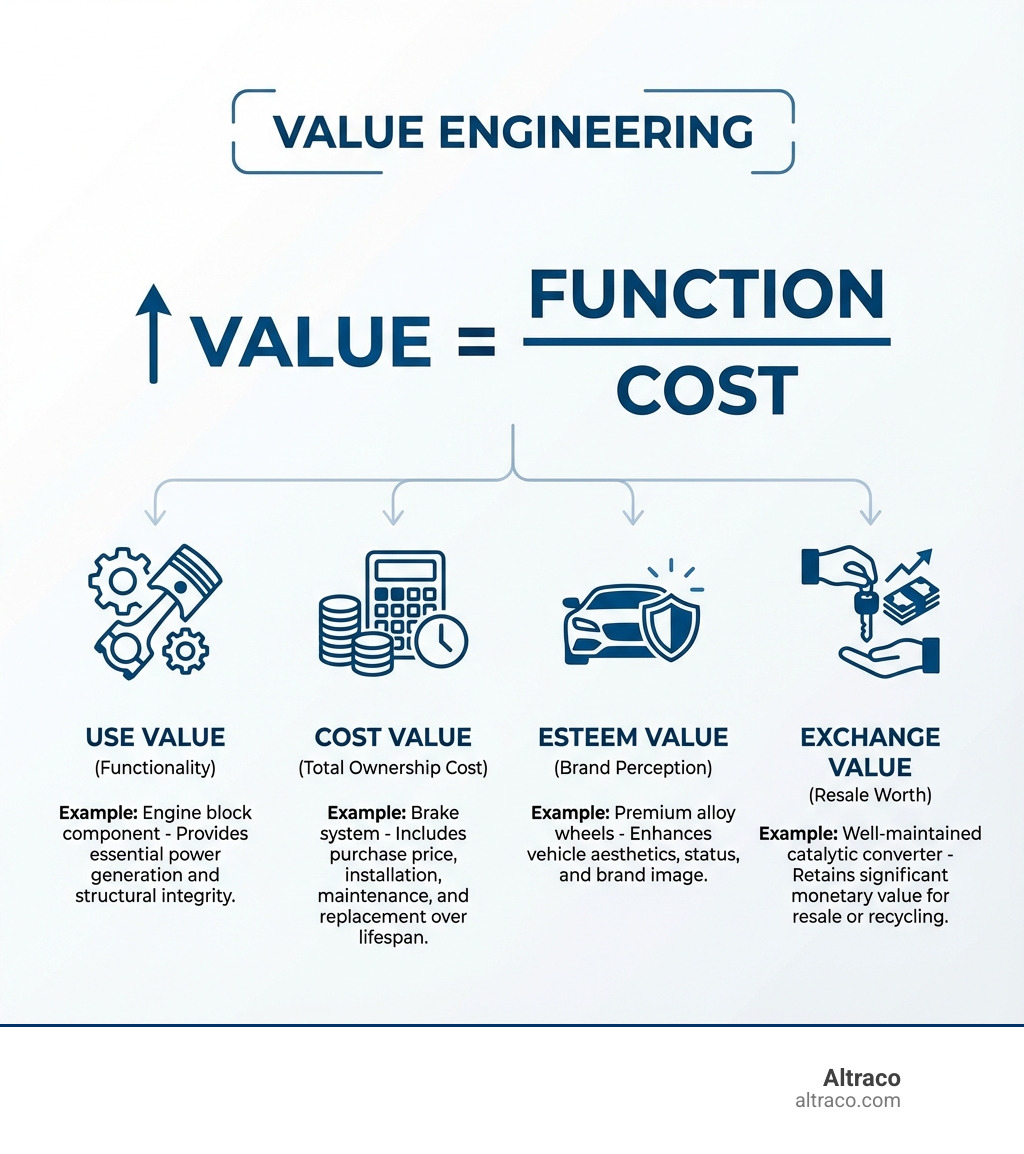
At its heart, cost value engineering is a strategic approach to optimizing functionality and cost, often misunderstood as simple expense slashing. It is a sophisticated methodology focused on enhancing value by systematically analyzing a product’s functions and their associated costs. Value is defined by the ratio: Value = Function / Cost. This means value increases by improving function without raising cost, or by reducing cost without compromising essential functions.
This systematic analysis was born from necessity. The origins of value engineering trace back to World War II, when Lawrence D. Miles, an engineer at General Electric, faced severe material and labor shortages. He developed a new approach to find functional equivalents for scarce resources, creating low-cost alternatives that maintained or improved performance. This pioneering work laid the foundation for modern value engineering. You can read more about its beginnings at History of Value Engineering.

This history highlights that cost value engineering is about creative problem-solving, not compromise. It forces us to ask: “What does this component do?” rather than “What is this component?” This function-oriented mindset uncovers innovative solutions. At Altraco, this means seeking alternative materials or manufacturing processes in our offshore contract manufacturing that deliver the same or better functionality for our clients’ home improvement, sporting goods, automotive, and outdoor products, while keeping costs competitive.
Defining ‘Value’: The Four Key Types
To apply cost value engineering, we must understand that ‘value’ has several dimensions. Lawrence D. Miles identified four primary types:
- Use Value: The properties that make a product useful and functional. For an automotive roof rack, it’s the ability to securely transport cargo.
- Cost Value: The total cost of producing and owning a product, including manufacturing, shipping, and warranty costs.
- Esteem Value: The subjective qualities that make a product desirable, such as aesthetics or brand perception. A sleek design on a roof rack increases its esteem value.
- Exchange Value: The product’s market price or resale potential. A durable, well-designed roof rack will have a higher exchange value.
When applying cost value engineering, we analyze these four types to ensure any change improves the overall value proposition, finding the sweet spot where function is maximized and costs are optimized.
Value Engineering vs. Value Analysis: A Critical Distinction
While often used interchangeably, value engineering and value analysis are applied at different stages of a product’s lifecycle.
Value engineering is a proactive process applied during the early design or pre-production phases. The goal is to prevent value loss before it occurs by optimizing functionality and cost from the outset. At Altraco, we work with clients during their New Product Introduction phase to ensure optimal designs for their products. For example, value engineering a new outdoor grill would involve selecting the most appropriate grade of steel during the design phase, balancing corrosion resistance with material cost.
In contrast, value analysis is a reactive process applied to existing products already in production. Its objective is to improve value or fix deficiencies like excessive costs or quality issues. For instance, if an existing line of automotive parts has high warranty claims, value analysis would be used to identify a better, more cost-effective material.
In short: value engineering is like designing an efficient house from the ground up, while value analysis is like renovating an existing house to improve it. Understanding this distinction allows us to apply the right methodology at the right time.
The Value Engineering Job Plan: A Step-by-Step Methodology
Cost value engineering is a systematic, team-oriented approach guided by a structured job plan, often called the Value Methodology (VM). This collaborative effort involves engineers, designers, and procurement specialists to ensure a holistic perspective. The Society of American Value Engineers International (SAVE International) defines it as a “function-oriented, systematic, team approach to provide value.” Their Value Methodology Standard outlines the process we follow.

At Altraco, a diverse team brings a wealth of knowledge crucial for identifying innovative solutions in offshore contract manufacturing, ensuring our clients’ specifications for home improvement, sporting goods, automotive, and outdoor products are met with optimal value.
Phase 1: Information & Function Analysis
The cost value engineering journey begins with a deep dive into information and function. This phase involves comprehensive data gathering, including drawings, material specifications, performance requirements, manufacturing processes, and cost breakdowns. We aim to understand the product’s entire lifecycle to get a complete picture.
Next is function analysis, the most critical step. We focus on what a product does, not what it is. We identify primary (essential) and secondary (supporting) functions, describing them with a two-word, active verb-noun combination (e.g., “support weight,” “resist corrosion”). Analyzing a bracket as “support component” instead of just “a bracket” opens the door for creative alternatives.
Phase 2: Creative & Evaluation
With functions defined, the process moves to its creative phase. Our multidisciplinary teams hold intensive brainstorming sessions to generate a wide array of alternative solutions for achieving the identified functions. No idea is dismissed initially; the goal is a large quantity of diverse ideas.
Following brainstorming, we begin a rigorous evaluation process. Each idea is assessed for feasibility, practicality, and potential impact on value. We weigh the pros and cons of promising ideas using criteria like:
- Functionality: Does it perform the function as well as or better than the original?
- Cost: What are the short-term and long-term cost implications?
- Quality & Manufacturability: Does it meet quality standards and can it be reliably produced in our offshore facilities?
- Risk: What are the potential risks of implementation?
This phase narrows the pool of ideas to a select few that offer the highest potential for increasing the Value = Function / Cost ratio.
Phase 3: Development & Presentation
The final stages transform concepts into actionable proposals. First, we focus on developing workable proposals by fleshing out the selected ideas with preliminary designs and detailed cost estimations. A crucial tool here is Life-Cycle Cost Analysis (LCCA), which considers all costs over a product’s entire lifespan, including manufacturing, operation, maintenance, and disposal. This helps reveal how a slightly more expensive material might offer superior long-term value.
Finally, we present recommendations to clients and stakeholders. The presentation clearly articulates the proposed changes, their benefits (improved function, reduced cost, better quality), and the rationale behind them. Gaining stakeholder approval is paramount for smooth implementation, and our transparent, data-backed communication empowers clients to make informed decisions.
Applying Cost Value Engineering in Modern Manufacturing
In today’s interconnected world, cost value engineering is critical for companies in global manufacturing. The complexities of international supply chains, fluctuating material costs, and dynamic trade policies demand a proactive approach to value optimization. At Altraco, we apply VE principles to address these modern challenges in our offshore contract manufacturing.
One key application is material substitution. When a commodity like lumber sees its price leap over 400%, original specifications can become unfeasible. Through VE, we identify available, cost-effective alternatives with similar or superior performance. For example, a specific grade of plastic might replace a metal component in a home improvement product, reducing both cost and weight.
Process streamlining is another area of focus. By analyzing workflows in our partner factories in Mexico, China, or Vietnam, we identify and eliminate inefficiencies. For automotive parts, this could mean redesigning a component for easier molding or fewer assembly steps, saving significant time and labor.
Our expertise also extends to tariff mitigation. Shifting trade policies, like recent US Supreme Court decisions on tariffs, require agility. We analyze the impact of tariffs on components and may recommend shifting production or sourcing from countries with more favorable trade agreements, such as Mexico. Our guides on Mexico Manufacturing and Navigating US Tariffs detail how we integrate this expertise into our VE strategies to maintain our clients’ competitive edge.
Real-World Success Stories
The power of cost value engineering is best seen in its real-world impact. A classic example is the Golden Gate Bridge, where VE efforts during the Great Depression reduced the final cost from a projected $100 million to $35 million through design modifications and material substitutions, as detailed in The History of the Golden Gate Bridge.
In the automotive industry, Toyota’s renowned production system (TPS) is a continuous application of VE principles, focusing on waste reduction and efficiency to deliver high-quality vehicles at competitive prices. You can learn more at Toyota’s Production System.
For sporting goods and outdoor products, VE drives innovation. A new hiking backpack might use alternative fabrics that offer the same durability at a lower cost. For a smart thermostat, VE could optimize internal circuitry for lower manufacturing costs. These examples show that VE is about smart decisions, not just cheap ones.
Essential Tools and Techniques for Cost Value Engineering
To effectively implement cost value engineering, we use a suite of powerful tools. Lawrence D. Miles’ seminal work, “Techniques of Value Analysis and Engineering,” remains a foundational text on these methodologies.
Essential tools include:
- Function Analysis System Technique (FAST): A diagram that visually maps the logical relationships between functions.
- Brainstorming: A creative technique to generate a large number of alternative ideas.
- Benchmarking: Comparing a product against industry best practices or competitors.
- Value Stream Mapping (VSM): A visual map of material and information flow to identify and eliminate waste.
- Design of Experiments (DOE): A statistical method to identify which factors most impact performance and cost.
- Pareto Analysis (80/20 rule): Helps focus efforts on the few critical elements that contribute to the majority of costs.
- Function-Cost Matrix: Links functions to their costs to identify disproportionately expensive functions.
By integrating these tools, we conduct thorough analyses and generate innovative solutions that improve value for our clients.
Navigating the Challenges and Criticisms of Value Engineering
While cost value engineering offers immense benefits, it’s not without challenges. A balanced perspective is essential to use its power effectively and avoid pitfalls, which requires careful risk management and transparent stakeholder communication. If not managed thoughtfully, VE can lead to negative outcomes. An experienced partner like Altraco is crucial to ensure cost optimization never comes at the expense of brand integrity or product reliability.
Common Pitfalls and How to Avoid Them
Cost value engineering can fall prey to several pitfalls if not executed with discipline:
- Sacrificing Quality: The most dangerous pitfall is viewing VE as a mandate to simply “make it cheaper,” compromising essential quality or durability. We apply our Maintain a Quality Control Program to prevent this.
- Stifling Innovation: A rigid process can discourage creative solutions, focusing only on incremental cost reductions.
- Short-Term Focus: Prioritizing immediate savings over long-term value can be detrimental. A higher initial investment might lead to significant lifecycle savings.
- Resistance to Change: Stakeholders can resist VE proposals. Early involvement and clear communication are key to overcoming this.
- Lack of a Clear Project Vision: Without a defined understanding of core functions and quality expectations, VE efforts can become directionless.
To avoid these pitfalls, we emphasize a collaborative approach, clear objectives, and a holistic view of value, ensuring every change is vetted against long-term implications.
The Dark Side: When Value Engineering Goes Wrong
The most severe criticisms of cost value engineering arise when it is misapplied as aggressive cost-cutting, leading to unethical or dangerous outcomes.
One criticism is its association with planned obsolescence—designing products with an intentionally limited lifespan. This is a slippery slope if a product’s life cycle is artificially shortened at the expense of the consumer.
More gravely, misapplied VE can lead to safety compromises. The tragic Grenfell Tower fire is a stark warning. The inquiry heard that non-combustible panels were swapped for cheaper, highly flammable aluminum composite material (ACM) cladding to save money as part of a “value engineering” exercise, a decision with devastating consequences as reported in “How they built Grenfell”.
This example underscores that cost value engineering is not about reducing safety or quality for cost. It is about optimizing value within acceptable parameters of quality, performance, and safety. For our clients manufacturing automotive parts, sporting goods, or outdoor products, safety is non-negotiable. Our role is to find efficiencies that improve value without ever compromising the end-user’s well-being.
Frequently Asked Questions about Cost Value Engineering
When is the best time to implement value engineering?
The optimal time to implement cost value engineering is as early as possible, ideally during the concept and design phases. This is when changes are least expensive to make and their impact is maximized. Integrating VE early allows for:
- Maximum impact: Fundamental changes to design or manufacturing can lead to substantial long-term savings.
- Minimal redesign costs: Changes made late in the development cycle are costly and cause significant delays.
- Greater innovation: Exploring a wider range of alternatives is possible before major commitments are made.
While VE can be beneficial at any stage, early intervention consistently yields the best return on investment.
How does value engineering contribute to sustainability?
Cost value engineering is a powerful tool for promoting sustainability. By optimizing function and cost throughout a product’s lifecycle, VE naturally aligns with eco-friendly practices:
- Material optimization: We identify sustainable alternatives like recycled or renewable materials, which also reduces waste.
- Waste reduction: Streamlining manufacturing processes and designs minimizes material waste during production.
- Energy efficiency: VE can lead to designs that require less energy to produce, transport, or operate.
- Lowering life-cycle impact: Considering the entire lifecycle encourages choices that reduce a product’s overall environmental burden.
By designing for efficiency, cost value engineering helps create products that are more cost-effective and environmentally responsible.
What is the relationship between cost engineering and value engineering?
Cost engineering and value engineering are complementary disciplines that work hand-in-hand.
Cost engineering is concerned with cost estimation, cost control, and profitability analysis. It provides the detailed, accurate cost data essential for decision-making.
Value engineering takes that cost data and integrates it with a systematic analysis of function. While cost engineering provides the “how much,” value engineering asks “what does it do?” and “is there a better way?” It uses cost data to analyze the function-to-cost ratio and generate alternatives to improve it.
In short, the cost engineer provides the financial map, while the value engineer uses that map to find the most efficient and valuable route to the desired function.
Conclusion
In an era of global supply chain volatility and rising demands for quality and cost-effectiveness, mastering cost value engineering is a strategic imperative. This systematic methodology empowers businesses to move beyond mere cost-cutting and instead optimize the balance between function and expense. From its origins in wartime necessity to its modern application, VE provides a clear path to enhancing product value and navigating economic challenges.
For manufacturers of home improvement, sporting goods, automotive parts, and outdoor products, applying cost value engineering effectively can mean the difference between market leadership and obsolescence. It enables smarter material choices, more efficient manufacturing, and strategic cost management, including navigating international tariffs.
At Altraco, cost value engineering is a core tenet of our operations. With decades of experience in offshore contract manufacturing in countries like Mexico, China, and Vietnam, we act as an extension of your team, applying these principles to deliver quality products on time and within budget. Our expertise turns concepts into cash with optimal value.
Ready to open up the full potential of your manufacturing projects? Explore Altraco’s Integrated Supply Chain Services and find how our partnership can help you achieve superior value and efficiency.