Understanding the Pre-2025 Tariff Landscape Between the U.S. and China
China tariffs on u.s. before 2025 underwent a dramatic change from relatively low rates to historically high levels. Here’s what you need to know:
Key Historical Tariff Levels:
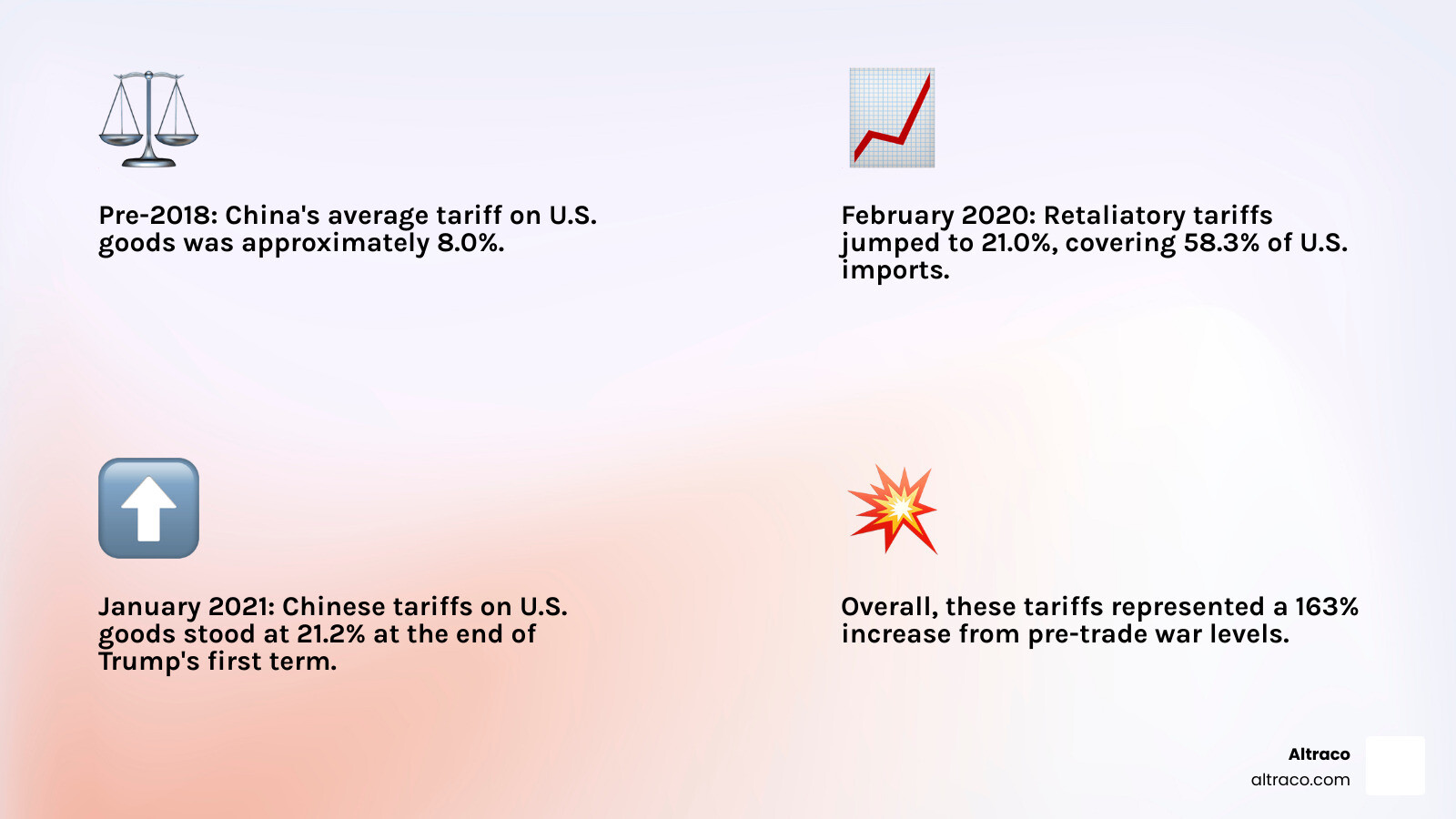
- Pre-2018 (Before Trade War): China’s average tariff on U.S. goods was approximately 8.0%
- February 2020 (Phase One Agreement): China’s retaliatory tariffs jumped to 21.0%, covering 58.3% of U.S. imports
- End of Trump’s First Term (January 2021): Chinese tariffs stood at 21.2%
- Biden Administration (2021-2024): Tariffs remained largely stable at 21.1-21.2%
- January 2025: China’s tariffs increased slightly to 21.2%
These tariffs represented a 163% increase from pre-trade war levels and affected roughly $90 billion worth of U.S. exports, with agricultural products like soybeans, pork, and sorghum among the hardest hit.
The story of China tariffs on u.s. before 2025 is one of rapid escalation. Between 2018 and 2020, what began as an 8% average tariff rate transformed into a full-scale trade war. China imposed retaliatory measures in response to U.S. Section 301 tariffs, targeting American agricultural exports, automotive parts, and energy products.
By the time the Phase One agreement was signed in February 2020, the damage to bilateral trade was substantial. China’s tariffs covered more than half of U.S. exports to the country, worth approximately $90 billion measured at 2017 trade levels. Throughout the Biden administration, these liftd tariff rates remained largely unchanged, with only minor adjustments in late 2024.
For manufacturers relying on global supply chains, this volatile period created significant challenges. The tariff increases affected key industries including home improvement, sporting goods, automotive parts, and outdoor products—sectors where cost efficiency and supply chain reliability are critical.
I’m Albert Brenner, and over my 40+ years managing a contract manufacturing company, I’ve guided Fortune 500 clients through multiple tariff cycles, including the entire period of China tariffs on u.s. before 2025 and the strategic shifts required to maintain competitive production costs. At Altraco, we’ve helped companies steer these complexities by diversifying manufacturing across Mexico, Vietnam, and China, ensuring resilient supply chains regardless of tariff volatility.
The State of Tariffs Before the Escalation (Pre-2018)
Before the onset of the trade war, the landscape of China tariffs on u.s. before 2025 was markedly different. For decades, trade relations between the United States and China operated under a framework of relatively low tariffs, primarily governed by their respective commitments to the World Trade Organization (WTO). This period, stretching back to China’s entry into the WTO in 2001, was characterized by a push towards global economic integration and market liberalization.
Prior to President Trump taking office, the general range of U.S. tariffs on Chinese goods was quite low, typically averaging around 3%. These rates were largely consistent with “Normal Trade Relations” (NTR) or “Most-Favored-Nation” (MFN) status, meaning the U.S. applied the same low tariff rates to China as it did to most other WTO member countries. This stability fostered predictable trade environments, allowing businesses to plan their global supply chains with a reasonable degree of certainty.
On China’s side, before the retaliatory measures began, their average tariffs on U.S. goods hovered around 8%. While slightly higher than U.S. tariffs, these rates were also within the bounds of standard international trade practices. The system was designed to facilitate the smooth flow of goods, with mechanisms in place through the WTO to address trade disputes. However, as we often explain to our clients, the complexities of tariffs extend far beyond simple percentages, encompassing rules of origin, customs valuation, and non-tariff barriers, all of which can significantly impact the final cost of goods.
This pre-2018 era was a time when the focus was on leveraging global production efficiencies, and for many U.S. companies, including those in California, outsourcing manufacturing to China was a strategic decision driven by cost savings and access to vast production capabilities. Our operations in Thousand Oaks, Los Angeles, and Long Beach, CA, have always been at the forefront of helping businesses optimize these global supply chains.
U.S. Tariffs on Chinese Goods
In the years leading up to 2018, U.S. tariffs on Chinese imports were generally low, averaging around 3%. This reflected the prevailing policy of global trade liberalization and the MFN principle of the WTO. Specific product tariffs varied, but the overall landscape was one of predictability and open markets. This policy fostered a massive increase in trade volume between the two nations, benefiting consumers with lower-cost goods and providing manufacturers with diverse sourcing options.
For instance, many home improvement products, sporting goods, automotive parts, and outdoor products imported from China faced minimal duties, making them highly competitive in the U.S. market. This stability was a cornerstone of many businesses’ sourcing strategies, allowing them to focus on innovation and market expansion rather than navigating complex and fluctuating trade barriers.
China’s Tariffs on U.S. Goods
Similarly, China’s tariffs on U.S. goods before the trade war were relatively low, averaging about 8%. While this rate was somewhat higher than the U.S. average, it didn’t present an impossible barrier to trade. U.S. agricultural goods, such as soybeans and pork, and various manufactured products found a robust market in China, contributing significantly to bilateral trade volumes.
However, even in this period of relative calm, the potential for retaliatory tariffs was always present within the framework of international trade law. This potential would become a stark reality as the trade dispute escalated, fundamentally altering the dynamics for sectors heavily reliant on exports to China, particularly agriculture. This historical context is crucial for understanding the dramatic shifts that defined China tariffs on u.s. before 2025.
A Timeline of the US-China Trade War and Tariffs on U.S. Before 2025

The period leading up to and including China tariffs on u.s. before 2025 is essentially a detailed timeline of escalating trade tensions. What started as concerns over trade imbalances and intellectual property rights quickly evolved into a full-blown trade war, initiated primarily during the Trump administration.
The stated reasons for the imposition of tariffs by the U.S. were multifaceted. A core justification stemmed from a Section 301 investigation, which concluded that China engaged in unfair trade practices, including intellectual property theft, forced technology transfers, and cyber intrusions. These practices, the U.S. argued, distorted global markets and harmed American businesses. Furthermore, the massive U.S. trade deficit with China was a significant point of contention, with the administration aiming to reduce it. Beyond these, national security concerns were cited for tariffs on specific goods, such as steel and aluminum, under Section 232 of the Trade Expansion Act of 1962, arguing that reliance on foreign sources for these critical materials threatened national defense.
For businesses looking to understand and manage these shifting policies, Navigate Section 301 Tariffs effectively. Our team at Altraco specializes in dissecting these regulations and guiding our clients through the complexities.
The Trump Administration’s Escalation (2018-2021)
President Trump’s first term saw a dramatic shift in U.S. trade policy towards China. Beginning in 2018, the administration initiated several waves of tariffs under Section 301. These tariffs initially targeted specific Chinese goods, starting with a 10% rate on certain products, which quickly escalated to 25% on a broader range of imports.
The escalation was rapid and comprehensive. By February 2020, U.S. tariffs on Chinese exports averaged 19.3%, a staggering increase—more than six times higher than the rates in January 2018. These tariffs covered a significant portion of U.S. imports from China, approximately 66.6%, or about $335 billion of trade (measured in 2017 import levels). This aggressive approach was a cornerstone of the Trump administration’s strategy, which aimed to compel China to address its trade practices.
Key targets for U.S. tariffs included machinery, electronics, and various manufactured goods that underpin sectors like home improvement, sporting goods, and outdoor products. The impact on U.S. businesses that relied on Chinese manufacturing was immediate and profound, leading to increased costs and pressure to re-evaluate supply chains. For a deeper dive into this period, the Analysis from the Peterson Institute for International Economics provides invaluable context.
Understanding China Tariffs on U.S. Before 2025: The Retaliatory Response
China’s response to the U.S. tariffs was swift and followed a “tit-for-tat” strategy, mirroring the U.S. actions with its own retaliatory tariffs on American goods. This meant that as the U.S. increased tariffs on Chinese imports, China responded with tariffs on U.S. exports, often targeting politically sensitive sectors.
A primary target for China’s retaliatory tariffs was U.S. agricultural products. Soybeans, pork, and sorghum, key exports from the U.S. to China, faced significant duties, severely impacting American farmers. Other targeted goods included automotive parts, which are crucial for the global supply chains of major manufacturers, and energy products.
By February 2020, China’s average retaliatory tariffs on U.S. exports had reached liftd levels of 21%, a substantial jump from the 8.0% average seen prior to the trade war. These retaliatory tariffs covered approximately 58.3% of imports from the United States, amounting to roughly $90 billion in trade (based on 2017 import levels). This aggressive countermeasure was designed to exert economic pressure on U.S. industries and stakeholders, hoping to influence U.S. trade policy. The China Duty Impact was felt across various sectors, creating immense challenges for businesses engaged in cross-border trade.
The “Phase One” Agreement and Its Aftermath

Amidst the escalating trade war, the U.S. and China engaged in negotiations that culminated in the signing of the “Phase One” Economic and Trade Agreement on January 15, 2020, which went into effect on February 14, 2020. This agreement was touted as a significant step towards de-escalation, aiming to address some of the underlying trade imbalances.
Under the Phase One agreement, the U.S. agreed to reduce some of its tariffs on Chinese goods, while China committed to increasing its purchases of U.S. goods and services by at least $200 billion over 2020 and 2021, compared to 2017 levels. These purchase commitments specifically targeted agricultural products, manufactured goods, energy, and services. The agreement also included provisions for structural changes in China’s economic and trade regime regarding intellectual property, technology transfer, agriculture, financial services, and currency.
However, despite the fanfare, the implementation of the Phase One agreement faced significant challenges. While U.S. tariffs on Chinese exports averaged 19.3% in February 2020, a rate more than six times higher than pre-trade war levels, China’s retaliatory tariffs also remained liftd at 21%. Crucially, China ultimately did not meet its purchase commitments under the agreement, falling significantly short of the promised $200 billion in additional purchases. This outcome highlighted the difficulties in achieving a comprehensive resolution to the deep-seated trade issues between the two economic giants. For specific details, the Details of the US-China phase one agreement provide the official context.
Tariff Impact on Trade and Key Industries
The period of escalating China tariffs on u.s. before 2025 had a profound and undeniable impact on annual trade volume between the two nations. The conflict virtually halted $600 billion in annual trade, disrupting established supply chains and forcing businesses to rapidly adapt. Ports, which are the arteries of global trade, felt the immediate effects. For instance, the Port of Los Angeles saw a whipsaw effect, with record freight volumes as companies rushed to beat tariff deadlines, followed by significant drops as trade slowed under the weight of higher duties. In May 2025, the busiest U.S. seaport reported a 9% drop in imports, reflecting the ongoing challenges posed by tariffs.
This volatility underscored the critical need for businesses to have resilient supply chains. At Altraco, we witnessed how our clients, particularly those in home improvement, sporting goods, automotive parts, and outdoor products, needed to rethink their sourcing strategies. The increased costs due to tariffs directly impacted their bottom line and competitiveness. Our guide on Outsourced Manufacturing The Guide to Navigating US Tariffs became an essential resource for many.
Let’s look at how average tariff rates evolved:
| Key Point | Average U.S. Tariff on Chinese Goods | Average Chinese Tariff on U.S. Goods |
|---|---|---|
| January 2018 | ~3.0% | ~8.0% |
| January 2021 | 19.3% | 21.2% |
| January 2025 | 20.8% | 21.2% |
This table clearly illustrates the dramatic escalation from pre-trade war levels to the liftd rates that persisted through January 2025.
Targeted Sectors: From Agriculture to Automotive
The tariffs were not uniformly applied across all goods but strategically targeted specific sectors, maximizing economic and political pressure.
U.S. Targeted Sectors (by China’s Retaliatory Tariffs):
- Agricultural Goods: Soybeans, sorghum, pork, and other agricultural products were hit hard, impacting farmers and rural economies across the U.S.
- Automotive Parts: Components for vehicles faced significant tariffs, affecting the complex global supply chains of the automotive industry.
- Energy Products: Certain U.S. energy exports to China also saw increased duties.
Chinese Targeted Sectors (by U.S. Tariffs):
- Electronics and Machinery: These broad categories, encompassing a vast array of consumer and industrial goods, were heavily impacted.
- Home Improvement Goods: Products ranging from building materials to fixtures faced higher costs, affecting retailers and consumers.
- Sporting Goods: Items like athletic equipment and outdoor recreation gear were subject to increased duties.
- Automotive Parts: Similar to China’s actions, the U.S. also applied tariffs to Chinese-made automotive components.
- Outdoor Products: A wide variety of goods used for outdoor activities saw tariff hikes.
The impact on manufacturers and consumers was substantial. U.S. manufacturers sourcing from China faced increased input costs, leading either to higher prices for consumers or reduced profit margins. This spurred many companies, including our clients in California, to explore alternative manufacturing locations in countries like Mexico and Vietnam, leveraging our contract manufacturing expertise to steer these new trade realities.
The Biden Administration’s Approach (2021-2025)
When President Biden took office in January 2021, the landscape of China tariffs on u.s. before 2025 was already significantly altered by the Trump administration’s actions. The Biden administration largely maintained the existing tariff structure, starting on a comprehensive review rather than immediately rolling back the duties.
Throughout most of Biden’s term, tariffs against China remained fairly stable. The average U.S. tariff on Chinese goods sat at 19.3% for a considerable period. While the Trump administration saw frequent and substantial increases, the Biden administration’s approach was characterized by strategic stability, with only minor adjustments. For instance, U.S. tariffs on imports from China only increased twice during this period: to 19.9% near September 27, 2024, and then to 20.8% near January 1, 2025. Conversely, Chinese tariffs against the U.S. saw a slight dip from 21.2% around July 1, 2020, to 21.1% around May 1, 2021, before increasing back to 21.2% around January 1, 2025.
The Biden administration’s focus shifted towards supply chain resilience, addressing unfair trade practices through multilateral engagement, and investing in domestic manufacturing capabilities. The administration continued to use tariffs as leverage, while also exploring other tools to counter China’s economic policies.
It’s worth noting the ongoing legal scrutiny surrounding the executive authority to impose some of these tariffs. For example, in a hypothetical scenario, the U.S. Court of Appeals for the Federal Circuit ruled on August 29, 2025, that the International Emergency Economic Powers Act (IEEPA) might not authorize the President to impose tariffs in the manner it had been done. This decision led to an appeal, with the Supreme Court of the United States scheduled to hear oral arguments on November 5, 2025, highlighting the complex legal underpinnings of these trade actions. Such developments underscore the dynamic and often unpredictable nature of international trade policy.
Frequently Asked Questions about US-China Tariffs
How high were Chinese tariffs on the U.S. at the end of President Trump’s first term?
At the end of President Trump’s first term in January 2021, China’s average retaliatory tariff on U.S. goods was approximately 21.2%, a significant increase from the 8.0% level before the trade war began in 2018.
What were the main reasons the U.S. imposed tariffs on China?
The U.S. cited several reasons, primarily under Section 301 of the Trade Act of 1974. These included China’s alleged unfair trade practices, theft of U.S. intellectual property and technology, and the large bilateral trade deficit. National security concerns were also cited for tariffs on steel and aluminum under Section 232.
Did the Biden administration remove the Trump-era tariffs on China before 2025?
No, the Biden administration largely maintained the tariff structure inherited from the Trump administration. While a comprehensive review was conducted, the average tariff rate on Chinese goods remained around 19.3% for most of the term, with only minor increases toward the end of 2024.
Conclusion: Navigating a Volatile Global Supply Chain
The journey through China tariffs on u.s. before 2025 illustrates a period of unprecedented tariff volatility and profound shifts in global trade dynamics. From the low, stable rates pre-2018 to the dramatic escalations under the Trump administration and the sustained levels through the Biden years, the landscape for businesses has been anything but static. This era has underscored the critical importance of strategic sourcing and supply chain diversification for companies worldwide, particularly those in California and across the United States.
For manufacturers of home improvement, sporting goods, automotive parts, and outdoor products, the tariff saga has been a wake-up call. The increased costs and unpredictability associated with sourcing solely from China have driven many to explore alternative contract manufacturing locations. Our experience at Altraco, with decades of navigating these challenges, has shown us that resilience lies in flexibility and strategic partnerships.
We believe that the ongoing need for tariff navigation expertise is critical for businesses importing goods. To mitigate risk and ensure cost-effective production, many companies are wisely exploring contract manufacturing in alternative countries. A partner like Altraco, with our base in Thousand Oaks, CA, and strong presence in Los Angeles and Long Beach, can simplify this transition. We leverage our deep experience and trusted factory relationships in regions like Mexico and Vietnam, as well as our continued operations in China, to build resilient supply chains. This approach helps our clients bypass the complexities of direct U.S.-China trade when necessary, while still capitalizing on global manufacturing strengths. Altraco’s contract manufacturing services are designed to help companies adapt to changing tariff environments and maintain their competitive advantage, ensuring quality and on-time delivery even amidst global trade uncertainties.
To ensure your business remains agile and profitable in this changing trade environment, we encourage you to learn more about navigating tariffs on products from China.

Al is an entrepreneur, founder, and owner of multiple businesses, including Altraco, an outsourcing and contract manufacturing company. Working across multiple continents and trusted by Fortune 500 companies, Al finds innovative solutions to traditional supply chain challenges. He is a member of Vistage Worldwide.