Why Logistics Management Activities Are the Backbone of Your Supply Chain
Logistics management activities are the coordinated processes that plan, implement, and control the efficient movement and storage of goods, services, and information from point of origin to point of consumption. These activities form the operational core of supply chain management and directly impact your company’s ability to deliver products on time, control costs, and satisfy customers.
The 7 Core Logistics Management Activities:
- Strategic Sourcing – Finding and contracting reliable suppliers
- Inbound Logistics – Managing incoming raw materials and supplies
- Warehousing – Storing and organizing inventory efficiently
- Inventory Management – Balancing stock levels to meet demand
- Transportation Management – Moving goods via optimal routes and modes
- Order Fulfillment – Processing, packaging, and shipping customer orders
- Reverse Logistics – Handling returns, repairs, and recycling
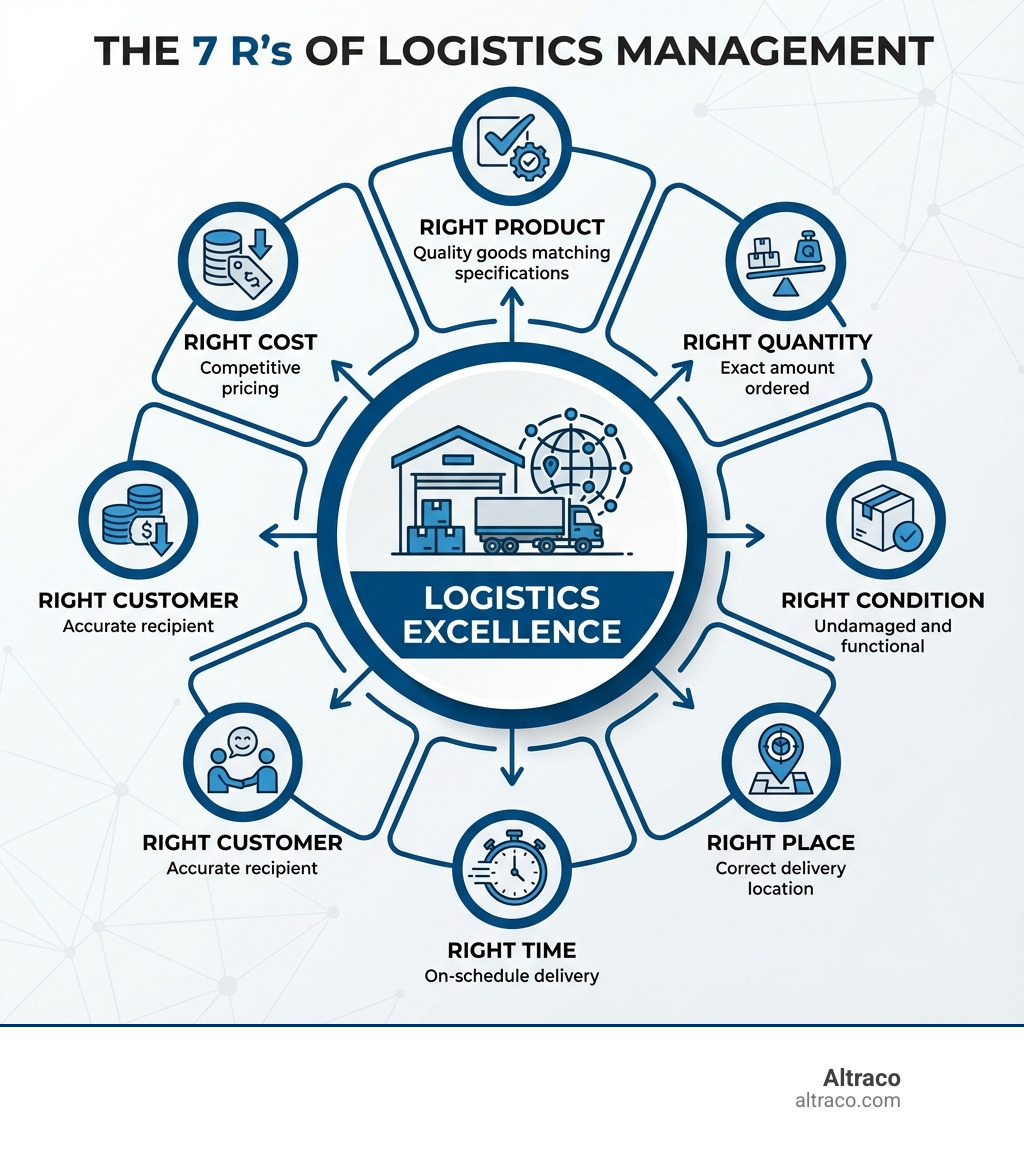
These activities work together to achieve what industry professionals call the 7 R’s of Logistics: delivering the right product, in the right quantity, in the right condition, to the right place, at the right time, for the right customer, at the right cost. When executed effectively, logistics management reduces operational expenses, speeds up delivery times, and builds customer trust—all of which translate to a stronger competitive position in your market.
For Fortune 500 companies manufacturing home improvement products, sporting goods, automotive parts, and outdoor equipment overseas, mastering these activities becomes even more critical. The complexities of international shipping, evolving tariff regulations (including recent U.S. Supreme Court decisions), and the need to maintain quality across borders make logistics management both challenging and essential. The global logistics market, valued at approximately $9.5 trillion in 2021 and projected to reach $13.3 trillion by 2027, reflects just how fundamental these activities are to modern business operations.
As Albert Brenner, co-owner of Altraco with over 40 years of experience in contract manufacturing, I’ve seen how effective logistics management activities separate successful overseas manufacturing partnerships from costly failures. Our firm has built trusted factory relationships across Mexico, China, Vietnam, and other countries, helping Fortune 500 companies steer complex tariff environments while ensuring quality products arrive on time and within budget.
Defining the Foundation: Logistics vs. Supply Chain Management

To truly grasp the power of logistics management activities, it’s helpful to understand their place within the broader universe of supply chain management (SCM). Think of logistics management as a crucial, well-oiled engine within the larger vehicle that is your supply chain. It’s a subset, a vital component, but not the entirety of the journey.
The Council of Supply Chain Management Professionals (CSCMP), a leading authority in our field, defines logistics management as “that part of supply chain management that plans, implements, and controls the efficient, effective forward and reverse flow and storage of goods, services, and related information between the point of origin and the point of consumption in order to meet customers’ requirements.” This definition highlights the operational focus of logistics: the physical movement and storage of things.
Supply chain management, on the other hand, takes a more holistic view. It encompasses the planning and management of all activities involved in sourcing and procurement, conversion (manufacturing), and all logistics management activities. Crucially, SCM also includes coordination and collaboration with channel partners—suppliers, intermediaries, third-party service providers, and, of course, customers. Supply chain management integrates supply and demand management within and across companies, from the moment a raw material is conceived to the final delivery of a product and even its return.
| Feature | Logistics Management | Supply Chain Management |
|---|---|---|
| Focus | Operational: Movement and storage of goods | Strategic: End-to-end integration of processes and partners |
| Scope | Subset of SCM, managing physical flow | Broader, encompassing all activities from source to consumer |
| Objective | Efficiency in delivering goods and services | Competitive advantage, customer value, and profitability |
| Key Activities | Transportation, warehousing, inventory, order fulfillment | Sourcing, procurement, manufacturing, logistics, collaboration |
While logistics is about getting the right product to the right place at the right time, SCM is about optimizing the entire network to create value, manage risk, and foster strong relationships across the entire ecosystem. We excel at integrating these two crucial elements, ensuring our clients benefit from both operational efficiency and strategic foresight. For a deeper dive into how we connect these dots, you can learn more about our Integrated Supply Chain Services.
The Core Logistics Management Activities Your Business Needs to Master
Now that we’ve placed logistics management in its proper context, let’s roll up our sleeves and dig into the specific logistics management activities that are essential for any business, especially for those involved in offshore contract manufacturing of home improvement, sporting goods, automotive parts, and outdoor products. These core functions are interconnected, each influencing the others, and mastering them is key to operational efficiency and customer satisfaction.

Strategic Sourcing and Inbound Logistics Management Activities
The journey of a product begins long before it’s assembled or shipped. It starts with strategic sourcing. This critical logistics management activity involves identifying, evaluating, and engaging with suppliers to secure the raw materials, components, and services needed for production. For us, this means finding the most reliable and cost-effective factories in regions like Mexico, China, and Vietnam that can meet the stringent quality requirements for our clients’ products.
Our strategic sourcing process isn’t just about finding the cheapest option; it’s about building enduring partnerships. This includes:
- Finding reliable suppliers: We leverage decades of experience and trusted factory relationships to identify partners that meet our clients’ specifications for home improvement, sporting goods, automotive parts, and outdoor products.
- Negotiating contracts: Securing favorable terms that ensure quality, timely delivery, and competitive pricing.
- Managing supplier relationships: Fostering strong, collaborative relationships is paramount. As we’ve seen, the value of robust buyer-supplier relationships cannot be overstated, contributing to resilience and innovation. You can read more about The Value of Buyer-Supplier Relationships and why Choosing the Right Manufacturing Partner is Critical to Your Business Success.
Once suppliers are selected and contracts are in place, inbound logistics management activities kick into gear. This refers to all the processes involved in bringing raw materials, components, and other necessary supplies from the supplier’s location to your manufacturing facility. For our clients, this means managing the transportation of everything from specialized plastics for outdoor gear to metal alloys for automotive parts, ensuring they arrive precisely when and where they’re needed. Effective inbound logistics is crucial; a failure to acquire necessary materials can delay manufacturing operations, creating a domino effect across the supply chain.
Warehousing and Inventory Management Activities
Once raw materials arrive, they need a home – and that’s where warehousing comes in. Warehousing management activities involve the strategic storage and movement of materials and finished goods within a facility. This isn’t just about stacking boxes; it’s a sophisticated operation encompassing receiving, storing, picking, packing, and shipping. Modern warehouses are increasingly automated, utilizing technologies like robotic arms and conveyor belts to reduce labor costs and improve efficiency.
Effective warehousing also includes:
- Optimizing layout: Placing fast-moving items closer to shipping areas and less frequently accessed goods further back to streamline operations.
- Space utilization: Maximizing every square foot (or meter!) to reduce storage costs.
- Special storage requirements: For certain automotive parts or sensitive outdoor equipment, maintaining specific temperatures or humidity levels is crucial. We also incorporate rigorous Quality Control checks within the warehouse to ensure products meet standards before moving further down the chain. You can dive deeper into managing warehouse operations and challenges with insights from Warehouse management.
Hand-in-hand with warehousing is inventory management activities. This crucial function focuses on balancing the delicate act of having enough stock to meet demand without incurring the high costs of overstocking. Inventory management is often called the “worst offender” in a supply chain due to its high carrying costs, but it’s absolutely vital for customer satisfaction.
Key aspects include:
- Demand forecasting: This is perhaps one of the most crucial logistics management activities. By analyzing current inventory, historical demand, sales trends, and even seasonal spikes (hello, holiday shopping for sporting goods!), we predict the volume of materials or products needed. This data-driven approach helps avoid both stockouts (empty shelves, unhappy customers) and overstocking (wasted capital, crowded warehouses). There are many different approaches to demand forecasting, often supported by sophisticated software to model various scenarios.
- Balancing stock levels: Using techniques like Just-in-Time (JIT) or safety stock to maintain optimal inventory.
- Material handling: Efficiently moving inventory within the warehouse and along the distribution chain. Incorrect handling can lead to product damage, delivery delays, and increased costs.
By carefully managing inventory, we ensure the right items are available in the right locations, precisely when needed, minimizing costs and maximizing responsiveness. For more on this vital area, explore Inventory management.
Transportation and Fleet Management
Ah, transportation – the visible face of logistics! This is the logistics management activity that moves products from point A to point B, often across continents and oceans. For our clients manufacturing home improvement, sporting goods, automotive parts, and outdoor products overseas, transportation is arguably the most expensive logistics activity, consuming 60 to 70% of total logistics costs.
Outbound logistics specifically refers to the movement of finished goods from manufacturing plants or warehouses to distribution centers, retailers, and eventually, the end customers. We coordinate a symphony of transportation modes, each chosen for its efficiency, cost-effectiveness, and suitability for the product:
- Road: Trucks offer flexibility for last-mile delivery and regional distribution.
- Rail: Cost-effective for bulk goods over long distances, often connecting ports to inland hubs.
- Air: The fastest option, ideal for high-value, time-sensitive goods, though the most expensive.
- Sea: The backbone of international trade, essential for moving large volumes of goods across oceans, though the slowest.
Beyond choosing the right mode, effective transportation management involves:
- Route planning and optimization: Using sophisticated software to determine the most efficient routes, minimize fuel consumption, and ensure timely delivery.
- Fleet management: If applicable, managing a company’s own vehicles, including maintenance, scheduling, and driver management.
- Cost management: Constantly seeking ways to reduce expenses related to fuel, maintenance, tolls, and labor.
- Delivery to final destinations: Ensuring smooth handoffs to distribution centers, retailers, or directly to consumers.
Given the complexities of international shipping, we also prioritize Managing regulatory compliance to steer customs and legal requirements seamlessly.
Order Fulfillment and Reverse Logistics
The moment of truth for any business is when a customer places an order. Order fulfillment is the complete process from the moment an order is received until the product is delivered to the customer. This multi-step logistics management activity involves:
- Order processing: Accurately receiving and validating customer orders, checking for negotiated terms, payment, and delivery specifics.
- Picking and packing: Retrieving items from the warehouse and packaging them securely for transit. Packaging isn’t just about aesthetics; it’s about protecting the product, streamlining handling, and ensuring compliance with shipping regulations. No one wants their new outdoor grill to arrive dented!
- Shipping: Handing off the packaged order to the chosen transportation carrier.
Effective order fulfillment is paramount for boosting customer satisfaction and maintaining a positive brand reputation. A smooth, accurate, and timely delivery experience is what keeps customers coming back. For a comprehensive look at the process, check out Order fulfillment.
But what happens when a customer isn’t happy or the product needs to come back? That’s where reverse logistics comes into play. This is a crucial, often overlooked, set of logistics management activities that handles the return of products from the end consumer back to the seller or manufacturer. It’s not just a simple reversal of the forward flow; reverse logistics includes:
- Receiving returns: Efficiently accepting and documenting returned items.
- Inspection: Assessing the condition of the returned product – is it damaged, defective, or simply unwanted?
- Disposition: Deciding the next step: restock, repair, refurbish, recycle, or dispose. For example, a returned sporting good might be refurbished and resold, while a damaged automotive part might be recycled.
Managing reverse logistics effectively can turn a potential negative customer experience into a positive one and even recover value from returned products.
How Technology and Global Trends are Reshaping Logistics
Our world is constantly evolving, and so too are logistics management activities. Technology and global trends are not just influencing logistics; they are fundamentally reshaping it, making it more complex, more efficient, and more vital than ever before.
The role of technology in modern logistics is transformative. We rely on sophisticated software solutions to automate processes, analyze data, and provide real-time visibility across the supply chain:
- Warehouse Management Systems (WMS): Streamline warehouse operations, from inventory tracking and order fulfillment to optimizing storage space and managing labor.
- Transportation Management Systems (TMS): Handle route planning, carrier selection, freight cost management, and fleet tracking.
- Enterprise Resource Planning (ERP) systems: Integrate core business processes, including finance, HR, supply chain, and manufacturing, providing a single source of truth.
Beyond these foundational systems, data analytics is increasingly used to optimize logistics operations. By collecting and analyzing vast amounts of data—from historical demand and current inventory levels to real-time traffic conditions and weather patterns—logistics managers can make more informed decisions, predict future needs, and identify bottlenecks before they occur. This predictive power allows us to proactively manage risks and seize opportunities.
The rise of eCommerce has dramatically increased customer expectations. Consumers now demand faster, cheaper, and more transparent deliveries, putting immense pressure on logistics networks. This shift has fueled innovations like micro-fulfillment centers and advanced last-mile delivery solutions.
Perhaps the most significant external force shaping logistics, especially for companies engaged in offshore manufacturing of home improvement, sporting goods, automotive parts, and outdoor products, is global trade complexities. Navigating international shipping involves a labyrinth of regulations, customs procedures, and varying infrastructure standards. We’ve seen how crucial it is to understand and adapt to these challenges.
A prime example of this complexity is managing tariffs on China and the impact of recent U.S. Supreme Court decisions regarding tariffs. These policies can significantly affect the cost and feasibility of sourcing from certain regions. At Altraco, our expertise in tariff navigation is a cornerstone of our service, helping clients understand and mitigate these financial impacts.
This fluctuating global landscape has also led many companies to explore sourcing from alternative regions. While China remains a key manufacturing hub, we’ve seen growing interest in diversifying supply chains. Our established relationships in Mexico Manufacturing and Vietnam, along with our capability to establish strong factory partnerships in other countries, provide our clients with flexible and resilient sourcing options, helping to reduce risk and maintain competitive pricing. This strategic diversification is a direct response to global trade dynamics and a proactive approach to managing supply chain resilience.
Key Benefits and Common Challenges
Effective logistics management activities are not just about moving things around; they are about strategically orchestrating a complex dance that yields significant benefits for your business. However, like any intricate operation, logistics also comes with its fair share of challenges.
Here are some of the key benefits we see our clients achieve:
- Reduced operational costs: By optimizing routes, managing inventory efficiently, and streamlining warehousing processes, we help minimize expenses related to transportation, storage, and labor. Transportation alone can consume a large portion of logistics costs, so any efficiency gain here is substantial.
- Improved delivery speed: Faster, more reliable delivery times are a direct result of well-managed logistics, which translates to quicker market entry for new products and improved customer satisfaction.
- Increased visibility: Modern logistics systems provide real-time tracking and data, allowing businesses to monitor the movement of goods, identify potential issues, and make proactive decisions.
- Boosting customer satisfaction: When products arrive on time, in perfect condition, and with accurate order fulfillment, customers are happier. This loyalty is invaluable.
- Improved brand reputation: A reputation for reliable, efficient service builds trust and positions your brand as a leader in the market.
Despite these compelling benefits, logistics managers face a dynamic array of challenges today:
- Rising fuel costs: As a major component of transportation expenses, fluctuating fuel prices can significantly impact profitability.
- Labor shortages: Finding and retaining skilled logistics professionals, from warehouse staff to truck drivers, can be a constant struggle.
- Regulatory problems: Constantly evolving international trade laws, environmental regulations, and local compliance requirements add layers of complexity.
- Port congestion: Global events and increased trade volumes can lead to significant delays at ports, impacting lead times and costs.
- Supply chain disruptions: Geopolitical events, natural disasters, and global pandemics can all disrupt the flow of goods, requiring robust risk management and contingency planning.
Navigating these challenges requires continuous adaptation, strategic planning, and often, the expertise of experienced partners.
Conclusion
The world of manufacturing and distribution is intricate, but at its heart are the essential logistics management activities that ensure goods flow smoothly from origin to destination. From strategically sourcing raw materials for home improvement, sporting goods, automotive parts, and outdoor products to managing complex international transportation and handling returns, each activity plays a critical role in your business’s success.
We’ve explored how logistics management, while a subset of the broader supply chain management, is the operational powerhouse responsible for the efficient movement and storage of goods. Mastering functions like strategic sourcing, inbound logistics, warehousing, inventory management, transportation, order fulfillment, and reverse logistics is not just about efficiency; it’s about achieving the “7 R’s” and delivering value at every step.
In today’s , globalized market, technology and data analytics are indispensable tools, changing how we approach these activities. Furthermore, global trends, including the complexities of international trade and evolving tariff landscapes (like those affecting tariffs on China), necessitate a flexible and informed approach, often involving diversification of sourcing to regions like Mexico and Vietnam.
A holistic approach to logistics management activities isn’t just a cost-saving measure; it’s a powerful competitive advantage. It boosts customer satisfaction, improves brand reputation, and allows businesses to thrive amidst challenges.
At Altraco, we pride ourselves on simplifying global supply chains for our clients. Through our expert management of Contract Manufacturing Services and our deep understanding of international sourcing, we help businesses steer these complexities, ensuring quality products arrive on time and within budget. We build the trusted factory relationships and provide the tariff navigation expertise that allows you to focus on what you do best.
Ready to optimize your supply chain and turn logistics into a strategic asset? Learn more about our Integrated Supply Chain Services and find how we can help your business master the flow.