The Nearshoring Wave Reshaping American Industry
Moving manufacturing to Mexico has become a defining trend for American companies seeking to optimize their supply chains in an era of unprecedented disruption. In 2023, Mexico surpassed China as the United States’ largest trading partner—a historic shift that signals a fundamental realignment of North American manufacturing.
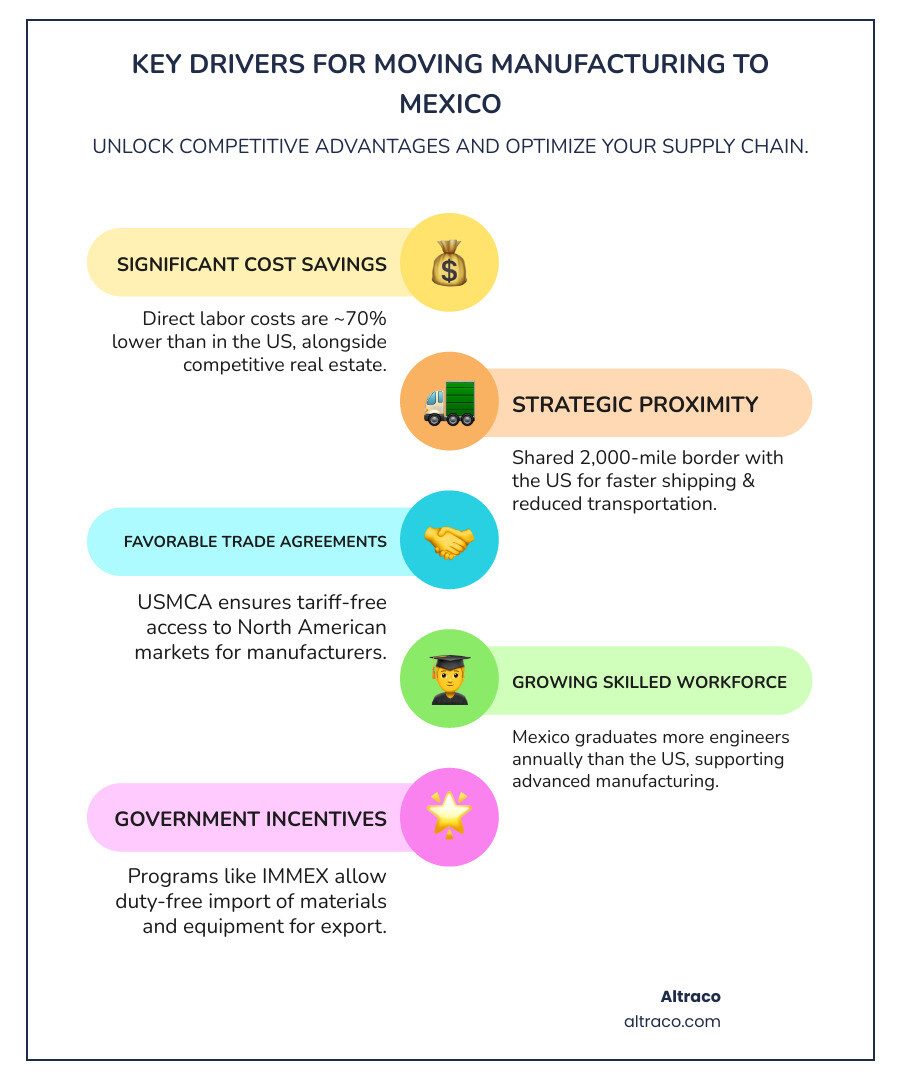
Key Drivers for Moving Manufacturing to Mexico:
- Labor Cost Savings – Direct labor costs are approximately 70% lower than in the US
- Strategic Proximity – Shared 2,000-mile border enables faster shipping and reduced transportation costs
- Trade Advantages – USMCA provides tariff-free access to North American markets
- Skilled Workforce – Mexico graduates more engineers annually than the United States
- Modern Infrastructure – Billions invested in ports, highways, and electrical grids
- Government Incentives – IMMEX program allows duty-free import of materials and equipment
The numbers tell a compelling story. More than 90% of North American manufacturing executives have relocated some production or sourcing in the past five years. For companies in automotive parts, sporting goods, home improvement, and outdoor products, this southward migration offers dramatic cost reductions—often 20% to 50%—while maintaining quality and cutting delivery times.
But recent developments add urgency to this trend. Rising tariffs on Chinese goods, ongoing trade tensions, and even recent Supreme Court decisions on tariff enforcement have made manufacturers rethink their global footprint. The question is no longer if companies should consider Mexico, but how to execute the move successfully.
I’m Albert Brenner, and over 40 years of moving manufacturing to Mexico and other countries, I’ve helped Fortune 500 companies steer the complexities of offshore production through Altraco’s contract manufacturing services. We’ve built deep factory relationships across Mexico, China, and Vietnam, specializing in helping brands manufacture home improvement, sporting goods, automotive parts, and outdoor products with quality, reliability, and cost efficiency.
The Economic Case: Unpacking the Cost Advantages
The allure of moving manufacturing to Mexico often begins with the compelling economic advantages it offers. For businesses facing the squeeze of rising operational costs, Mexico presents a strategic opportunity to significantly improve profitability and competitiveness. We’ve seen how these economic incentives can transform a company’s bottom line.
One of the most significant advantages is the cost of labor. Direct labor in Mexico is roughly 70% less expensive compared to the average hourly wage in the US. This substantial difference translates into considerable savings, particularly for labor-intensive industries such as the production of automotive parts, home improvement components, sporting goods, and outdoor products. Imagine the impact this can have on your manufacturing budget!
Beyond wages, the cost of industrial real estate also plays a crucial role. Industrial real estate in Mexico typically sells for 50% less than in the US, offering a cost-effective foundation for new facilities or expansions. These lower overheads allow companies to reinvest savings into innovation, technology upgrades, or market expansion.
The Mexican government actively encourages foreign investment in manufacturing through a variety of incentives. These often include tax breaks, grants, and streamlined permitting processes designed to attract and retain international businesses. These government incentives can significantly reduce the initial capital outlay and ongoing operational costs for companies establishing a presence.
A cornerstone of Mexico’s economic appeal is the IMMEX (Maquiladora) program. This program allows foreign manufacturers to import raw materials, components, and even machinery and equipment into Mexico tax and duty-free on a temporary basis, provided the finished goods are then exported. This means manufacturers focused on export markets, especially to the US, can avoid significant import duties on their inputs, further boosting their cost efficiency. It’s like having a fast pass through customs for your production materials!
These combined factors — lower labor costs, competitive real estate, government incentives, and the strategic IMMEX program — create a powerful economic argument for companies considering moving manufacturing to Mexico. We help our clients thoroughly analyze these benefits, ensuring they fully understand the potential for reduced operational expenses. For a deeper dive into how we help companies leverage these advantages, explore our International Sourcing Services.
To illustrate the stark differences, consider this simplified comparison of manufacturing costs:
| Cost Factor | Mexico | USA | China (for US export) |
|---|---|---|---|
| Direct Labor | ~70% lower than US | Baseline | Comparable to Mexico* |
| Real Estate | ~50% lower than US | Baseline | Varies, often higher |
| Tariffs (USMCA) | Reduced/Eliminated | N/A | Significant |
| Transportation | Lower (to US) | Baseline | Higher (to US) |
| IMMEX Program | Duty/Tax-free imports for export | N/A | N/A |
*Note: Chinese manufacturing labor costs have risen significantly and can now be comparable to or even higher than Mexican skilled labor, especially when considering tariffs and transportation to the US.
Strategic Location: Proximity and Supply Chain Power
Mexico’s geographical location is arguably its most potent strategic advantage, especially for manufacturers targeting the North American market. It’s not just about being “south of the border”; it’s about being intricately linked to the US and Canadian economies through a shared 2,000-mile land border. This proximity offers unparalleled benefits for supply chain efficiency and responsiveness.

Imagine your products, whether they are automotive parts, robust outdoor gear, or essential home improvement items, needing to reach US consumers quickly. With manufacturing in Mexico, transportation times are dramatically reduced compared to sourcing from overseas. This translates directly into lower transportation costs and shorter lead times, a critical factor in today’s market. For industries reliant on just-in-time inventory systems, Mexico’s proximity is a game-changer, allowing for rapid replenishment and minimizing the need for large, costly inventory holdings.
The implications of Mexico’s proximity to the US market for supply chain efficiency are profound. We can help our clients achieve greater responsiveness to market demands, enabling them to react swiftly to changes in consumer preferences or unexpected surges in orders. This level of agility is simply not possible when dealing with trans-Pacific shipping routes.
To support this busy trade, Mexico has invested significantly in modernizing its infrastructure. Its transportation networks, including highways, railroads, and ports, have seen substantial upgrades. The highway network, for instance, is one of the most extensive in Latin America, facilitating smooth and efficient movement of goods. The Mexican government has committed to improving infrastructure, including highways, ports, and the electrical grid, further bolstering its capabilities. The US has also pledged billions to improve land ports of entry, with six at the southern border, further streamlining cross-border trade. This commitment ensures that the arteries of commerce between our nations remain robust and efficient. You can read more about these investments and their impact on trade at US-Mexico ports investment.
This advanced infrastructure, coupled with the geographic advantage, creates a powerful synergy for manufacturers. It means a more reliable and predictable supply chain, reduced logistical complexities, and ultimately, a more competitive product. For a deeper understanding of how this strategic location is redefining global commerce, we invite you to explore Why Mexico Manufacturing Is Changing Global Supply Chains.
Navigating the Landscape: Why Moving Manufacturing to Mexico Requires a Plan
While the economic and geographic advantages of moving manufacturing to Mexico are compelling, success hinges on careful planning and a nuanced understanding of the operational landscape. It’s not just about picking a spot on a map; it’s about strategic planning that encompasses regulatory frameworks, workforce assessment, and cultural integration. That’s where our expertise comes in.

Regulatory and Trade Agreement Benefits
Navigating the regulatory environment in Mexico is a critical step for any company considering a move. This includes understanding local labor laws, environmental regulations, safety standards, and the process for obtaining necessary permits and licenses. We ensure our clients are fully compliant, avoiding costly delays or penalties.
A major draw for manufacturers is Mexico’s extensive network of free trade agreements. Mexico has free trade agreements with over 40 countries, including the US and Canada through the USMCA. The USMCA, in particular, is a cornerstone of North American manufacturing. It provides for the elimination of tariffs on qualifying goods traded between the US, Mexico, and Canada, a significant advantage over manufacturing in countries outside this bloc. For example, for automotive parts, the USMCA requires 75 percent of auto content to be made in North America and 40-45 percent of auto content to be made by workers earning at least $16 per hour. This incentivizes regional production and strengthens our shared supply chains. You can find detailed information on these agreements in the UNITED STATES–MEXICO–CANADA TRADE FACT SHEET.
Furthermore, Mexico has strong intellectual property laws that protect patents, trademarks, and copyrights, providing a secure environment for your innovations. The political environment in Mexico has also evolved to support foreign investment in manufacturing, providing a stable climate crucial for long-term business planning. In fact, the Mexican government recently announced a temporary measure to raise tariffs from 5% to 50% for 544 HS codes, affecting imports from non-FTA countries like China. This move further strengthens Mexico’s position within the USMCA bloc and makes manufacturing in Mexico even more attractive for companies targeting the North American market.
Tapping into a Skilled Workforce for Your Move to Mexico
One of the pleasant surprises for many of our clients is the availability and skill level of the Mexican workforce. Mexico graduates more engineers annually than the US, creating a vibrant talent pool. The country boasts a large pool of skilled and experienced workers across various disciplines, with many educational institutions offering training programs specifically custom to the manufacturing sector. This ensures a steady stream of qualified personnel ready to contribute.
For industries like automotive parts, sporting goods, home improvement products, and outdoor products, this means access to a capable and increasingly specialized workforce. We help companies assess the local labor market to ensure it meets their specific skill requirements, and if there are gaps, we can help facilitate collaborations with local educational institutions and training programs. This ensures your operations are staffed with the right talent from day one. To learn more about the broader manufacturing landscape in Mexico, visit our page on Mexico Manufacturing.
Cultural and Language Considerations When Moving Manufacturing to Mexico
Relocating operations to a new country always involves cultural and language considerations. While Mexico shares a border and increasing cultural ties with the US, understanding local business etiquette and communication styles is vital for smooth operations. We’ve found that proactive efforts in this area significantly contribute to success.
Language can be a barrier, but many Mexican professionals and skilled workers are bilingual, particularly in border regions and industrial hubs. We advise companies to consider hiring bilingual staff or providing language training to bridge any communication gaps. More importantly, it’s about fostering an environment of mutual respect and understanding. Building strong relationships with local teams, suppliers, and community members is key to long-term success. A little humor and genuine effort go a long way in building rapport! Our experience in integrating global supply chains, detailed further in our Integrated Supply Chain Services, emphasizes the importance of these soft skills in a hard-nosed industry.
Mitigating Risks and Leveraging Altraco’s Support Systems
No strategic business decision comes without risks, and moving manufacturing to Mexico is no exception. However, with thorough planning and the right partners, these risks can be effectively managed and mitigated. Our role at Altraco is to help our clients steer these complexities, turning potential challenges into manageable aspects of a successful relocation.
Key risks often include concerns around political stability, economic fluctuations, and security. While Mexico has a stable political climate that actively supports foreign investment, establishing robust contingency plans is crucial for mitigating any unforeseen disruptions. This means having strategies in place for various scenarios, from supply chain interruptions to shifts in economic conditions.
Security is another aspect that often comes up. While certain regions may face challenges, many industrial parks in Mexico feature state-of-the-art security measures. We work closely with our clients to identify locations that align with their security requirements and implement comprehensive risk management protocols.
Furthermore, we help companies understand and mitigate the evolving landscape of global trade, particularly in comparison to other manufacturing hubs like China. Mexico surpassed China as the US’s biggest trading partner in 2023, partly due to rising costs in China, geopolitical uncertainties, and tariffs. The US tightening national security by restricting trade with China is seen as revealing the early stages of a more segregated North American trading bloc, where Mexico plays a pivotal role. The recent temporary tariffs Mexico imposed on non-FTA countries like China further underscore this shift, making Mexico an even more attractive alternative for US-bound goods.
Here are some of our Key Risk Mitigation Strategies:
- Thorough Due Diligence: Conduct in-depth research into potential locations, including political, economic, and security assessments.
- Legal & Regulatory Compliance: Engage local legal and compliance experts to ensure adherence to all Mexican laws and regulations.
- Diversified Supply Chains: Build redundancy into your supply chain to minimize the impact of any single point of failure.
- Insurance & Security Protocols: Implement comprehensive insurance coverage and robust security measures for facilities and personnel.
- Local Partnerships: Foster strong relationships with local government, community leaders, and trusted service providers.
- Contingency Planning: Develop detailed plans for various scenarios, including natural disasters, economic downturns, or unforeseen operational challenges.
At Altraco, our contract manufacturing expertise means we provide end-to-end supply chain support, from site selection and factory relationships to tariff navigation and quality control. We specialize in industries like automotive parts, sporting goods, home improvement, and outdoor products, understanding the specific needs and challenges of these sectors. We’re not just finding a factory; we’re building a resilient and efficient manufacturing solution for you. To explore how our contract manufacturing services can de-risk your move, visit our dedicated page on Contract Manufacturing Services.
Frequently Asked Questions about Moving Manufacturing to Mexico
What is the IMMEX (Maquiladora) program?
The IMMEX program, formerly known as the Maquiladora program, is a crucial incentive for foreign manufacturers in Mexico. It allows companies to import raw materials, components, machinery, and equipment into Mexico tax and duty-free on a temporary basis. The primary condition is that these imported goods must be used in the production process and the final products must be exported. This program significantly reduces production costs for manufacturers focused on export markets, especially the US, making it highly attractive for industries like automotive parts, sporting goods, home improvement, and outdoor products.
How do labor costs in Mexico really compare to the US?
Direct labor costs in Mexico are approximately 70% lower than the average hourly wage in the United States. While wages in Mexico are experiencing an upward trend, the country maintains a substantial cost advantage, particularly for labor-intensive manufacturing processes. This cost differential provides a significant competitive edge for companies looking to optimize their production budgets without compromising on quality or skill, especially when compared to other global manufacturing hubs where labor costs have risen considerably.
What are the biggest risks of manufacturing in Mexico?
The biggest risks associated with manufacturing in Mexico typically include navigating a different legal and regulatory system, managing potential cultural and language differences, and addressing security concerns in certain regions. However, these risks are not impossible. With thorough planning, engaging local expertise, and partnering with experienced entities like Altraco, these challenges can be effectively mitigated. We help our clients understand the landscape, implement robust compliance strategies, foster strong cross-cultural communication, and ensure appropriate security measures are in place, allowing them to focus on their core manufacturing operations.
Conclusion: Partnering for a Successful Move South
The decision to start on moving manufacturing to Mexico is a strategic one, driven by compelling advantages in cost efficiency, supply chain resilience, and proximity to the lucrative North American market. As global supply chains continue to evolve and geopolitical landscapes shift, Mexico stands out as a vital partner for companies seeking long-term growth and competitive advantage.
From the significant cost savings offered by lower labor and real estate expenses to the strategic benefits of reduced transportation times and robust trade agreements like the USMCA, the case for Mexico is stronger than ever. The availability of a skilled and growing workforce, coupled with a commitment to infrastructure development and a supportive regulatory environment, creates an ecosystem ripe for manufacturing success.
At Altraco, we understand that navigating this move can seem daunting. That’s why we pride ourselves on being more than just an offshore contract manufacturing partner; we are your strategic guide. With decades of experience, trusted factory relationships in Mexico, China, and Vietnam, and unparalleled expertise in tariff navigation—including understanding recent Supreme Court decisions that impact global trade—we simplify the complexities of global supply chains. We specialize in helping brands manufacture home improvement, sporting goods, automotive parts, and outdoor products, ensuring quality, on-time delivery, and significant cost savings.
Let us help you open up the full potential of moving manufacturing to Mexico. Partner with us to streamline your operations, improve your competitiveness, and secure your place in the future of North American manufacturing.