Why Understanding States Tariffs Matters in 2025
States tariffs – or more accurately, U.S. federal tariffs on imported goods – have undergone a dramatic change in 2025. If you’re searching for tariff information, here’s what you need to know right now:
Quick Answer: Key 2025 U.S. Tariff Actions
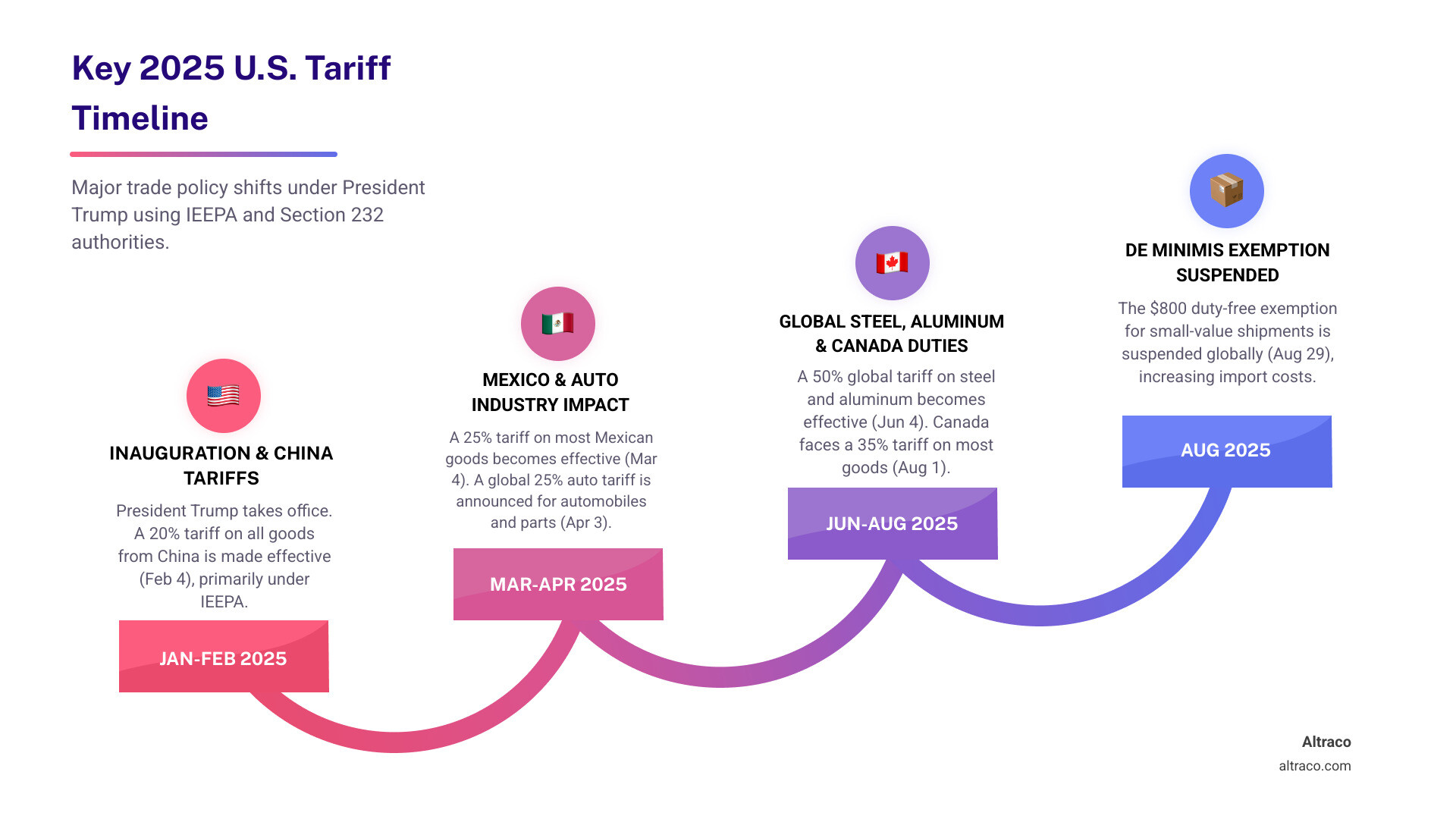
- Canada: 35% tariff on most goods (effective August 1, 2025)
- Mexico: 25% tariff on most goods (effective March 4, 2025)
- China: 20% tariff on all goods (effective February 4, 2025)
- Global Steel & Aluminum: 50% tariff (effective June 4, 2025)
- Automobiles & Parts: 25% tariff globally (April-May 2025)
- De Minimis Exemption: Suspended for all countries (August 29, 2025)
Since January 20, 2025, President Trump’s administration has used the International Emergency Economic Powers Act (IEEPA) and Section 232 of the Trade Expansion Act of 1962 to increase tariffs on imports from nearly all global partners. This has pushed the average applied tariff rate from a historical 2% to nearly 19% on many goods.
The impact is immediate, especially in manufacturing-heavy states like Kentucky, Michigan, and Tennessee. Businesses importing components for home improvement, sporting goods, automotive, or outdoor products face significant cost increases that disrupt entire supply chains.
While the federal government collected a record $190 billion in tariffs in the first nine months of 2025, this revenue comes at a cost. Past research shows these costs are passed on to U.S. consumers and businesses, raising prices and triggering retaliatory tariffs from trading partners.
Navigating this landscape is crucial. The Harmonized Tariff Schedule of the United States (HTS) is the starting point for classifying goods and finding duty rates. However, 2025’s actions add complexity through “tariff stacking” (multiple tariffs on one product) and the suspension of the $800 “de minimis” duty-free exemption for small shipments.
My name is Albert Brenner. With over 40 years of experience, I’ve helped companies steer evolving trade policies. At Altraco, we leverage our factory relationships in Mexico, China, and Vietnam to help businesses adapt their supply chains to dramatic tariff shifts like those seen in 2025.
A Sweeping Overhaul of U.S. Trade Policy: Key Tariff Actions in 2025
The 2025 trade landscape has been fundamentally altered by a series of sweeping tariff actions from the Trump administration, affecting nearly every imported product category, from automotive parts to sporting goods. The administration has used powerful legal authorities to impose these tariffs, citing national security, trade deficits, and the flow of illicit drugs. The legal basis for a tariff is important, as it affects rates, dispute resolution, and potential exemptions.
Legal Foundations for New Tariffs
Three legal acts form the basis for 2025’s states tariffs:
- The International Emergency Economic Powers Act (IEEPA): This act grants the President broad powers to regulate commerce during a national emergency. It has been the primary tool for tariffs against Canada, Mexico, and China.
- Section 232 of the Trade Expansion Act of 1962: This provision allows the President to adjust imports that are found to threaten national security, such as steel, aluminum, and automobiles.
- Section 301 of the Trade Act of 1974: Designed to combat unfair trade practices, this authority is being used for several ongoing investigations that could lead to future tariffs.
IEEPA-Based Tariffs on Neighbors and Rivals
The administration used IEEPA to impose dramatic tariffs on top trading partners, citing the flow of illicit drugs as a primary justification.
- Canada: A 35% tariff on most goods not qualifying for USMCA preference, effective August 1, 2025. The related executive order frames it as a border security measure.
- Mexico: A 25% tariff on most non-USMCA goods, effective March 4, 2025, justified by similar border security concerns in its executive order.
- China: A 20% tariff on all goods, effective February 4, 2025, targeting the synthetic opioid supply chain as detailed in its executive order.
Crucially, goods that qualify for duty-free preference under USMCA are exempt from the new tariffs on Canada and Mexico. At Altraco, we work with our Mexican factory partners to ensure clients’ products maintain USMCA qualification, as proper origin verification is now more critical than ever.
Section 232 National Security Tariffs
Using Section 232, the administration has imposed global tariffs on products deemed vital for national security.
- Steel and aluminum imports face a 50% global tariff (25% for the UK), effective June 4, 2025.
- Automobiles and automobile parts face a 25% global tariff, effective April 3 (vehicles) and May 3 (parts), 2025. The proclamation includes some negotiated exceptions, like a 10% rate on UK parts.
- Copper products face a 50% tariff on their copper content, effective August 1, 2025, as outlined in the copper proclamation.
| Product Category | Countries Affected | Current Tariff Rate | Effective Date(s) |
|---|---|---|---|
| Steel & Aluminum | Global (with some exemptions) | 50% globally (UK 25%) | June 4, 2025 |
| Automobiles & Parts | Global (with some exemptions) | 25% globally (UK parts 10%, Japan 15%) | April 3, 2025 (vehicles), May 3, 2025 (parts) |
| Copper Products | Global (with some exemptions) | 50% on copper content | August 1, 2025 |
The End of De Minimis and Other Broad Actions
Perhaps the most far-reaching change is the suspension of the $800 duty-free de minimis exemption for all countries, effective August 29, 2025. This means even small-value shipments now face tariffs. Other targeted actions include tariffs on Brazil (40%) and India (25%).
To manage situations where multiple tariffs apply to one product (“tariff stacking”), an executive order addressing tariff stacking established a hierarchy, ensuring importers typically pay the highest applicable rate rather than a cumulative total. Navigating this complexity makes strategic sourcing through partners like Altraco, with established networks in Mexico, China, and Vietnam, more important than ever.
Navigating the New Landscape of United States Tariffs
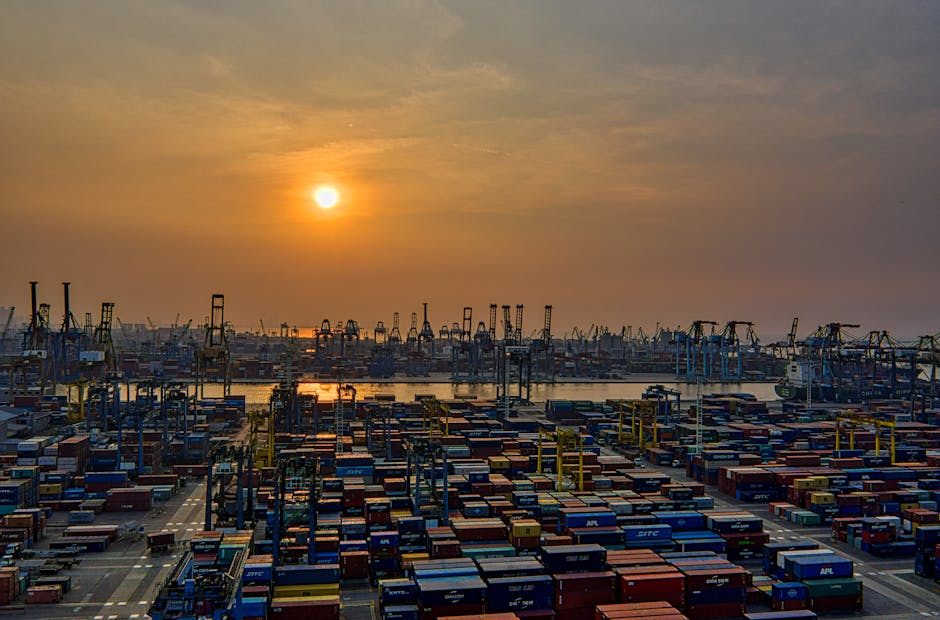
The rapid implementation of new states tariffs in 2025 has created a challenging environment for importers of home improvement products, sporting goods, and automotive parts. This has sparked intense diplomatic activity, including negotiations, truces, and retaliatory measures from trading partners. Understanding these dynamics is essential for business strategy.
Negotiations, Truces, and Retaliation
The U.S. government’s aggressive tariff stance has been paired with a willingness to negotiate. Several preliminary agreements have emerged:
- EU: A Joint Statement outlines a framework aiming for a 15% tariff ceiling for EU goods entering the U.S. in exchange for EU concessions on U.S. industrial and agricultural products.
- UK: A nonbinding agreement secured a lower 10% rate for certain imports and established a tariff-rate quota (TRQ) for vehicles, allowing a specific number to be imported at a lower duty.
- Japan: Negotiations resulted in a 15% tariff on auto trade and exemptions for certain other goods.
However, retaliation has been swift. China responded with escalating countermeasures that reached 125% on some U.S. goods. Canada implemented 25% retaliatory tariffs on billions in U.S. exports, targeting products from orange juice to automobiles. These shifting dynamics underscore the volatility of the current trade environment, making the supply chain flexibility offered by Altraco’s multi-country factory network invaluable.
Legal Challenges to Presidential Authority
The administration’s authority has been challenged in court. On May 28, 2025, the U.S. Court of International Trade ruled that the IEEPA tariffs were illegal. However, on June 10, 2025, an appeals court allowed the tariffs to remain in effect while the government’s appeal proceeds.
This ongoing legal uncertainty means businesses must continue to pay the duties while awaiting a final decision. This legal limbo adds another layer of risk to supply chain decisions, reinforcing the need for resilient manufacturing strategies that can withstand policy shifts.
Understanding the states tariffs and the HTS
Successfully navigating U.S. import regulations requires understanding the Harmonized Tariff Schedule of the United States (HTS). This framework classifies every imported product with a 10-digit code that determines its base duty rate. The U.S. International Trade Commission (USITC) maintains the official HTS at https://hts.usitc.gov and offers an Interactive HTS Training.
Correct classification is the first step in managing tariff costs. An incorrect code can lead to overpayment or penalties. For complex products like home improvement goods or automotive parts, strategic classification or even “tariff engineering” (modifying a product to fit a lower-duty category) can yield significant savings.
The cumulative effect of 2025 tariffs is substantial, with government revenue doubling but costs being passed to importers and consumers. Determining your final duty rate involves finding the HTS code, country of origin, and layering on any new tariffs according to the stacking hierarchy. With over 40 years of experience, Altraco helps clients steer this complexity, ensuring products are classified correctly and produced in the most cost-effective locations.
Future Outlook: Ongoing Investigations and Potential Tariffs

The 2025 tariff landscape may become even more turbulent, as the Trump administration is pursuing multiple investigations that could trigger further states tariffs. For businesses in the home improvement, sporting goods, automotive, and outdoor equipment sectors, monitoring these developments is essential for survival.
Section 232 Investigations in the Pipeline
The Department of Commerce’s Bureau of Industry and Security (BIS) has several ongoing Section 232 investigations that could lead to new tariffs on national security grounds. You can track these at the BIS website. Key investigations cover a wide range of products, including:
- Timber and lumber
- Processed critical minerals, uranium, and their derivatives (e.g., semiconductor wafers, EV batteries)
- Pharmaceuticals and semiconductors
- Medium-duty and heavy-duty trucks
- Commercial aircraft, jet engines, and drones
- Polysilicon and wind turbines
Section 301 Reviews and Actions
Simultaneously, the U.S. Trade Representative (USTR) is conducting Section 301 reviews targeting unfair trade practices. Active investigations that could result in new tariffs include:
- China’s semiconductor industry practices
- Foreign digital services taxes
- China’s maritime, logistics, and shipbuilding industries
- A comprehensive review of Brazil’s trade practices
Details on these can be found on the USTR Section 301 Investigations page. These reviews signal that the administration’s aggressive trade posture is not slowing down.
How states tariffs could impact your business
These current and potential tariffs create ongoing supply chain disruption and increased costs for importers. For industries like home improvement, sporting goods, automotive parts, and outdoor products, the impact is direct, affecting everything from raw materials like steel and timber to finished goods. A client manufacturing cabinet hardware, for example, saw landed costs jump 30% in six months.
This environment demands a strategic sourcing approach that builds in resilience and flexibility. At Altraco, we help clients steer this complexity. Our established factory relationships in Mexico, China, and Vietnam provide the flexibility to pivot production and mitigate tariff exposure. We offer expert guidance on tariff navigation, from HTS classification to strategic product design, simplifying your global supply chain so you can focus on your business.
Frequently Asked Questions about 2025 U.S. Tariffs
We understand that the current landscape of states tariffs can feel overwhelming. Here are answers to the questions we receive most frequently from companies trying to make sense of these 2025 changes.
How do I find the current tariff rate for my product?
Finding your product’s tariff rate is a two-step process.
- First, you must correctly classify your product using the Harmonized Tariff Schedule (HTS) to find its base duty rate. The official HTS from the U.S. International Trade Commission is the primary resource. Their Interactive HTS Training is a helpful guide.
- Second, you must check for any recent Presidential Proclamations or Executive Orders that add to or override the base rate for your product’s country of origin. This second step is critical in 2025 due to numerous new tariff actions.
Are these new tariffs cumulative, or do they replace older ones?
It’s complicated, as some tariffs are cumulative, meaning they can “stack.” A product could theoretically be subject to multiple duties. However, the administration issued guidance that creates a hierarchy to prevent certain duties from stacking. This generally means an importer will pay the single highest applicable tariff rather than adding them all together. For example, auto tariffs often take precedence over steel or country-specific tariffs.
Are any countries or products exempt from the new tariffs?
Yes, but exemptions are specific and limited. The most significant exemption is for goods that qualify for duty-free treatment under the USMCA, which are exempt from the new IEEPA tariffs on Canada and Mexico. This makes maintaining USMCA qualification for products made in those countries essential.
Additionally, the U.S. has negotiated limited relief with key partners. The EU secured a 15% tariff ceiling, while the UK and Japan received lower rates or quotas for specific products, particularly in the automotive sector. These agreements are conditional and subject to change, highlighting the need for flexible supply chains like those Altraco helps build in Mexico, Vietnam, and China.
Conclusion
The states tariffs landscape of 2025 has overhauled global trade for U.S. businesses. The volatility, legal challenges, and shifting negotiations require proactive, not reactive, supply chain management. Companies that thrive today are those with flexible sourcing strategies already in place.
At Altraco, this is our expertise. We leverage decades of experience and trusted factory relationships in Mexico, China, and Vietnam to help our clients steer this complexity. We assist businesses in the home improvement, sporting goods, automotive, and outdoor product sectors to pivot production, manage costs, and maintain quality.
Our services go beyond sourcing; we provide expert tariff navigation, from HTS classification to tariff engineering. Based in Thousand Oaks, California, we simplify global supply chains for companies ranging from innovative startups to Fortune 500s.
Let us help you build a more resilient, cost-effective supply chain in this evolving trade environment. Our goal is to deliver quality, on-time products with significant cost savings, no matter how complex the trade environment becomes.