
Introduction: Why Your Business Can’t Afford to Guess on Inventory
Best inventory forecasting software helps businesses predict future inventory needs, ensuring they have the right amount of stock at the right time to meet customer demand efficiently. Here are the top solutions for 2026:
| Software | Best For | Starting Price | Key Strength |
|---|---|---|---|
| Conjura | E-commerce brands focused on profitability | $299/month | SKU-level ad spend attribution and contribution profit analysis |
| Inventory Planner by Sage | Growing Shopify and Amazon sellers | $129/month | User-friendly forecasting with fast, data-backed purchasing decisions |
| NetSuite Demand Planning | Enterprise businesses with complex global operations | Custom (typically $1,000+/month) | Full ERP integration with finance, inventory, and supply chain modules |
| Cin7 | Omnichannel retailers with multiple warehouses | $325/month | Full-featured inventory and order management with forecasting |
| Cogsy | Fast-growing brands aligning marketing and inventory | $499/month | Revenue planning tool that syncs inventory with marketing campaigns |
Let’s face it: running a business without inventory forecasting tools is like navigating a ship without a compass. You might end up with a mountain of products nobody wants (hello, overstocking) or worse, run out of the hot-selling items (hello, stockouts).
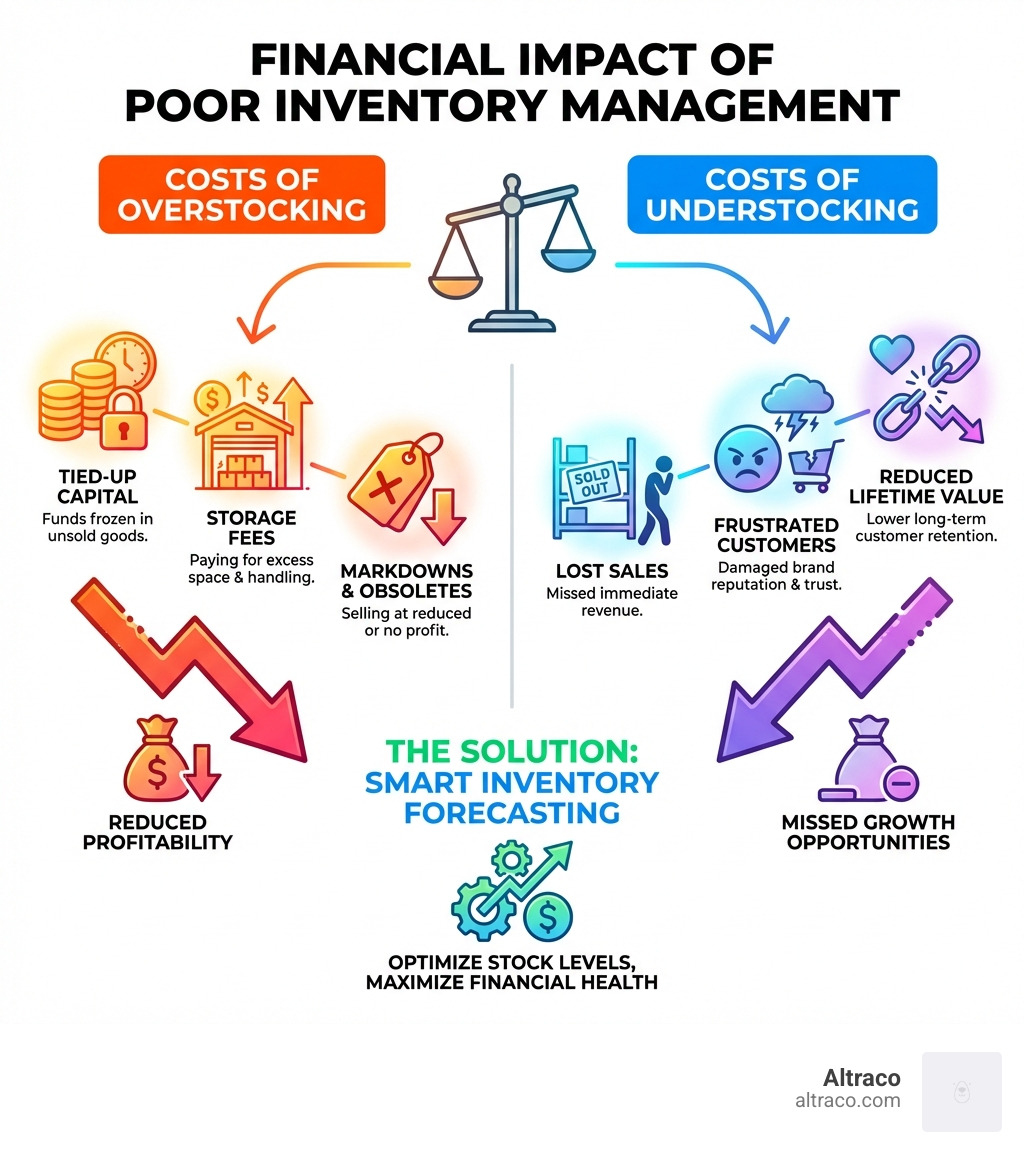
Overstocking ties up capital in unsold inventory, racks up storage costs, and often leads to markdowns when products become obsolete. Understocking creates lost sales, frustrated customers, and a direct hit to customer lifetime value and retention.
The modern marketplace makes this even harder. SKU proliferation is rising. Supply chains have gotten longer. Lead times are less predictable. Demand patterns are more intermittent and less forecastable. Traditional methods like spreadsheets or basic ERP-provided solutions simply fall short.
Smart inventory planning saves businesses up to 23 hours per week and reduces human errors with automated, reliable planning and purchasing power. The right forecasting software assists businesses in optimizing stock levels, reducing costs, and improving client satisfaction.
As Albert Brenner, co-owner of Altraco, a contract manufacturer for Fortune 500 companies producing home improvement, sporting goods, automotive, and outdoor products, I’ve seen how the best inventory forecasting software transforms operations by connecting accurate demand predictions with global manufacturing capabilities across countries like Mexico, China, and Vietnam. With over 40 years of experience navigating complex supply chains and tariff challenges, I know that getting inventory right is critical for cost-efficient, on-time delivery.
Best inventory forecasting software terms you need:
The Core Benefits of Automating Your Inventory Forecasts
Why should your business invest in best inventory forecasting software? Because the benefits ripple across your entire operation, from your bottom line to your customer relationships. These tools are designed to pull you out of the guesswork and into a world of data-driven decisions, saving you time, money, and headaches.
We’ve seen businesses save up to 23 hours per week and significantly reduce human errors by leveraging automated, reliable planning and purchasing power. This translates directly into cost reduction, improved cash flow, increased customer satisfaction, and the prevention of those dreaded stockouts and overstocking scenarios. Managing your supply chain with inventory forecasting software is no longer a luxury; it’s a necessity. We constantly look for ways to optimize our own Inventory Management Solutions and those of our clients.
Optimizing Stock Levels and Cash Flow
One of the most immediate and impactful benefits of inventory forecasting software is its ability to help you strike the perfect balance between having enough stock and having too much. Overstocking, as we mentioned, ties up valuable capital, incurs storage costs, and often leads to obsolescence and markdowns. Imagine a mountain of unsold automotive parts or outdoor gear taking up precious warehouse space in Los Angeles, CA – that’s capital sitting idle.
By accurately predicting future demand, these software solutions allow us to optimize stock levels, reducing carrying costs and freeing up cash flow that can be reinvested in growth. They help us make smarter, profit-driven decisions, ensuring we buy the right stock at the right time to maximize our margins. Features like Open-to-Buy planning even assist in forecasting needs for new product introductions (SKUs), helping to prevent overstock and understock from day one.
Improving Customer Satisfaction and Retention
In today’s competitive market, customer satisfaction is paramount. Running out of stock on a popular home improvement item or a must-have sporting good can quickly lead to lost sales and frustrated customers. Nobody likes waiting weeks for an item that was supposed to be readily available.
Best inventory forecasting software helps us ensure product availability aligns with customer needs, minimizing lost sales and meeting customer expectations. When customers consistently find what they’re looking for, when they need it, their satisfaction improves, leading to increased loyalty and a stronger brand reputation. Keeping customers happy is indeed the name of the game, and inventory forecasting plays a key role in that success.

Key Features to Look for in Inventory Forecasting Software
Choosing the right inventory forecasting software is like picking the perfect tool for a specific job – you need the right features to get the best results. We look for solutions that offer a robust set of capabilities to handle the complexities of modern supply chains, especially for businesses manufacturing home improvement, sporting goods, automotive parts, and outdoor products.

Here are the key features we consider essential:
- Advanced Demand Forecasting: This is the heart of any good system. It should leverage historical sales data, seasonal trends, marketing efforts, and even external factors like economic conditions to provide highly accurate predictions. AI and machine learning capabilities allow the software to learn and improve its predictions over time.
- Real-Time Tracking and Visibility: Forecasting models rely on up-to-date stock data. The software must provide real-time inventory tracking across all sales channels and locations (e.g., warehouses in Thousand Oaks, CA) to accurately calculate replenishment needs. Without current data, you risk ordering too much, too little, too early, or too late.
- Automated Replenishment: This feature dynamically adjusts order quantities or timing based on demand spikes or supply delays. It can automatically generate purchase orders or replenishment requests when stock levels hit predefined reorder points, streamlining the process and reducing manual errors.
- Supplier Management: Effective forecasting isn’t just about demand; it’s also about supply. The software should include features for managing supplier information, tracking lead times, and monitoring supplier performance (delivery punctuality, order accuracy). This is crucial when working with offshore manufacturing partners in Mexico or Vietnam.
- Customizable Reporting and Dashboards: Every business has unique needs. Customizable dashboards allow users to tailor the display of complex inventory data to their specific roles and priorities, providing quick, actionable insights. Exec-level reports with customized, automated summaries are also a huge plus.
- Scalability and Industry Fit: The software should be able to handle increasing data volumes, expanding product lines, and complex models as your business grows. It’s also beneficial if it offers industry-specific forecasting models or workflows that align with sectors like home improvement or automotive parts.
- Security and Compliance: Protecting sensitive business data is non-negotiable. Look for robust security features like strong encryption, granular access controls, and multi-factor authentication. Additionally, the software should support compliance with relevant regulations, such as GDPR for businesses operating in Europe.
Critical Integration Capabilities
The effectiveness of any best inventory forecasting software is significantly amplified by its ability to integrate seamlessly with your existing business systems. Think of it as connecting all the vital organs of your business to a central nervous system. This ensures a single source of truth for all your data, eliminating silos and streamlining workflows.
Key integrations include:
- ERP (Enterprise Resource Planning) Integration: Connecting with your ERP system (like NetSuite) is crucial for a holistic view of your operations, linking inventory data with finance, sales, and production.
- POS (Point of Sale) Integration: For retailers, integrating with POS systems provides real-time sales data, which is vital for accurate demand forecasting and replenishment decisions.
- E-commerce Platform Integration: For online businesses, integration with platforms like Shopify or Amazon Seller Central ensures that online sales and inventory levels are constantly synchronized.
- WMS (Warehouse Management System) Integration: This allows for precise tracking of inventory movements within your warehouses, ensuring that the forecasting software has the most accurate stock counts.
Seamless data flow between these systems is what makes an inventory forecasting solution truly powerful, delivering integrated supply chain services and driving efficiency across your entire operation.
AI-Driven vs. Statistical Forecasting Approaches
When we talk about inventory forecasting, we’re essentially talking about predicting the future based on past data. How this prediction is made often falls into two main categories: statistical models and AI-driven models. Each has its strengths and ideal use cases.
| Feature | Statistical Models (e.g., ARIMA) | AI-Driven Models (e.g., LSTM) |
|---|---|---|
| Approach | Mathematical formulas applied to historical data | Machine learning algorithms that learn from data patterns |
| Data Type | Primarily time-series data with clear patterns | Large, complex datasets, including non-linear and irregular trends |
| Complexity | Simpler, requires data stationarity, manual tuning | More complex, can handle multiple influencing factors |
| Forecast Horizon | Best suited for short-term forecasts | Highly effective for long-term forecasts |
| Accuracy | Good for predictable, linear trends | Excels at capturing complex, non-linear patterns, highly adaptive |
| Learning | Static, needs re-tuning for significant changes | Learns and improves predictions over time with new data |
Statistical Models like ARIMA (AutoRegressive Integrated Moving Average) are best suited for short-term, linear time series forecasting when historical data follows a clear, predictable pattern. They require data stationarity (meaning the statistical properties of the series don’t change over time) and often involve manual parameter tuning. If your inventory demand follows predictable, linear trends, ARIMA can provide quick and reliable forecasts.
AI-Driven Models like LSTM (Long Short-Term Memory), a type of deep learning model, are highly effective for long-term forecasting and can handle irregular trends much better than statistical methods. They excel at capturing complex, non-linear patterns in large datasets, making them ideal for volatile demand or when multiple factors influence sales. AI and machine learning improve inventory forecasting capabilities by enabling the software to improve predictions over time, learning from new data and adapting to changing market conditions. This provides a significant competitive advantage in inventory management. We leverage these advanced approaches as part of our Global Production Strategy to inform our clients’ manufacturing decisions worldwide.
Many modern best inventory forecasting software solutions integrate both approaches, allowing statistical methods like ARIMA for comparison while leveraging AI-driven models like LSTM for more complex or long-term predictions.
A Guide to the Best Inventory Forecasting Software Solutions
Choosing the best inventory forecasting software isn’t a one-size-fits-all decision. What works for a small e-commerce startup might not be suitable for a large enterprise manufacturing automotive parts. We always advise our clients to consider their specific inventory size, industry needs, budget, and the resources available within their team to support the software.
Finding the Best Inventory Forecasting Software for E-commerce
E-commerce businesses, especially those leveraging platforms like Shopify and Amazon, have unique forecasting needs driven by rapid sales cycles, marketing campaigns, and diverse product portfolios. The best inventory forecasting software for e-commerce often emphasizes user-friendliness, quick integration, and insights into profitability.
- Inventory Planner by Sage: This is a powerful yet user-friendly forecasting tool trusted by thousands of Shopify and Amazon sellers. It offers data-driven forecasting, purchase order automation, and integrations with popular e-commerce platforms. Pricing for Inventory Planner starts around $129/month, scaling based on order volume, making it accessible for growing brands seeking fast, data-backed purchasing decisions. Inventory Planner: #1 Inventory Forecasting & Planning Software
- Conjura: Positioning itself with a strong emphasis on aligning inventory with marketing campaigns, Conjura is particularly strong for e-commerce brands focused on profitability. It’s the only platform that offers SKU-level ad spend attribution, enabling true contribution profit analysis. Conjura’s AI models learn from product trends, conversion rates, ad performance, and seasonality. Pricing starts at $299/month and scales by GMV.
- Cogsy: This tool positions itself as a “revenue planning” tool for e-commerce, with a strong emphasis on aligning inventory with marketing campaigns. Cogsy starts at $499/month.
While tools like NetSuite Demand Planning offer deep ERP functionality, they are often not purpose-built for DTC or fast-moving consumer brands, making the specialized e-commerce solutions a better fit for many online sellers.
The Best Inventory Forecasting Software for SMBs vs. Enterprise
The needs of a small to medium-sized business (SMB) are vastly different from those of a large enterprise, especially when it comes to inventory forecasting.
For SMBs: We look for affordability, ease of use, and quick setup. SMBs often have smaller teams and may not have dedicated data scientists, so intuitive interfaces and automated features are crucial.
- StockTrim: Its technology democratizes advanced inventory forecasting, making it accessible to SMBs with affordable subscriptions.
- Akkio: Pricing for Akkio starts at $49 per month, with a free trial (no credit card required) available, making it a very accessible entry point for smaller businesses looking to leverage AI workflows for stock optimization.
- EazyStock and SmartForecasts are also strong contenders for SMBs, though some sources suggest they may not be suitable for larger organizations with more intricate requirements or businesses with limited budgets.
For Enterprise Businesses: These organizations typically require deep ERP integration, multi-warehouse management capabilities, global supply chain modules, and advanced customization to handle complex operations, such as those involved in contract manufacturing.
- NetSuite Demand Planning: As part of Oracle’s cloud ERP platform, its demand planning tools are built into a full suite of finance, inventory, and supply chain modules. It’s a heavyweight, with pricing typically starting in the thousands per month, reflecting its comprehensive enterprise-level capabilities.
- Logility: Logility’s Digital Supply Chain Platform combines AI and analytics to help businesses respond quickly to market conditions and optimize inventory planning. It offers a robust suite of tools designed to improve entire supply chain management and demand planning, though its features might be overwhelming or costly for companies with simpler needs.
- Infor Planning & Forecasting: This cloud-native platform offers improved speed, adaptability, and accuracy for supply chain and warehouse management, with customized solutions custom to various industries.
- Oracle Retail Demand Forecasting Cloud Service: A powerful solution for large retail operations, though it may lack third-party integrations crucial for some businesses.
- Cin7: A full-featured inventory and order management platform built for omnichannel retailers, including forecasting, warehouse management, POS systems, and integrations. Pricing starts around $325/month, depending on modules.
For businesses engaged in Contract Manufacturing Services Complete Guide particularly across international borders, the ability to integrate with diverse systems and manage complex logistics is paramount, making enterprise-grade solutions often the better choice.
How to Implement and Maximize Your Forecasting Software
Implementing new best inventory forecasting software is more than just installing a program; it’s a strategic initiative that requires careful planning, change management, and a commitment to continuous improvement. Done right, it can revolutionize your inventory operations and significantly boost your ROI.
The Foundation: Data Preparation and Employee Training
The success of any inventory forecasting software hinges on two critical pillars: the quality of your data and the proficiency of your team.
-
Data Preparation: Your forecasting software is only as good as the data you feed it. We cannot stress enough the importance of clean, accurate, and up-to-date historical sales data and inventory information. This means:
- Cleaning historical sales data: Removing outliers, correcting errors, and ensuring consistency.
- Organizing inventory data: Accurately cataloging all SKUs, locations, and current stock levels.
- Defining parameters: Clearly setting up system parameters such as lead times (especially crucial for offshore manufacturing), minimum order quantities, desired safety stock levels, and service levels.
- Automated data syncing: The software should automatically sync with your data sources to ensure purchasing recommendations are always up to date.
Poor data quality leads to poor forecasts, rendering even the most advanced software ineffective. Investing time in data preparation upfront will save countless hours and prevent costly mistakes down the line. This is where robust Quality Control In Manufacturing processes come into play, ensuring the integrity of data from the factory floor to the forecasting dashboard.
-
Employee Training: Even the most intuitive software requires comprehensive training for your employees. They need to understand not just how to use the software, but why they are using it and how it benefits their role and the business as a whole. This includes:
- Software navigation: Ensuring users are comfortable with the interface and features.
- Understanding outputs: Explaining how to interpret forecasts, purchase order recommendations, and performance metrics.
- Workflow integration: Showing how the software fits into existing purchasing, sales, and warehouse processes.
- Continuous learning: Encouraging ongoing education as the software evolves or new features are introduced.
Effective training fosters adoption, reduces resistance to change, and ensures your team can leverage the software’s full potential to make confident, data-driven decisions.
Aligning Software with Global Manufacturing Strategy
For businesses manufacturing home improvement, sporting goods, or automotive parts, the right software is just one piece of the puzzle. The true power emerges when forecasting insights are seamlessly connected to your physical operations and global supply chain strategy.
Imagine your best inventory forecasting software predicting a surge in demand for outdoor products. This insight needs to trigger precise actions across your manufacturing network. If you’re utilizing offshore manufacturing, as many of our clients do, this means communicating accurate production targets to factories in Mexico, China, or Vietnam.
A strategic partner like Altraco simplifies Offshore Manufacturing And Supply Chain Support by leveraging expertise in these countries. We help bridge the gap between software-driven forecasts and real-world production. Our decades of experience include navigating complex tariff landscapes, such as those influenced by recent US Supreme Court decisions, ensuring that your forecasted inventory arrives on time and within budget. We establish trusted factory relationships and manage the intricacies of global logistics, allowing you to focus on your core business while we handle the manufacturing and supply chain complexities. This alignment ensures that the optimized stock levels predicted by your software are actually realized in your warehouses in California and beyond.
Conclusion: Take Control of Your Inventory and Fuel Growth
In a marketplace that’s constantly shifting, relying on guesswork for inventory management is a recipe for disaster. The best inventory forecasting software provides the clarity and control you need to transform your inventory from a liability into a strategic asset. By optimizing stock levels, reducing costs, enhancing customer satisfaction, and making data-driven decisions, these tools offer a significant competitive advantage.
We’ve explored why accurate inventory forecasting is crucial, the core benefits of automating your forecasts, the essential features to look for, and a guide to top solutions for various business sizes and needs. We’ve also emphasized the critical roles of data preparation, employee training, and, for businesses with global manufacturing, aligning software insights with a robust offshore manufacturing strategy.
Choosing the right tool and partner empowers you to stock smarter, not harder. To optimize your entire global manufacturing process from forecasting to final delivery, explore Altraco’s Integrated Supply Chain Services. We’re here to help you steer the complexities of global production and ensure your inventory strategy fuels sustainable growth.

Al is an entrepreneur, founder, and owner of multiple businesses, including Altraco, an outsourcing and contract manufacturing company. Working across multiple continents and trusted by Fortune 500 companies, Al finds innovative solutions to traditional supply chain challenges. He is a member of Vistage Worldwide.