Why Navigating the China Customs Tariff 2025–2026 Landscape Matters for Your Business
The evolving china customs tariff 2025 framework is not just a one-year event; it is the foundation for China’s tariff and trade posture heading into 2026 and beyond. Many of the structural changes and provisional rates introduced for 2025 are expected to influence policy reviews, renewals, and adjustments over the coming years, making them highly relevant for businesses planning for 2026.
China has announced sweeping tariff adjustments affecting 8,960 tax items, with 935 items slated to receive lower provisional import rates and targeted increases on strategic goods to protect domestic industries. As Beijing refines these measures, companies need to treat 2025 as the baseline phase of a multi-year tariff regime that will continue shaping landed costs and sourcing decisions in 2026.
Quick Overview: Key Changes in China’s 2025 Tariff Structure and Their 2026 Relevance
- Total Tax Items: 8,960 products subject to tariffs, providing the reference structure trade professionals will still lean on in 2026.
- Provisional Reductions: 935 items with rates lower than MFN tariffs that may be extended, modified, or replaced as part of China’s ongoing high-quality development agenda.
- Strategic Focus: Support for technological innovation, green development, and healthcare access that aligns with China’s medium- and long-term policy direction.
- FTA Benefits: 24 Free Trade Agreements offering conventional rates that continue to shape where manufacturers place production in 2026.
- Export Tariffs: 107 commodities, with 68 under provisional rates, influencing export competitiveness into 2026.
- US Trade Dynamic: Volatile, with the potential for sudden retaliatory tariffs, legal challenges (including recent US court and Supreme Court actions on tariff authority), and subsequent de-escalations that can shift cost structures year to year.
These adjustments aim to expand domestic demand while supporting high-quality development. For businesses importing critical components for home improvement, sporting goods, automotive parts, or outdoor products, understanding these changes is essential for cost management and supply chain planning not only in 2025 but also as you budget and negotiate contracts for 2026 shipments.
The tariff landscape is becoming increasingly complex. While China is set to reduce duties on materials like recycled copper and aluminum to support green initiatives, and lower rates on automotive transmission systems, it will simultaneously raise tariffs on products like battery separators and vinyl chloride to shield domestic production. Many of these policy levers are designed with a multi-year horizon, so decisions you make now about tooling, factory onboarding, and logistics lanes will continue to matter in 2026.
The US-China trade relationship adds another layer of uncertainty. The history of this relationship is marked by sudden escalations, such as the imposition of Section 301 tariffs, subsequent legal reviews, and court challenges, followed by periods of negotiation and temporary truces. This volatility makes strategic planning difficult for enterprises relying on stable trade relationships, particularly as rulings and policy shifts can retroactively affect duties or redefine how future tariffs are applied.
I’m Albert Brenner, and over four decades of navigating China’s customs tariffs and international manufacturing challenges, I’ve helped Fortune 500 companies optimize their supply chains across multiple countries. At Altraco, we specialize in contract manufacturing for home improvement, sporting goods, automotive parts, and outdoor products, helping businesses adapt to tariff shifts through strategic sourcing in Mexico, Vietnam, and China while ensuring quality and on-time delivery.
Learn more about our contract manufacturing services and how we help businesses steer complex tariff environments into 2026 and beyond.
Related content about china customs tariff 2025:
China’s 2025 Tariff Adjustment Plan: Strategic Goals and Overview
China’s 2025 import and export tariff adjustments are more than just a list of numbers; they are a carefully orchestrated strategy designed to steer the nation’s economic development. The main objectives behind these changes are ambitious: to expand domestic demand, support high-quality development and opening up, and improve the synergy between domestic and international markets. This means China is using its tariff policy as a powerful tool to shape its economic future, encouraging specific imports and exports that align with its broader national goals.

The “Import and Export Tariff of the People’s Republic of China (2025),” set to take effect on January 1, 2025, will cover a staggering 8,960 tax items. Among these, 935 items will benefit from provisional import tariff rates, which are set lower than the Most Favored Nation (MFN) tariffs. This selective reduction reflects China’s aim to optimize its industrial structure and promote technological advancement. These adjustments also address changes in domestic industrial development and supply-demand dynamics, ensuring the tariff policy remains responsive to the evolving economic landscape.
For a deeper dive into the official announcement, you can refer to the Official 2025 Tariff Announcement.
More info about China tariffs.
Tariff Rate Types Explained
Understanding the different types of tariff rates is crucial for any business engaged in trade with China. It’s not just a single number; it’s a layered system:
- Most-Favored-Nation (MFN) rates: These are the standard tariffs China applies to goods from most of its trading partners. Think of them as the baseline.
- Conventional (FTA) rates: These are preferential rates applied to imported goods originating from countries or regions with which China has signed Free Trade Agreements (FTAs) or preferential trade arrangements. These are often significantly lower than MFN rates and are a huge benefit for businesses whose goods qualify.
- Provisional rates: As seen with the 935 items in 2025, these are temporary, often lower rates applied to specific goods for a limited period, usually to stimulate certain industries or address supply shortages.
- Tariff Rate Quota (TRQ) rates: These apply to a certain quantity of imported goods (the quota) at a lower tariff rate, with quantities exceeding the quota facing a higher rate. China continues to apply TRQ management on eight categories, including agricultural staples.
- General rates: These are typically higher rates applied to goods from countries that do not have MFN status or other preferential agreements with China.
Key Changes to the Tariff Structure
Beyond the rate adjustments, China is also refining the very architecture of its tariff system. The 2025 adjustments include the introduction of new tariff items and improvements to existing descriptions. This isn’t just bureaucratic tidying; it’s a strategic move to better align the tariff system with current industrial development and technological advancements. By refining tariff classifications and annotations, China aims for greater clarity and more precise trade management. This helps to accurately reflect changes in product categories driven by innovation and ensures that the tariff structure supports, rather than hinders, industrial progress. For us, this means more precise classification can either open doors to lower tariffs or highlight areas where careful compliance is paramount.
More info about trade compliance.
Sector-Specific Impacts: Which Industries Are Affected?
The china customs tariff 2025 adjustments are highly targeted, designed to influence specific sectors in line with China’s long-term economic strategy. This means that while some industries will see a welcome reduction in import costs, others might face increased duties aimed at protecting domestic production. Our clients in home improvement, sporting goods, automotive parts, and outdoor products will find these sector-specific changes particularly relevant.

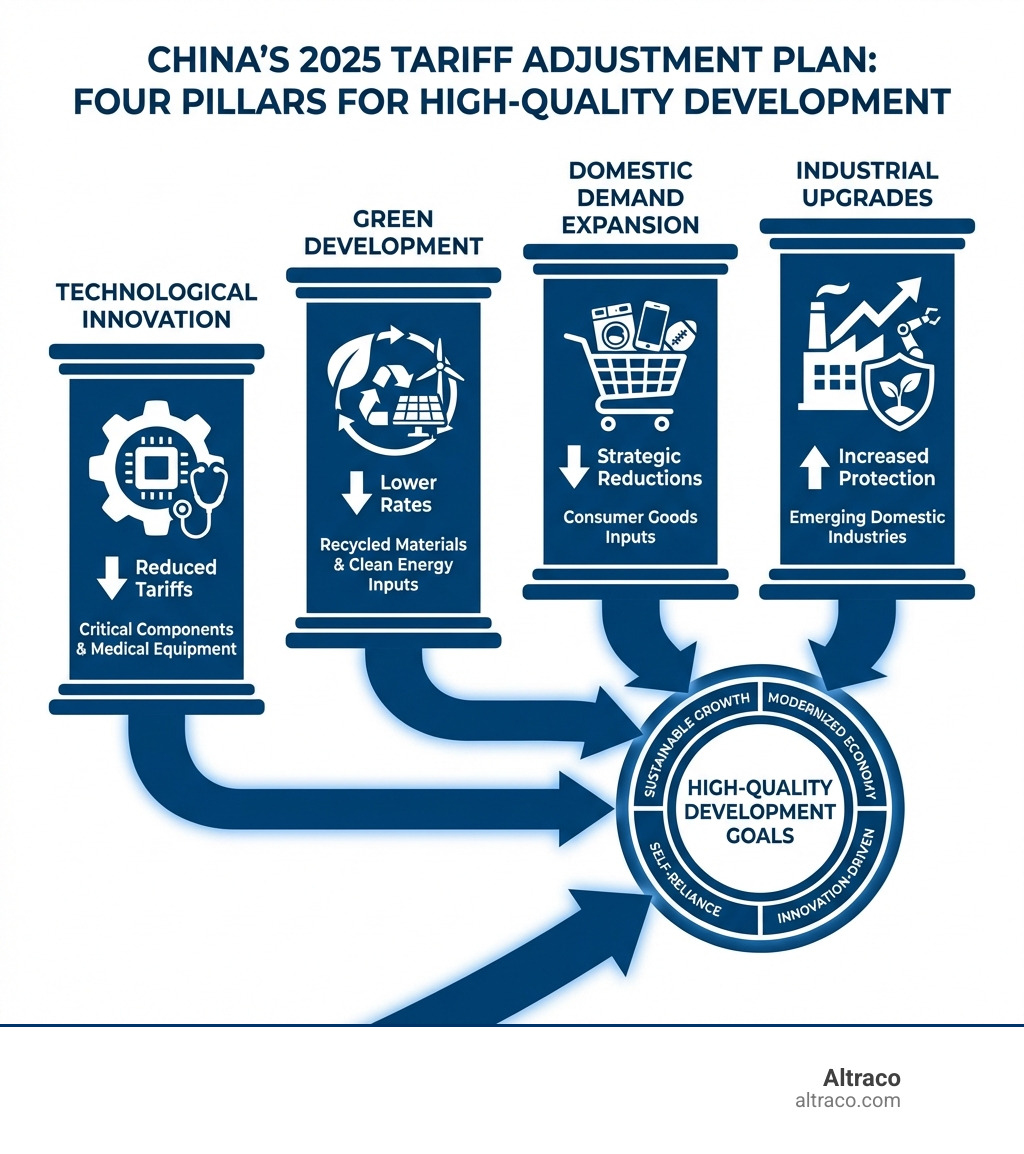
These adjustments serve several key purposes: supporting technological innovation and industrial upgrades, advancing green and low-carbon development initiatives, ensuring accessibility and affordability of medical and healthcare materials, and protecting burgeoning domestic industries. It’s a delicate balancing act, aiming to foster growth in strategic areas while safeguarding national interests.
More info about our global production strategy.
Tariff Reductions: Fueling Innovation and Key Sectors
Good news for many! A significant portion of the 2025 tariff adjustments involves reductions, especially for critical components and materials vital for technological innovation and industrial upgrades. This is a clear signal from China that it wants to attract high-tech inputs and support advanced manufacturing.
For our clients in automotive parts, for instance, lower tariffs are expected on items like automatic transmissions for special-purpose vehicles. This can directly translate into cost savings for manufacturers incorporating these advanced components into their products. Similarly, polyolefin polymers, used in electronics for component protection, are also slated for tariff reductions. These are often found in outdoor products or home improvement items requiring durable, weather-resistant plastics.
China’s commitment to green and low-carbon development will be evident through reduced tariffs on products like ethane and recycled copper and aluminum materials. For manufacturers of sporting goods or home improvement products that use these sustainable inputs, this is a win-win, aligning with global environmental goals and potentially lowering production costs.
Healthcare is another area of focus, with reduced tariffs on medical supplies and critical equipment. This includes viral vectors for CAR-T cancer therapies and sodium zirconium cyclosilicate. While not directly in our manufacturing focus, this highlights China’s broader strategy to improve public well-being and access to advanced treatments.
More info about electronics contract manufacturing.
Tariff Increases: Shielding Domestic Production
On the flip side, some product categories will face tariff increases. These adjustments are typically made to protect nascent domestic industries, balance supply and demand within China, or discourage the import of goods that China aims to produce domestically. It’s China saying, “We’ve got this, or we’re getting there.”
For instance, import tariffs will be raised on certain commodities like vinyl chloride and battery separators. For manufacturers of outdoor products or automotive parts that rely on these materials, particularly in the growing electric vehicle (EV) sector where battery components are key, this could mean higher input costs. Spodumene, a critical lithium ore, is another example of a material seeing tariff adjustments, reflecting China’s strategic interest in securing its supply chain for new energy technologies.
These increases reflect China’s dynamic approach to managing its industrial landscape, carefully nurturing its own production capabilities while selectively opening its markets.
Navigating the China Customs Tariff 2025: A Guide for Businesses
The complexities of the china customs tariff 2025 can feel like trying to solve a Rubik’s Cube blindfolded. However, with the right approach and expert guidance, it’s entirely manageable. For businesses importing into or exporting from China, particularly those in California or operating globally, understanding HS code compliance, GACC registration, and strategic cost management is paramount. Navigating this landscape effectively can mean the difference between thriving and merely surviving.
At Altraco, we understand these challenges intimately. Our expertise isn’t just in finding the right factories; it’s in ensuring your goods move smoothly and cost-effectively across borders, from Thousand Oaks to Shanghai. We help our clients diversify their supply chains, reduce risks, and optimize costs, whether through contract manufacturing in Mexico, Vietnam, or China.
More info about navigating tariffs.
Mastering HS Codes and Customs Compliance
The Harmonized System (HS) code is the universal language of trade, but China speaks a particularly detailed dialect. Their 13-digit HS code system is critical for accurate tariff assessment. The first 8 digits align with international standards, but digits 9-10 are for customs supervision, and 11-13 are for inspection and quarantine. Getting this wrong isn’t just a minor inconvenience; misclassification can lead to failed customs clearance, lengthy delays, increased storage costs, substantial fines, and even administrative or criminal charges. Imagine your shipment of automotive parts stuck in port because of a digit error – a costly headache we help you avoid.
Beyond HS codes, compliance with regulations like GACC Decree 248 is essential. Since January 1, 2022, all overseas food manufacturers, exporters, and Chinese importers need to register with the GACC. While our focus is not on food, this regulation highlights the increasing stringency of Chinese customs, requiring meticulous documentation and pre-market approvals for various goods. For any product, ensuring compliance with Chinese GB standards and other regulatory requirements is non-negotiable. We guide our clients through these intricate processes, ensuring every ‘i’ is dotted and ‘t’ is crossed.
More info about our trade compliance consulting guide.
Leveraging FTAs and Preferential Policies in the china customs tariff 2025
One of the smartest ways to mitigate tariff impacts is by leveraging China’s extensive network of Free Trade Agreements (FTAs). China currently has 24 FTAs and preferential trade arrangements in force, covering 3 countries or regions. These agreements allow for conventional tariff rates, which are often significantly lower than MFN rates.
A notable example is the China-Maldives FTA, which is set to come into effect on January 1, 2025. This agreement will see nearly 96% of tariff items between the two parties achieving zero tariffs after final reductions. While the Maldives might not be a primary sourcing destination for our clients, this illustrates the powerful cost-saving potential of FTAs.
Furthermore, China continues to offer zero-tariff treatment to 43 least-developed countries that have established diplomatic relations and completed the necessary documentation. For businesses, exploring the origin of their components and finished products can open up significant tariff advantages if they qualify under these agreements. This is where our expertise in global sourcing and contract manufacturing really shines. We help you explore manufacturing options in countries like Vietnam manufacturing and Mexico manufacturing, which often have their own beneficial trade agreements, allowing for strategic diversification of your supply chain to reduce tariff exposure and boost profitability.
The US-China Trade Dynamic: A Volatile Landscape
The relationship between the US and China, particularly concerning trade, has been a rollercoaster, and the outlook for 2025 remains uncertain. The landscape is characterized by a mix of escalating tensions, retaliatory measures, and intermittent attempts at rapprochement. For businesses in California, importing or exporting goods related to home improvement, sporting goods, automotive parts, or outdoor products, this volatility creates a complex and often unpredictable environment.
This dynamic is shaped by various legal authorities and policy tools, including the US’s Section 301 tariffs, which remain in effect for a wide range of Chinese imports (rates typically between 7.5% and 25%), and the International Emergency Economic Powers Act (IEEPA), which grants the President broad authority to regulate international commerce in response to national emergencies. Navigating these layers of tariffs and counter-tariffs requires constant vigilance and expert advice.
More info about navigating Section 301 tariffs.
A Tale of Two Policies: Retaliation vs. Rapprochement in the china customs tariff 2025
The US-China trade relationship is a prime example of how quickly policies can shift between retaliation and rapprochement. In the past, we have seen the US impose significant Section 301 tariffs on Chinese goods, prompting swift retaliatory tariffs from China on a wide range of US products. These escalations were often followed by periods of intense negotiation, leading to temporary truces, tariff suspensions, or phased agreements.
This “tit-for-tat” cycle demonstrates the highly fluid nature of US-China trade policy. Agreements can be reached, only to be threatened by new disputes, and tariff rates can change with little warning. For example, a sudden increase in retaliatory tariffs could make US goods virtually unmarketable in China, while an unexpected tariff suspension could create a brief window of opportunity.
These fluctuations have direct implications for businesses dealing with automotive parts, outdoor products, or home improvement goods. The constant uncertainty underscores the need for agile supply chain strategies and the ability to pivot quickly to alternative sourcing locations or manufacturing partners. We’ve helped many clients re-evaluate their sourcing strategies, leveraging our contract manufacturing capabilities in regions less affected by these specific bilateral tensions, such as Mexico and Vietnam.
Frequently Asked Questions about China’s 2025 Tariffs
What is the primary objective of China’s 2025 tariff adjustments?
The main goals are to foster high-quality development, support technological innovation, advance green initiatives, and expand domestic demand by strategically lowering duties on key inputs and technologies while protecting certain domestic industries. China aims to improve the synergy between its domestic and international markets, using tariffs as a tool to shape its industrial structure and economic future. For instance, reduced tariffs on recycled materials support green development, while lower duties on advanced components facilitate technological upgrades in sectors relevant to automotive parts and outdoor products.
How do I find the correct tariff rate for my product?
Finding the correct tariff rate requires accurate Harmonized System (HS) code classification. China uses a detailed 13-digit HS code system, which can be tricky. Small differences in product descriptions or materials can lead to a different HS code and, consequently, a different tariff rate. Due to the complexity of the Chinese system and frequent updates, it is crucial to use official databases and consult with trade compliance experts to avoid costly errors, delays, and potential penalties. Don’t just rely on your supplier’s word; verify. We at Altraco have experience in this area, helping our clients steer these complexities with confidence. More info about our trade compliance services.
Are US-China tariffs going up or down in 2025?
The situation is fluid and contradictory, making it difficult to give a simple “up” or “down” answer. The US-China trade relationship is characterized by ongoing negotiations and the potential for sudden policy shifts. While the US Section 301 tariffs on many Chinese goods remain in place, and China has its own retaliatory tariffs, the exact rates and product lists could change in 2025 based on political and economic developments. We have seen cycles of escalation followed by temporary truces in the past. This creates an unpredictable environment for businesses, where the specific product, its origin, and the timing of the shipment can all dramatically affect the applicable tariff rate. For businesses in California importing from or exporting to China, this requires constant monitoring and agile strategy adjustments.
Conclusion: Building a Resilient Supply Chain in 2025
The china customs tariff 2025 landscape presents both opportunities and challenges for businesses engaged in global trade. From strategic tariff reductions aimed at fostering innovation and green development to targeted increases designed to protect domestic industries, and the ever-present volatility of US-China trade relations, the complexity is undeniable. Navigating this environment effectively is not just about understanding the numbers; it’s about building a resilient, adaptable supply chain.
For companies manufacturing home improvement, sporting goods, automotive parts, or outdoor products, the key to success lies in strategic sourcing, meticulous tariff navigation, and proactive risk management. This often means looking beyond a single manufacturing hub. The ongoing trade tensions between the US and China, with their cycles of retaliation and temporary truces, highlight the critical need for supply chain diversification. Relying solely on one region, especially one subject to such frequent policy shifts, can expose your business to significant and unpredictable costs.
As a leader in offshore manufacturing, Altraco helps businesses steer the complexities of global trade, leveraging deep expertise in tariff mitigation and diversified production. With our base in California, we understand the specific needs of US businesses. We’ve spent decades building trusted factory relationships and honing our tariff navigation expertise to deliver quality, on-time products with significant cost savings. Whether it’s exploring contract manufacturing opportunities in Mexico or Vietnam to mitigate China-specific tariffs, or optimizing your current production in China, we provide the insights and support you need to ensure your products remain competitive.
Don’t let the complexities of global tariffs disrupt your business. Partner with experts who can help you build a resilient and cost-effective supply chain for 2025 and beyond.
Contact us to learn more about tariffs on China.

Al is an entrepreneur, founder, and owner of multiple businesses, including Altraco, an outsourcing and contract manufacturing company. Working across multiple continents and trusted by Fortune 500 companies, Al finds innovative solutions to traditional supply chain challenges. He is a member of Vistage Worldwide.