Why Global Trade Compliance is Your Business’s North Star
Trade compliance consulting helps businesses steer the complex web of international regulations governing import and export activities. These consulting services include:
- Regulatory guidance on ITAR, EAR, OFAC sanctions, and customs regulations
- Risk assessments to identify compliance gaps and potential violations
- Program development to establish policies, procedures, and internal controls
- Employee training on classification, licensing, and documentation requirements
- Audit support for government investigations and voluntary disclosures
- Technology implementation for automated classification and risk monitoring
Does your company rely on international trade to keep your supply chain running? If so, you already know that global trade compliance is complex and constantly changing. The global trade compliance market was valued at USD 12.5 billion in 2022 and is projected to reach USD 25.8 billion by 2030, growing at a CAGR of 9.5%. This explosive growth reflects a simple reality: the cost of getting it wrong is too high to ignore.
The consequences of non-compliance aren’t just theoretical. Companies face shipment delays, liquidated damages, costly penalties, loss of exporting privileges, and even prison time for criminal violations. A seized shipment or a “friendly” phone call from government agents can signal serious compliance issues that demand immediate attention.
For manufacturers of home improvement products, sporting goods, automotive parts, and outdoor products, these challenges are even more complex. Managing global supply chains across countries like Mexico, China, and Vietnam requires navigating multiple regulatory frameworks simultaneously. U.S. Customs and Border Protection (CBP), the Bureau of Industry and Security (BIS), the Directorate of Defense Trade Controls (DDTC), and the Office of Foreign Assets Control (OFAC) all scrutinize different aspects of your international transactions.
I’m Albert Brenner, co-owner of Altraco, a contract manufacturing company with over 40 years of experience helping Fortune 500 companies steer trade compliance consulting challenges while sourcing products internationally. Through decades of managing complex import/export operations, I’ve seen how proper compliance guidance transforms supply chain reliability and protects bottom-line profitability.
What is Trade Compliance Consulting? A Deep Dive into Services and Regulations
At its heart, trade compliance consulting is about ensuring that your business adheres to all applicable laws and regulations when moving goods across international borders. Think of it as having a seasoned navigator on your team, expertly steering your ship through the often-turbulent waters of global commerce. Without this guidance, your business could run aground on regulatory reefs, facing severe consequences.
The regulatory landscape is a dense jungle, particularly for businesses operating in the United States and sourcing from global partners. Key agencies like U.S. Customs and Border Protection (CBP) oversee imports, ensuring duties are paid and goods meet entry requirements. The Bureau of Industry and Security (BIS) handles export controls for dual-use items (commercial goods with potential military applications), while the Directorate of Defense Trade Controls (DDTC) governs the export of defense articles and services under ITAR. And let’s not forget the Office of Foreign Assets Control (OFAC), which administers and enforces economic and trade sanctions programs. Each has its own set of rules, and ignorance is, unfortunately, no defense.

Key Regulatory Frameworks You Must Know
Navigating international trade means becoming familiar with a specific alphabet soup of regulations. For any business involved in manufacturing home improvement, sporting goods, automotive parts, or outdoor products, understanding these frameworks is non-negotiable:
- Export Controls (ITAR & EAR): These are critical for anyone exporting from the U.S. The International Traffic in Arms Regulations (ITAR) control defense-related articles and services (items on the U.S. Munitions List, or USML). The Export Administration Regulations (EAR) cover most commercial items, including those with dual-use potential, and assign them an Export Control Classification Number (ECCN). Misclassifying an item can lead to significant penalties. We often encounter businesses that are unsure if their product falls under ITAR or EAR jurisdiction, a critical first step for compliance.
- Sanctions Programs: OFAC, under the U.S. Department of the Treasury, implements economic sanctions against targeted foreign countries, regimes, terrorists, international narcotics traffickers, those engaged in activities related to the proliferation of weapons of mass destruction, and other threats to the national security, foreign policy, or economy of the United States. This means careful screening of all parties involved in a transaction.
- Customs Regulations: These are the rules governing the import of goods into the U.S., enforced by CBP. They dictate everything from documentation requirements to duty payments and proper valuation.
- Harmonized Tariff Schedule (HTS): This is the classification system used to determine the duty rates for imported goods. Correct HTS classification is vital for accurate duty payments and avoiding costly errors.
- Country of Origin Determination: Accurately identifying where your product originates is crucial for tariffs, trade agreements, and labeling requirements.
- Trade Agreements: Understanding and leveraging Free Trade Agreements (FTAs) can significantly reduce or eliminate duties, but requires meticulous documentation and adherence to rules of origin.
For a deeper dive into how tariffs specifically impact manufacturers, we recommend our [Manufacturers Guide to Navigating US Tariffs](https://altraco.com/manufacturers-guide-united-states-tariffs/).
Core Services Offered by Consultants
Trade compliance consulting firms offer a spectrum of services designed to help businesses manage their international trade activities effectively and compliantly:
- Compliance Program Development: This is about building a robust, demonstrable system for handling imports and exports. It involves creating policies, procedures, and internal controls custom to your business operations. A compliance program should never be a static document; it requires regular review and updates to remain effective.
- Risk Assessments & Audits: Consultants conduct thorough reviews of your current processes to identify potential gaps or areas of non-compliance. These can be proactive, aimed at preventing issues, or reactive, in response to a government inquiry. They help uncover opportunities for duty savings and increased efficiencies.
- Employee Training: Even the best policies are useless if your team doesn’t understand them. Consultants provide customized training programs covering classification, licensing, documentation, and specific regulatory requirements.
- License Applications: For controlled items, obtaining the correct export or import licenses can be a complex process. Consultants assist with drafting and submitting these applications accurately and efficiently.
- Voluntary Disclosures: If you find a compliance violation, a voluntary disclosure to the relevant government agency can often mitigate penalties. Consultants help investigate the root cause and prepare these sensitive submissions.
- Commodity Classification: Determining the correct HTS code for imports or ECCN/USML category for exports is fundamental. Consultants provide expert classification services to ensure accuracy.
We believe in providing practical, sustainable solutions that not only mitigate risks but also improve business efficiencies. For more insights into how international cooperation fosters smoother trade, consider reviewing resources from [More on trade facilitation from APEC](https://www.apec.org/).
The High Stakes of Global Trade: Mitigating Risks and Opening up Benefits
The statistics speak for themselves: a significant portion of businesses are not fully compliant with trade regulations, highlighting a widespread vulnerability. The cost of noncompliance isn’t just a slap on the wrist; it can be catastrophic for businesses, especially those engaged in offshore manufacturing for home improvement, sporting goods, automotive parts, and outdoor products.
Imagine this scenario: you’ve got a crucial shipment of automotive parts from Mexico, destined for a major assembly line in California. Suddenly, it’s flagged by CBP. What happens next?

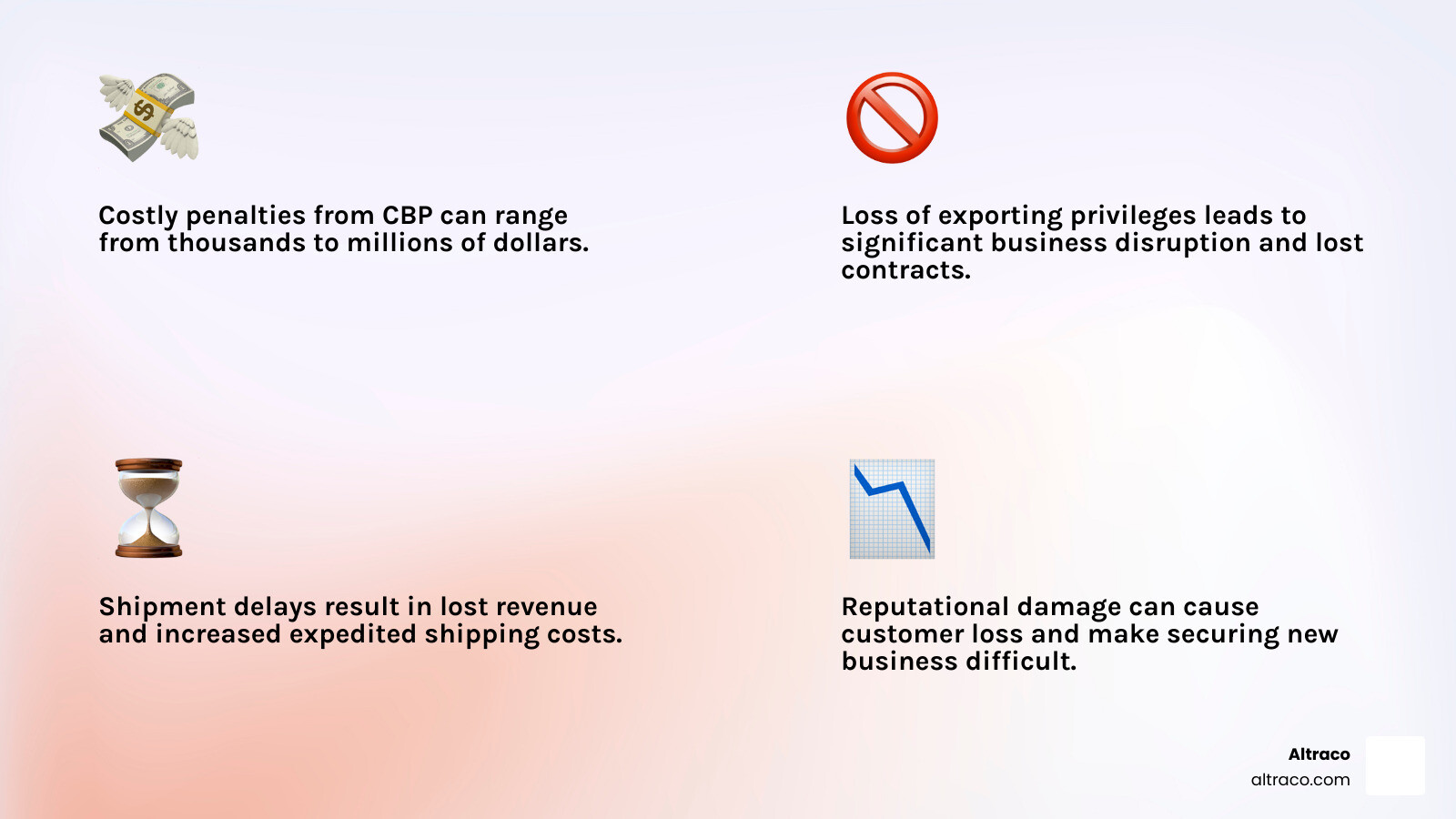
- Shipment Delays: Your goods are held up, causing production stoppages, missed deadlines, and potentially idle labor. This isn’t just an inconvenience; it’s a direct hit to your bottom line and reputation.
- Liquidated Damages: If those delays impact your delivery commitments, you could face contractual penalties from your customers.
- Costly Penalties: Government agencies can impose fines that range from thousands to millions of dollars, depending on the severity and frequency of the violation. These penalties can cripple a business.
- Loss of Exporting Privileges: For severe or repeated violations, your company could lose the ability to export or import, effectively shutting down your international operations.
- Reputational Damage: News of compliance failures spreads quickly, eroding trust with customers, suppliers, and investors. This can be harder to recover from than financial losses.
- Criminal Penalties: In cases of willful violations, individuals can face prison time.
These are not hypothetical risks. The complexity of international trade regulations, including ITAR and EAR, requires specialized knowledge that many companies simply lack in-house, driving the demand for external consultants.
Red Flags: Signs You Need Trade Compliance Consulting
How do you know if your business might be at risk? Here are some clear signs that it’s time to consider engaging trade compliance consulting services:
- You’re unsure about regulations (ITAR/EAR): If you’ve never heard of these, or aren’t certain if they apply to your products, you’re operating with a significant blind spot. Ignorance is definitely not bliss when it comes to export controls.
- Shipments seized by Customs: This is a major flashing red light. A seized shipment means something went wrong, and it’s a direct indicator that your compliance processes need urgent attention.
- Lack of in-house expertise: Has your sole compliance person recently left? Or perhaps your team relies heavily on freight forwarders for compliance decisions? While freight forwarders are invaluable for logistics, they are not your compliance officers. We’ve seen companies receive “friendly” phone calls from government agents, a clear sign that regulators are looking closely at their activities.
- Expanding to new international markets: Every new country brings a new set of regulations, duties, and cultural nuances. What works for manufacturing in China might not work for Mexico or Vietnam.
- Facing a government audit or inquiry: If CBP, BIS, or any other agency is asking questions, it’s past time to get expert help.
- Reliance solely on freight forwarders for compliance: This is a common misconception. Freight forwarders facilitate the movement of goods, but the ultimate responsibility for compliance rests with the importer/exporter.
The Strategic Advantages of a Robust Compliance Program
While avoiding penalties is a huge motivator, a strong compliance program offers much more than just risk mitigation. It’s a strategic asset that can provide significant competitive advantages:
- Risk Mitigation: This is the obvious one, preventing the costly fines, delays, and legal messs we discussed.
- Cost Savings: Expert classification, duty optimization, and leveraging free trade agreements can lead to substantial reductions in landed costs for your products. We help businesses proactively identify opportunities to lower duties and other costs.
- Duty Optimization: Through strategies like duty drawback, first sale for export, and proper valuation, consultants can help you legally minimize your duty payments.
- Supply Chain Efficiency: A well-structured compliance program streamlines your import and export processes, leading to faster customs clearance, fewer delays, and a more predictable supply chain for your contract manufactured goods.
- Improved Market Access: By demonstrating adherence to international standards, your business gains credibility and can more easily expand into new markets.
- Building a Culture of Compliance: Beyond policies, consultants help foster an organizational mindset where ethical behavior and compliance are embedded, safeguarding your long-term success.
For comprehensive insights into how to steer duties and tariffs strategically, our [Tariff Guide for Business](https://altraco.com/tariff-guide-for-business/) offers invaluable information.
Choosing Your Partner: How to Select the Right Expertise
When the stakes are this high, selecting the right trade compliance consulting partner is paramount. This isn’t a decision to be taken lightly; it requires careful evaluation, due diligence, and asking the right questions to ensure a good fit for your business. We know not all consultants are the same. We focus on delivering practical, sustainable solutions and business efficiencies alongside risk mitigation.
You need a partner that understands your unique challenges, whether you’re dealing with automotive parts, sporting goods, home improvement items, or outdoor products. They should be able to scale their services to meet your evolving needs, from a one-off audit to comprehensive program management.
What to Look for in a Trade Compliance Consulting Firm
Here’s what we believe makes a truly effective trade compliance consulting partner, especially for businesses with global manufacturing operations:
- Industry Expertise: Look for firms with proven experience in your specific industry. If you manufacture automotive parts, you need consultants who understand the nuances of automotive supply chains and regulations. The same applies to sporting goods, home improvement, or outdoor products. Their expertise should translate into practical solutions for your unique operational environment.
- Experience with Specific Regulations: They should have deep knowledge of the specific U.S. regulations that impact you (ITAR, EAR, OFAC, CBP) and understand how these interact with the regulations in key manufacturing regions like Mexico, China, and Vietnam.
- Global Network: A consultant with a global reach can provide invaluable insights into local customs, laws, and best practices in your manufacturing countries, ensuring seamless operations from origin to destination.
- Proven Track Record: Look for a history of successful outcomes, from mitigating penalties to achieving duty savings and improving supply chain efficiency. Testimonials and case studies can offer good indicators.
- Technology Utilization: Modern trade compliance consulting increasingly leverages technology. Look for partners who use or advise on solutions that incorporate AI, machine learning, and data analytics to streamline classification, monitor sanctions, and provide real-time visibility into your compliance posture.
- A Consultative, Not Just Advisory, Approach: The best consultants don’t just tell you what to do; they help you implement it and educate your team to manage compliance independently. They should act as an extension of your team, not just a detached advisor.
Beyond Consulting: The Value of an Integrated Manufacturing Partner
For businesses already engaged in offshore manufacturing, the ideal solution often goes beyond mere consulting. It involves an integrated manufacturing partner like Altraco, who embeds trade compliance consulting directly into their service offering. We don’t just advise; we execute.
- Integrating Compliance into Sourcing: From the very beginning, when we help you identify and qualify factories in Mexico, China, or Vietnam, we integrate compliance considerations. This includes assessing supplier compliance with human rights and environmental mandates, ensuring they meet quality standards, and understanding their capabilities in providing necessary documentation for country of origin or free trade agreements.
[Contract Manufacturing Services](https://altraco.com/contract-manufacturing-services/): As your contract manufacturing partner, we manage the entire production process, including the intricate details of international trade. This means we take on the burden of navigating complex free trade agreements, ensuring accurate classification, and managing customs processes on your behalf.- Sourcing from Alternative Countries: Geopolitical shifts and tariffs can rapidly alter the cost-effectiveness of a manufacturing location. We help you explore and qualify alternative countries, like Mexico or Vietnam, to mitigate risks and optimize costs, always with compliance at the forefront.
[Why Mexico Manufacturing Is Changing Global Supply Chains](https://altraco.com/why-mexico-manufacturing-is-changing-global-supply-chains/)offers a compelling perspective on this. - Ensuring Supplier Compliance: We work directly with our trusted factory relationships to ensure they adhere to all relevant trade regulations, from product labeling to ethical labor practices, protecting your brand and supply chain.
The Evolving Landscape: Future Trends and Challenges in Trade
The world of international trade is anything but static. Geopolitical shifts, technological advancements, and a heightened focus on ethical supply chains are constantly reshaping the trade compliance consulting landscape. Staying ahead of these changes is crucial for businesses with global operations.
We’re seeing increased enforcement across the board, with regulatory agencies becoming more sophisticated in their ability to detect non-compliance. Supply chain security programs like CTPAT (Customs-Trade Partnership Against Terrorism) are more important than ever, encouraging businesses to implement robust security measures throughout their international supply chains. Furthermore, ESG (Environmental, Social, and Governance) requirements and stringent forced labor regulations are adding new layers of due diligence that extend deep into your manufacturing partners’ operations.
The Role of Technology in Modern Compliance
Technology isn’t just a buzzword; it’s becoming the backbone of effective trade compliance. For trade compliance consulting, this means leveraging cutting-edge tools to manage complexity:
- AI and Machine Learning: These technologies are revolutionizing export control classifications, streamlining and automating processes that were once manual and prone to human error. This leads to improved accuracy, consistency, and quality in classification.
- Data Analytics for Risk Profiling: By analyzing vast amounts of trade data, businesses can gain full insight into their global customs profile. This allows for the identification of compliance weaknesses, cost-saving opportunities, and informed decision-making.
- Automation of Classification: Tools that automate HTS and ECCN classification reduce manual effort, speed up processes, and ensure consistency across diverse product lines, which is especially beneficial for manufacturers of varied home improvement, sporting goods, automotive parts, and outdoor products.
- Real-time Monitoring: Advanced systems provide real-time alerts for sanctions list updates, regulatory changes, and shipment statuses, allowing businesses to react quickly to potential issues.
- Improved Visibility: Digital platforms offer end-to-end visibility across the supply chain, from factory floor to final destination, making it easier to track compliance and identify bottlenecks.
Navigating Current Challenges: Tariffs, Sanctions, and More
Beyond the foundational regulations, businesses today face immediate and dynamic challenges:
- Punitive Sanctions and Retaliatory Trade Measures: The proliferation of these measures, often driven by geopolitical events, adds immense complexity. They can impact where you can source, who you can trade with, and what items you can move.
- Recent Supreme Court Decisions on Tariffs: The legal landscape around tariffs is constantly evolving. For example, recent U.S. Supreme Court decisions regarding the constitutionality of certain tariffs, or challenges to Section 301 tariffs, can have significant implications for businesses. Staying informed and agile is key.
- Section 301 Tariffs: These tariffs, often imposed on goods from countries like China, have dramatically impacted sourcing strategies. Understanding how to
[Navigate Section 301 Tariffs](https://altraco.com/navigate-section-301-tariffs/)is vital for managing costs and maintaining competitiveness. [Complexities of Tariffs](https://altraco.com/complexities-of-tariffs/): Beyond Section 301, the general complexity of tariff regimes, including various types of duties and exceptions, requires constant vigilance and expert guidance.
Conclusion: Simplify Your Supply Chain with a Trusted Partner
In the intricate world of international trade, trade compliance consulting is not a luxury; it’s a necessity. The global trade landscape is only growing more complex, with increased enforcement, evolving regulations, and dynamic geopolitical pressures. For businesses involved in offshore manufacturing for home improvement, sporting goods, automotive parts, or outdoor products, a proactive approach to compliance is the only way to safeguard your operations and ensure long-term success.
The value of expert guidance cannot be overstated. It transforms compliance from a daunting burden into a strategic advantage, allowing you to mitigate risks, optimize costs, and streamline your supply chain.
At Altraco, we understand these challenges deeply. As your offshore contract and private label manufacturing partner, we simplify your global supply chain by managing these complexities for you. We integrate compliance into every step of our process, from factory selection in Mexico, China, or Vietnam to final delivery. Our decades of experience, trusted factory relationships, and tariff navigation expertise ensure your products are delivered on time, on budget, and always in compliance.
Don’t let the complexities of international trade slow you down or expose you to unnecessary risks. Partner with us to turn compliance into your competitive edge.
[Explore our International Sourcing Services to learn more](https://altraco.com/international-sourcing-services/).