The Evolution and Importance of Global Sourcing Manufacturing
Global sourcing manufacturing is the strategic practice of procuring goods, materials, components, or services from suppliers located across international borders to optimize cost, quality, innovation, and supply chain resilience. In today’s volatile business environment, it’s no longer just about finding the lowest price—it’s about building a diversified, agile supply network that can withstand disruptions while maintaining competitive advantage.
Key Components of Global Sourcing Manufacturing:
- Strategic procurement from international suppliers in countries like China, Mexico, Vietnam, and India
- Total landed cost analysis including shipping, tariffs, customs, insurance, and handling fees
- Risk diversification across multiple geographic regions and supplier networks
- Access to specialized capabilities not available domestically
- Compliance management with international trade regulations and quality standards
- Long-term supplier relationships built on transparency and mutual benefit
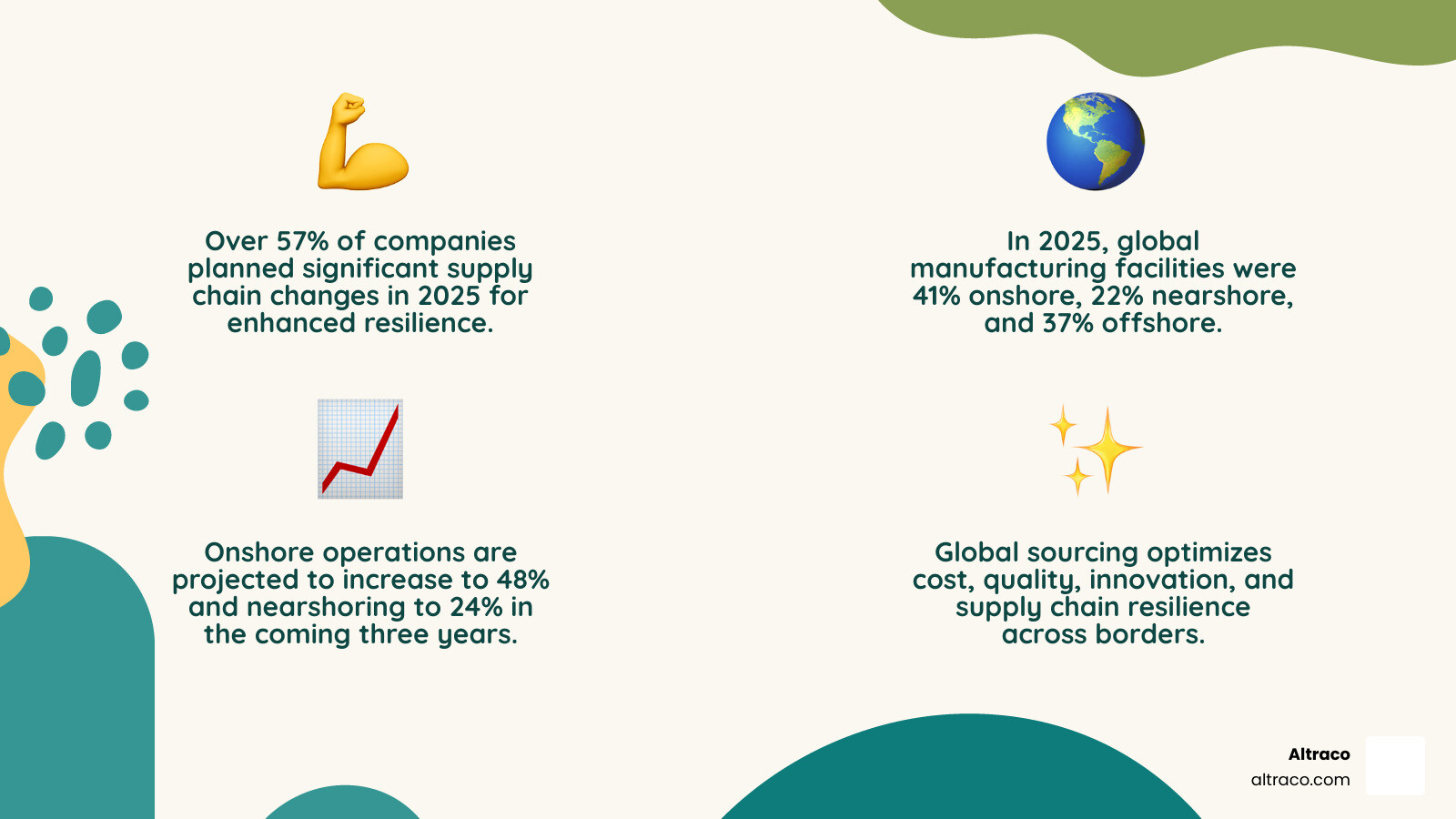
The landscape of global manufacturing has fundamentally changed. In 2025, 41% of manufacturing facilities are onshore, 22% nearshore, and 37% offshore, with projections showing onshore operations rising to 48% over the next three years. More than 57% of companies planned significant supply chain changes in 2025, driven by trade tensions, tariff volatility, and the need for greater resilience. The old model of simply chasing the lowest labor cost has given way to a more sophisticated approach that balances cost efficiency with supply chain stability, speed to market, and sustainability.
Recent disruptions—from the pandemic to geopolitical conflicts to evolving trade policies—have exposed the vulnerabilities of overly centralized supply chains. Manufacturers now face a critical question: How do we build a global sourcing strategy that delivers cost savings while protecting against future disruptions? The answer lies in strategic diversification, deep supplier partnerships, and leveraging the right expertise to steer complex international trade environments.
This shift is particularly urgent for companies in home improvement, sporting goods, automotive parts, and outdoor products—industries where quality, reliability, and cost-effectiveness directly impact competitive positioning. The US Supreme Court’s recent decisions on tariffs, combined with ongoing trade policy changes, have made it essential for Fortune 500 companies and large enterprises to rethink their sourcing strategies with expert guidance.
As Albert Brenner, co-owner of a contract manufacturing company with over 40 years of experience in global sourcing manufacturing, I’ve helped Fortune 500 companies steer these complexities across home improvement, sporting goods, automotive, and outdoor products. My firm has built proven factory relationships in multiple countries and developed deep expertise in managing challenges like tariffs, quality control, and on-time delivery to simplify your sourcing process.
The Strategic Shift in Global Sourcing Manufacturing
The world of manufacturing has undergone a seismic shift. For decades, the mantra was simple: find the cheapest labor, produce at scale, and ship globally. This cost-centric model drove incredible efficiencies, but recent years have revealed its fragility. Geopolitical tensions, trade wars, and pandemics have repeatedly disrupted supply chains, forcing businesses to rethink their strategies.
Today, the focus has broadened from cost to include resilience, agility, and sustainability. Companies are no longer just looking at the unit price; they’re assessing the total landed cost, the risk of disruption, and the ability to pivot quickly. A global survey revealed that 57% of companies planned significant changes to their supply chains in 2025, with many starting complete overhauls. This isn’t a minor adjustment; it’s a fundamental restructuring of how businesses operate, requiring agility to adapt to new challenges and opportunities.

Defining Key Sourcing Concepts
To master global sourcing manufacturing, it’s crucial to understand the terminology. These terms are often used interchangeably but represent distinct strategies:
- Global Sourcing vs. Traditional Sourcing: Traditional sourcing is domestic, while global sourcing expands the search for suppliers across international borders to optimize cost, quality, and innovation.
- Offshoring vs. Outsourcing: Offshoring means relocating a business operation to another country for cost benefits. Outsourcing means delegating a business process (like manufacturing) to a third-party provider, regardless of location. “Outsourced manufacturing” often combines both, which is where our contract manufacturing services provide value.
- Global Procurement: This is the transactional part of global sourcing, focusing on the purchasing of goods from international suppliers, whereas sourcing is the broader strategic process of managing the global supply base.
Effective global sourcing manufacturing relies on strategic partnerships and a deep understanding of these distinctions. For a deeper dive, explore our guide on Understanding Manufacturing Terminology in the Global Supply Chain.
The Modern Imperative: Why Global Sourcing Matters Now
In today’s hyper-competitive economy, global sourcing manufacturing is a strategic imperative for sectors like home improvement, sporting goods, automotive parts, and outdoor products. Key drivers include:
- Cost Reduction: Sourcing globally allows companies to procure parts and materials at lower prices, significantly impacting the bottom line, especially for high-volume production.
- Access to Innovation: Tapping into a worldwide network of suppliers provides access to cutting-edge technologies and specialized capabilities not available domestically, improving product features and performance.
- Supplier Diversification: Relying on a single source is risky. Diversifying the supplier base across multiple countries mitigates risks from geopolitical tensions or natural disasters. More than 9 in 10 US executives stressed the importance of diversifying supply chains as a top business continuity strategy.
- Competitive Advantage: By reducing costs and accessing innovation, our clients can offer better products at more competitive prices, which can also pave the way for future market expansion.
While the complexity is real, the benefits are substantial when executed with expert guidance. Dive deeper into this balancing act with our article on Supply Chain Globalization: Is It Worth the Risk?.
Benefits vs. Risks: A Balanced View of Global Sourcing
A global sourcing manufacturing journey offers immense opportunities but demands careful navigation. A successful strategy hinges on a thorough risk-reward analysis and a holistic understanding of the “total landed cost”—which includes shipping, tariffs, customs, insurance, and currency fluctuations. Ignoring these can turn a cheap deal into an expensive headache. A clear view of supply chain vulnerability, intellectual property concerns, and geopolitical factors is essential.
Maximizing the Advantages of a Global Strategy
When executed strategically, global sourcing manufacturing offers compelling advantages for home improvement, sporting goods, automotive parts, and outdoor products:
- Lower Labor Costs: Strategically selecting manufacturing locations with lower production costs can yield substantial savings, especially for clients sourcing from regions like Mexico.
- Specialized Manufacturing Capabilities: Global sourcing opens doors to unique expertise, from precision machining for automotive parts to advanced material composites for outdoor products that may be unavailable domestically.
- Access to Raw Materials: Sourcing globally allows access to regions rich in specific resources, ensuring a consistent supply and often better pricing.
- Innovation Hubs: Engaging with international suppliers provides access to innovation in material science and technology, leading to a faster New Product Introduction cycle.
- Faster Time-to-Market: Accessing specialized facilities abroad can accelerate product development, a key component of a robust Global Production Strategy.
Navigating the Potential Drawbacks and Risks
Despite the benefits, global sourcing manufacturing comes with challenges that demand expert management:
- Supply Chain Disruptions: Geopolitical tensions, natural disasters, and other unforeseen events can cause significant delays and shortages.
- Geopolitical Volatility: Trade wars and political instability directly impact costs and supply. For example, US manufacturers have expressed a pessimistic growth outlook amid global trade tensions.
- Quality Control Challenges: Maintaining consistent quality across international suppliers can be difficult without direct oversight and clear standards.
- Intellectual Property (IP) Theft: Protecting designs and proprietary information is critical and requires robust legal frameworks and due diligence.
- Communication Barriers: Language, time zones, and cultural differences can hinder decision-making and lead to costly errors.
- Hidden Costs: Beyond the unit price, costs like tariffs, inventory holding, and international logistics can erode savings. Understanding the Pros and Cons of Tariffs is vital.
- Logistics Complexity: Managing cross-border movement of goods involves intricate customs and procedures. Without efficient Logistics Management Activities, costs can rise and schedules can be jeopardized.
Our expertise lies in helping you steer these complexities, ensuring a balanced approach that maximizes benefits while proactively mitigating drawbacks.
Building a Resilient Global Sourcing Strategy
In an unpredictable world, a resilient global sourcing manufacturing strategy is paramount. It means designing a supply network that withstands disruptions and adapts quickly to changing market conditions. This requires proactive strategic planning, robust risk mitigation, strong supplier relationships, and cutting-edge technology. Our goal is to provide Integrated Supply Chain Services that empower our clients.
Essential Steps for Your Global Sourcing Manufacturing Plan
A successful plan is a custom strategy. Here are the essential steps we guide clients through for products like home improvement, sporting goods, automotive parts, and outdoor products:
- Align with Business Goals: Clearly define your objectives, whether it’s cost reduction, innovation access, or market expansion. Your sourcing strategy must support your overarching business goals.
- Conduct a Comprehensive Risk Assessment: Evaluate potential geopolitical, economic, and operational risks in target regions to create proactive mitigation strategies.
- Diversify Suppliers: Avoid relying on a single supplier or region. Diversifying your supplier base is a top business continuity strategy, ensuring that if one link breaks, others can compensate.
- Build Strong Supplier Relationships: We foster long-term, collaborative partnerships based on trust and transparency. Strong relationships, tracked with tools like our Supplier Scorecards Complete Guide, facilitate better problem-solving. The Value of Buyer-Supplier Relationships cannot be overstated.
- Leverage Contract Manufacturing Services: As your partner, we handle the complexities of overseas production, from vetting to logistics, as detailed in our Contract Manufacturing Services Complete Guide.
Ensuring Quality and Compliance Across Borders
Maintaining high standards is non-negotiable. Here’s how we ensure excellence in global sourcing manufacturing:
- Rigorous Supplier Qualification: We employ a multi-layered approach including factory audits, certification checks (ISO 9001), and on-site visits.
- Clear Specifications: We work with clients to create detailed product specifications and quality standards to eliminate ambiguity.
- Third-Party Inspections: We arrange independent inspections at various production stages to provide an unbiased assessment of quality. Our expertise in Industrial Quality Control is vital here.
- Regulatory Compliance: We steer complex international labor, environmental, and trade laws to protect clients from legal and reputational risks. Our guide on Proven Tips to Improve Quality in Overseas Manufacturing provides further insight on how we Maintain Quality Control Program.
The Role of Technology in Modern Sourcing
Technology is the backbone of effective global sourcing manufacturing, turning a reactive process into a data-driven one.
- Supply Chain Visibility Platforms: Tools like control towers provide end-to-end visibility to track orders and anticipate disruptions proactively.
- AI and Data Analytics: We use AI for better demand forecasting and data analytics to monitor supplier performance on metrics like on-time delivery and quality. This is key to Acting Decisively as Global Sourcing Shifts.
- ERP Systems: Enterprise Resource Planning (ERP) systems integrate business functions, automate processes, and provide a unified view of operations, which is crucial for managing complex global supply chains.
By leveraging these advancements, we ensure our clients’ operations are efficient, intelligent, and adaptable.
The Evolving Landscape: Tariffs, Trends, and Key Regions
The global manufacturing landscape is a dynamic, ever-shifting terrain. What was true yesterday might not hold true tomorrow. Factors like tariffs, geopolitical shifts, and a growing emphasis on sustainability are fundamentally reshaping how companies approach global sourcing manufacturing.
Navigating Tariffs and Geopolitical Shifts in Global Sourcing Manufacturing
Tariffs have become a significant variable in the global sourcing manufacturing equation. US manufacturers have seen input costs rising in 2025, partly due to tariff increases, and a survey by West Monroe consultancy ranked tariffs far ahead of any other supply chain issue in the first half of 2025. The US-China trade tensions, in particular, have prompted many companies to re-evaluate their sourcing strategies.
While China has historically been a dominant manufacturing hub, tariffs on critical imports have significantly impacted its cost-competitiveness for US imports. For instance, without tariffs, China often holds a slight landed cost advantage. However, with US tariffs in place, sourcing from China can become roughly 21% more expensive for goods imported into the US. This has led to a noticeable shift, with US goods imports from China declining by 10% (inflation-adjusted) from 2018-2022, while imports from Mexico rose 18%, India 44%, and ASEAN countries 65%.
The US Supreme Court’s decisions regarding tariffs, alongside ongoing trade policy changes, create a complex and often unpredictable environment. Navigating these Complexities of Tariffs requires deep expertise. As specialists in tariff navigation, we help our clients understand the implications of Section 301 Tariffs and develop strategies to mitigate their impact. Our China Tariffs Complete Guide and Navigate Section 301 Tariffs are invaluable resources.
Beyond tariffs, geopolitical shifts, such as regional conflicts or changes in government, can introduce substantial risk. This necessitates constant monitoring and a diversified approach to avoid over-reliance on any single region.
Key Manufacturing Hubs for the Modern Era
As companies adapt to these changes, new manufacturing hubs are gaining prominence, offering diverse advantages for global sourcing manufacturing of home improvement, sporting goods, automotive parts, and outdoor products.
- China’s Evolving Role: While diversification is a key trend, China remains an undeniable manufacturing powerhouse. It is transitioning from purely a low-cost manufacturing center to a leader in technological innovation and self-reliance. For certain industries and product types, China still offers unparalleled scale, infrastructure, and specialized capabilities. Our trusted factory relationships in China continue to deliver value for many clients, even as we explore alternatives.
- Mexico’s Growing Importance for Nearshoring: For US-based companies, Mexico has emerged as a crucial nearshoring destination. Its geographical proximity significantly reduces lead times and transportation costs, making it ideal for automotive parts or home improvement products that require just-in-time delivery. Mexico offers competitive costs and a growing skilled labor force, rapidly changing global supply chains. Our Mexico Manufacturing Companies Complete Guide and Why Mexico Manufacturing is Changing Global Supply Chains offer detailed insights.
- Vietnam’s Rise as a Manufacturing Power: Vietnam has steadily gained influence, becoming a popular destination for diversifying production, particularly in light electronics, certain sporting goods, and outdoor product components. Its growing manufacturing sector and favorable trade agreements make it an attractive alternative or complement to China. Our Vietnam Manufacturing Complete Guide provides comprehensive information.
- India’s Potential: India presents a dynamic and rapidly growing market with a vast labor pool and increasing capabilities in sectors like automotive parts. While its logistics infrastructure can be uneven, its cost-competitiveness and new trade deals position it as a significant player for future global sourcing manufacturing.
At Altraco, we don’t just focus on these three; we are capable of establishing relationships in other countries as well, always seeking the optimal balance of cost, quality, and resilience for our clients.
Frequently Asked Questions about Global Sourcing Manufacturing
How do I start with global sourcing for my products?
Starting your global sourcing manufacturing journey involves a structured approach. Begin by defining detailed product specifications and material requirements. Then, conduct thorough supplier research using online platforms, industry exhibitions, and established networks. Issue a Request for Quotation (RFQ) to gather pricing, and then begin the critical vetting process. This includes factory visits, checking certifications, requesting samples, and verifying references, prioritizing quality over the lowest price. We provide comprehensive Offshore Manufacturing and Supply Chain Support to guide you through each step.
Which country is best for manufacturing automotive parts or sporting goods?
There is no single “best” country; the ideal choice depends on your priorities. Key options include:
- China: Unparalleled for scale and a vast supplier ecosystem, but tariffs and geopolitical risks are a consideration.
- Mexico: Offers significant nearshoring benefits for US companies, reducing lead times and transport costs for automotive and home improvement products. Our Cost to Manufacture in Mexico resource provides a detailed analysis.
- Vietnam: A strong contender for diversification, offering competitive labor costs for sporting goods and outdoor products.
- India: An emerging option for automotive parts with a large, skilled workforce.
The decision rests on total landed cost, quality requirements, logistics, and risk appetite. We help clients analyze these factors to make informed choices.
How can I manage quality control with an overseas supplier?
Managing quality is critical for global sourcing manufacturing success. Our multi-layered approach includes:
- Clear Quality Standards: Establish unambiguous specifications and benchmarks in your contracts.
- Regular Communication: Maintain open communication to address issues promptly.
- On-Site and Third-Party Inspections: We facilitate factory visits and independent audits at various production stages to verify quality before shipment.
- Strong Contracts: Ensure contracts include clear clauses on quality, inspection rights, and remedies for non-compliance.
- Building Partnerships: Fostering a collaborative relationship ensures suppliers are invested in your success. Our guide on how to Maintain Quality Control Program outlines these best practices.
Conclusion
The world of global sourcing manufacturing has evolved dramatically, moving beyond a singular focus on cost to accept a more holistic strategy centered on resilience, agility, and strategic partnerships. For companies in home improvement, sporting goods, automotive parts, and outdoor products, understanding and adapting to this shift is not just beneficial—it’s essential for sustained competitive advantage.
We’ve explored how global sourcing manufacturing differs from traditional methods, its imperative role in modern business, and the critical balance between its immense benefits and inherent risks. We’ve also outlined the essential steps for building a resilient strategy, emphasizing quality control, compliance, and the transformative power of technology. The evolving landscape, marked by tariffs and shifting manufacturing hubs, further underscores the need for expert guidance.
At Altraco, we pride ourselves on being more than just a service provider; we are your dedicated offshore contract and private label manufacturing partner. Based in Thousand Oaks, CA, we simplify global supply chains for our clients, from Fortune 500s to large enterprises. With decades of experience, trusted factory relationships in key regions like China, Vietnam, and Mexico, and unparalleled expertise in tariff navigation, we deliver quality, on-time products with significant cost savings. We are also capable of establishing relationships in other countries as needed, always prioritizing your success.
Don’t let the complexities of global trade hinder your growth. Let us help you open up the full potential of global sourcing manufacturing.
Explore our International Sourcing Services

Al is an entrepreneur, founder, and owner of multiple businesses, including Altraco, an outsourcing and contract manufacturing company. Working across multiple continents and trusted by Fortune 500 companies, Al finds innovative solutions to traditional supply chain challenges. He is a member of Vistage Worldwide.