Why Vietnam Manufacturing is Capturing Global Attention
Vietnam manufacturing has become one of the most compelling stories in global supply chains over the past decade. If you’re evaluating where to manufacture products outside the United States, Vietnam now offers a unique combination of competitive costs, skilled labor, and strategic advantages that few other countries can match.
Key reasons companies are choosing Vietnam for manufacturing:
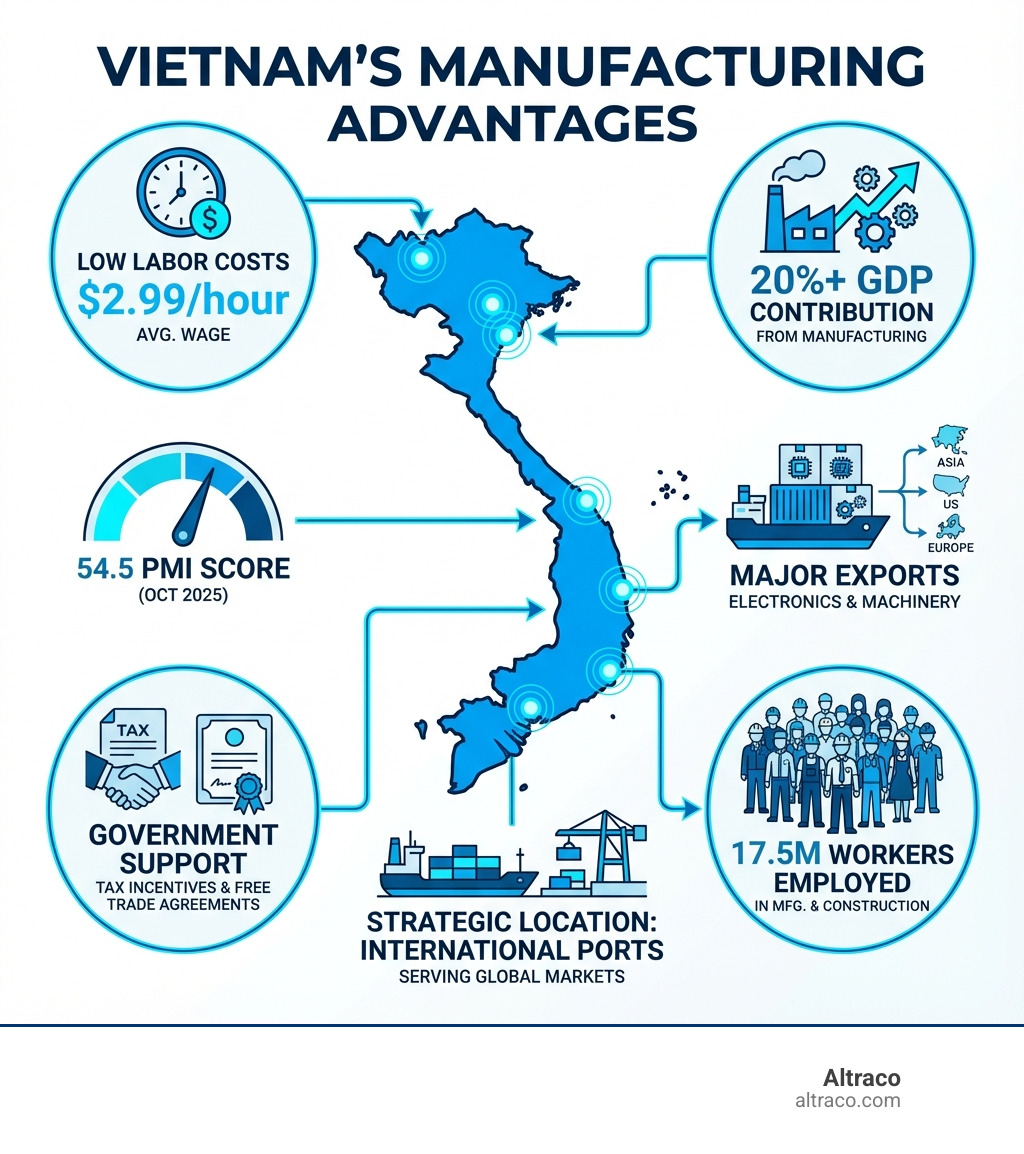
- Low labor costs – Manufacturing labor costs average $2.99 per hour, lower than China and Mexico
- Strong export infrastructure – Strategic location with international ports serving Asia, US, and Europe
- Government support – Corporate tax incentives, free trade agreements (CPTPP, EVFTA), and specialized industrial zones
- Growing capabilities – Major exports include electronics ($42B in broadcasting equipment), automotive parts, machinery, and plastics
- China Plus One strategy – Companies diversifying supply chains away from over-reliance on China
- Proven track record – Manufacturing contributes over 20% of Vietnam’s GDP and employs 17.5 million workers
The manufacturing sector has been at the epicenter of Vietnam’s exceptional growth. The country maintained positive GDP growth even during the COVID-19 pandemic and is projected to grow by 7-8% in 2025. Vietnam’s Manufacturing PMI reached 54.5 points in October 2025, signaling strong expansion driven by new orders and production increases.
I’m Albert Brenner, and I’ve spent over 40 years helping Fortune 500 companies steer vietnam manufacturing through contract manufacturing solutions in home improvement, sporting goods, automotive parts, and outdoor products. Having worked through multiple trade wars and tariff challenges, I’ve seen how Vietnam has emerged as a reliable alternative for companies seeking to diversify their global supply chains.
The State of Vietnam’s Manufacturing Sector: A 2025 Snapshot
Vietnam’s manufacturing sector is not just growing; it’s thriving. As a cornerstone of the nation’s economic growth and resilience, it continues to attract significant international attention and investment. This is a country that has proven its ability to perform, even amidst global economic shifts and challenges.

Economic Health and Key Indicators
The manufacturing sector has consistently contributed more than 20 percent to Vietnam’s GDP over the past decade, a testament to its robust health and pivotal role in the national economy. In the first three quarters of 2025, Vietnam’s GDP grew by an impressive 7.85 percent, with optimistic projections from financial institutions like the Asian Development Bank (ADB) and United Overseas Bank (UOB) forecasting 6.7 percent and 7.7 percent growth respectively for the full year. Our Prime Minister even targeted an ambitious 8 percent or more growth for 2025, aiming for a GDP per capita of US$5,000 and a national economy exceeding US$500 billion.
The industrial sector’s value-added contribution to GDP in the first nine months of 2025 surged by 9.92 percent year-over-year, accounting for 31.73 percent of the economy’s overall growth. This highlights the sector’s increasing sophistication and its move up the value chain.
To gauge the immediate health of the industry, we often look at key economic indicators. The Purchasing Managers’ Index (PMI) is a crucial one, reflecting manufacturing activity. Vietnam’s Manufacturing PMI was 54.5 points in October 2025, indicating a strong expansion. A reading above 50 signals growth, so 54.5 points is a fantastic sign of increasing output, new orders, and improved business sentiment. Similarly, the Index of Industrial Production (IIP), which measures the growth rate of industrial production, increased by 9.2 percent in the first 10 months of 2025 compared to the same period last year. The manufacturing and processing industry, a core component, saw an even higher increase of 10.5 percent during this period.
This consistent growth and positive outlook make Vietnam an appealing destination for companies looking to optimize their global supply chains. For more detailed insights into managing and integrating your supply chain operations, you might find our guide on Integrated Supply Chain Services particularly useful.
The manufacturing and construction sector also plays a significant role in employment, accounting for 17.5 million people in Q3 2025, which is 33.5 percent of the total employment. The average monthly income in this sector stood at VND 8.3 million (US$319) in the first 10 months of 2025, reflecting a 10.1 percent year-on-year increase. This indicates a growing and increasingly prosperous workforce.
Foreign Direct Investment (FDI) Trends
Foreign Direct Investment (FDI) is a powerful engine for Vietnam’s manufacturing growth, and the numbers speak for themselves. In the first 10 months of 2025, total registered FDI surpassed an impressive US$31.52 billion, marking a 15.6 percent year-over-year increase. This substantial inflow reflects strong international confidence in Vietnam’s industrial future.
The processing and manufacturing sector continues to be the crown jewel for foreign investors, attracting the largest share of this FDI at US$7.97 billion, representing a significant 56.7 percent of the total. New investment projects are booming, with 3,321 new projects registered, a 21.1 percent increase year-on-year. Furthermore, adjusted capital for existing projects almost doubled, showcasing long-term commitment from foreign enterprises already operating in the country.
Major investing countries are diverse, with Singapore, China, and Hong Kong (China) leading the pack in the first 10 months of 2025. This global interest underscores Vietnam’s role as a strategic hub for international production. Given these trends, it’s clear that understanding the intricacies of international sourcing is more critical than ever. We believe our insights on Why International Sourcing Services Are Critical for Modern Manufacturing can provide valuable perspective for your business.
Why Companies are Choosing Vietnam for Manufacturing
The shift towards vietnam manufacturing isn’t accidental; it’s a strategic move driven by a confluence of economic, geopolitical, and operational factors. Companies are actively seeking environments that offer both stability and opportunity, and Vietnam consistently delivers.

The “China Plus One” Advantage
One of the most significant drivers behind the surge in vietnam manufacturing is the “China Plus One” strategy. Faced with rising labor costs in China, increasing operational complexities, and the impact of the US-China trade war, many American companies, including our clients, have sought to diversify their supply chains. The trade tensions and subsequent tariffs have made manufacturing in China less predictable and often more expensive, prompting a strategic exodus.
The “China Plus One” approach isn’t about abandoning China entirely but rather about mitigating risk by adding another manufacturing base. Vietnam, with its close proximity, established infrastructure, and competitive advantages, has become a prime candidate for this diversification. Our experience in helping companies steer the complexities of Navigating Section 301 Tariffs has shown us how crucial this strategy has become for maintaining profitability and stability. By spreading production across multiple locations, businesses can build resilience against unforeseen disruptions and geopolitical shifts. This strategic diversification is essential in today’s interconnected world, where relying too heavily on a single source can pose substantial risks to your operations. Understanding the broader implications of Supply Chain Globalization Is It Worth The Risk is key to making informed decisions.
Competitive Labor Costs and Skilled Workforce
One of Vietnam’s most compelling attractions remains its competitive labor costs. While labor costs are rising globally, Vietnam still offers a significant advantage over many other manufacturing hubs. According to Statista, Vietnam’s manufacturing labor costs were estimated at $2.99 (USD) per hour, which is notably lower than both Mexico and China. This cost-effectiveness allows companies, especially those producing home improvement, sporting goods, automotive parts, and outdoor products, to achieve substantial savings on labor-intensive processes.
Here’s a quick comparison of manufacturing labor costs:
| Country | Average Hourly Manufacturing Labor Cost (USD) |
|---|---|
| Vietnam | $2.99 |
| China | Higher than Vietnam |
| Mexico | Higher than Vietnam |
Beyond just the cost, Vietnam boasts a young, dynamic, and increasingly skilled workforce. Vietnamese workers are often lauded for their excellent hand-assembly skills, which translates into high-quality products with fewer defects. This combination of affordability and quality is a powerful magnet for manufacturers. The average monthly income in the manufacturing and construction sector was VND 8.3 million (US$319) in the first 10 months of 2025, indicating a workforce that is both accessible and continuously improving its living standards.
Government Policies and Free Trade Agreements
Vietnam’s government has been proactive in creating an attractive environment for foreign manufacturers. Their pro-investment policies and a network of free trade agreements (FTAs) have significantly boosted the country’s appeal.
Vietnam is a signatory to numerous important trade agreements, which provide preferential access to major global markets. A prime example is the Comprehensive and Progressive Agreement for Trans-Pacific Partnership (CPTPP), which connects Vietnam with a vast network of economies across the Asia-Pacific. Equally important is the European Union Vietnam Free Trade Agreement (EVFTA), opening doors to one of the world’s largest consumer markets. These agreements reduce tariffs and non-tariff barriers, making it more cost-effective to export goods from Vietnam.
Beyond trade agreements, the Vietnamese government offers various incentives, including Corporate Income Tax (CIT) breaks, import duty incentives, and exemptions or reductions on land rents. These policies are designed to encourage foreign investment, particularly in high-tech and value-added manufacturing. For companies like ours that specialize in helping clients steer international trade, a thorough understanding of these agreements and incentives is paramount. We often assist our clients in understanding the nuances of these regulations to maximize their benefits and ensure compliance. Our comprehensive Manufacturers Guide United States Tariffs provides further context on how these international trade dynamics impact your business.
The government’s long-term vision is outlined in strategies like the National Industrial Development Policy for 2030, with a Vision to 2045, and the National Green Growth Strategy for 2021-2030. These frameworks aim to foster sustainable industrial growth, attract high-tech manufacturing, and promote environmentally friendly practices, aligning with global trends and investor expectations.
Key Industries and Capabilities for Vietnam Manufacturing
While Vietnam has historically been known for textiles, its manufacturing capabilities have diversified and matured significantly. Today, vietnam manufacturing is a powerhouse for a range of products, particularly in high-tech electronics, automotive components, machinery, and various outdoor and sporting goods.
Electronics and High-Tech Components
Vietnam has rapidly become a global hub for electronics manufacturing. Our clients in the home improvement and outdoor product sectors, for instance, often require sophisticated electronic components for smart devices or specialized equipment. The country’s expertise in this area is undeniable.
According to oec.world, Vietnam’s number-one export is broadcasting equipment with an export value of $42 billion. Telephones, including smartphones, rank second at $21.4 billion, followed closely by integrated circuits at $19.8 billion. This robust export performance is a clear indicator of the country’s advanced capabilities in this sector.
Major international players have established significant manufacturing operations in Vietnam. Samsung, for example, produces most of its Galaxy Smartphones in Vietnam and exports around USD 58 billion worth of goods annually from the country. Intel also maintains a substantial manufacturing presence. These companies leverage Vietnam’s skilled labor force and supportive ecosystem to produce high-volume, high-quality electronic goods. For businesses looking to bring new products to market, understanding Vietnam’s capabilities in electronics is crucial. Our insights on New Product Introduction can help you steer these complex processes.
Automotive, Machinery, and Industrial Products
The automotive sector in Vietnam is a rapidly growing area, transitioning from assembly to more localized manufacturing. While we don’t focus on the entire vehicle, our clients in automotive parts and accessories manufacturing can benefit from this burgeoning industry. Car manufacturing saw a significant boost, with a 23.5% year-over-year growth in 2025, and industries like machine tools also experienced rapid expansion. VinFast, a domestic automotive manufacturer, is a testament to Vietnam’s ambitions and capabilities in this sector.
Beyond vehicles, Vietnam is a notable producer of machinery, with exports valued at $7.6 billion. The iron and steel industry is also booming, growing at an annual rate of over 20% for nearly a decade. Vietnam now produces over 16 million tons of steel and more than 5 million tons of iron annually, making it a key player in Southeast Asia. This strength in basic industrial materials and machinery provides a solid foundation for manufacturing various industrial products, including components for home improvement and outdoor equipment. When considering where to source specialized parts, understanding the capabilities of original equipment manufacturers (OEMs) in Vietnam is essential. You can learn more about this in our guide on Original Equipment Manufacturer.
Plastics, Rubber, and Sporting Goods
Vietnam’s prowess extends into the production of plastics and rubber goods, with exports exceeding $5 billion annually. These materials are fundamental to a wide array of products, from automotive components and home improvement items to outdoor gear and sporting goods. For instance, the durability and versatility of plastics and rubber make them ideal for components in athletic equipment, protective cases for outdoor electronics, or various parts in home appliances.
The country’s manufacturing base for these materials supports the production of diverse finished goods. This includes items for home improvement, such as specialized seals, gaskets, and molded plastic parts, as well as components for outdoor products like durable casings, handles, and waterproof elements. For sporting goods, Vietnam’s factories produce everything from molded plastic sports equipment to rubber grips and components for fitness gear. The focus on quality and efficiency in these sectors ensures that our clients receive components that meet rigorous performance standards. We also explore the broader implications of material sourcing in our article on Why Bulk Natural Materials Are Changing Modern Manufacturing.
A Practical Guide: Navigating the Vietnamese Manufacturing Landscape
Venturing into vietnam manufacturing requires a clear understanding of its operational landscape. While the opportunities are vast, navigating the specifics of industrial zones, infrastructure, and legal frameworks is crucial for success.
Major Industrial Zones and Economic Regions
Vietnam has strategically developed numerous industrial zones and economic regions to attract and facilitate manufacturing investments. With over 220 industrial zones and 16 economic zones across the country, these areas offer specialized infrastructure, logistical advantages, and often, attractive investment incentives. They are typically clustered in three key economic regions: the North (around Hanoi), the Central Coast (around Da Nang), and the South (around Ho Chi Minh City).
For instance, the Dong Nai Industrial Zone Authority, located about 20 miles northeast of Ho Chi Minh City, is a well-established hub with over US$7 billion in total investment. Similarly, Hiep Phuoc Industrial Park hosts over 200 companies, showcasing a vibrant manufacturing ecosystem. The Dinh Vu – Cat Hai Economic Zone is a massive 22,000-hectare free trade zone on the coast near Hanoi, featuring deepwater ports—a significant advantage for export-oriented businesses.
These zones are classified under Decree No. 82/2018/ND-CP into categories such as export processing zones (focused on export goods), auxiliary industrial areas (for supporting industries), and eco-industrial parks (emphasizing sustainable practices). Investing in these zones often comes with benefits like preferential tax rates, tax holidays, and reduced land rents, making them highly attractive for foreign manufacturers.
Advantages and Challenges of vietnam manufacturing
Like any major manufacturing destination, Vietnam presents a unique set of advantages and challenges. We’ve seen how these factors influence our clients’ decisions and strategies.
Advantages:
- Competitive Labor Costs: As discussed, Vietnam’s hourly manufacturing labor costs of $2.99 are significantly lower than many other hubs, contributing to substantial cost savings.
- Skilled and Adaptable Workforce: Vietnamese workers are known for their strong hand-assembly skills and adaptability, leading to high-quality production with fewer defects.
- Strategic Geographic Location: Positioned centrally in Southeast Asia, Vietnam offers excellent access to major shipping routes, facilitating efficient export to global markets.
- Robust Network of Free Trade Agreements: Extensive FTAs like the CPTPP and EVFTA provide preferential access to key international markets, reducing duties and boosting competitiveness.
- Proactive Government Support: The Vietnamese government actively promotes foreign investment through tax incentives, investment certificates, and the development of specialized industrial zones.
Challenges:
- Infrastructure Bottlenecks: While rapidly improving, infrastructure can sometimes struggle to keep pace with the rapid industrial growth. For instance, only 20% of national roads are paved, which can impact transportation efficiency and logistics, especially outside major urban centers.
- Supply Chain Fragmentation: Vietnam still relies on imported raw materials for many industries, which can lead to supply chain vulnerabilities and increased lead times. Building a local supplier ecosystem is an ongoing effort.
- Bureaucracy and Regulatory Complexities: Navigating local regulations and administrative procedures can be complex and time-consuming for foreign investors.
- Rising Labor Costs: While still competitive, labor costs are on an upward trend, necessitating a shift towards higher productivity and value-added manufacturing to maintain an edge.
- Skilled Labor Shortages: As Vietnam moves into higher-tech manufacturing, a shortage of highly skilled workers for R&D and technical roles can be a concern.
Despite these challenges, with careful planning and the right partner, the advantages of vietnam manufacturing far outweigh the drawbacks for many businesses. Ensuring quality control in overseas operations is paramount, and our Proven Tips to Improve Quality in Overseas Manufacturing can provide valuable guidance.
Legal and Regulatory Steps for Foreign Companies
Establishing manufacturing operations in Vietnam involves specific legal and regulatory steps that foreign companies must steer. This process, while structured, requires careful attention to detail.
The primary requirement for foreign investors is obtaining an Investment Registration Certificate (IRC), which documents the legal status of the investment project and its eligibility for incentives. Following this, an Enterprise Registration Certificate (ERC) is needed to formally recognize the legal status of your new company. For very large-scale projects or those in sensitive sectors, an Investment Policies Decision (IPD) might also be required.
Beyond these core certificates, companies must secure various sub-licenses depending on their specific industry and operations. These can include fire safety permits, environmental permits, and construction licenses. Mergers and acquisition (M&A) approvals are also necessary if you plan to acquire capital, shares, or contribute to existing Vietnamese companies.
Understanding the corporate income tax (CIT) regime is also critical. While the standard CIT rate is 20%, Vietnam offers significant incentives, including reduced rates (e.g., 17% for a definite term), tax exemptions for periods of up to two years, and 50% reductions for subsequent years, especially for investments in preferred sectors or industrial zones. The legal framework, such as Decree No. 82/2018/ND-CP on the management of industrial parks and economic zones, outlines the specific conditions and benefits for operating within these designated areas.
Successfully navigating these legal and regulatory requirements is essential for a smooth and compliant operation. This is where partnering with an experienced manufacturing partner becomes invaluable. We pride ourselves on guiding our clients through these complexities, ensuring a compliant setup. Our insights on Why Choosing the Right Manufacturing Partner Is Critical to Your Business Success dig deeper into this crucial aspect.
Frequently Asked Questions about Vietnam Manufacturing
How does Vietnam’s infrastructure support its manufacturing sector?
Vietnam’s infrastructure is rapidly developing with significant government investment in ports, highways, and power generation. While major hubs like Ho Chi Minh City and Hanoi are well-connected, challenges remain in rural areas and with keeping pace with rapid industrial growth, which can impact logistics. The country’s extensive coastline and numerous ports, including deepwater facilities in economic zones, are crucial for its export-oriented manufacturing. However, the rapid growth of trade sometimes outpaces infrastructure improvements, leading to potential congestion at ports and on key transportation routes. For instance, the major railway connecting Hanoi and Ho Chi Minh City hasn’t seen substantial upgrades in decades. This means that while major international shipping is well-supported, internal logistics can still present bottlenecks that need careful planning.
What are the biggest risks when setting up manufacturing in Vietnam?
Key risks include navigating complex bureaucracy, potential supply chain disruptions due to reliance on imported raw materials, infrastructure bottlenecks, and ensuring consistent quality control. For example, while Vietnam excels in assembly, many industries still depend heavily on imported components, creating vulnerabilities if global supply chains are disrupted. There can also be challenges related to skilled labor shortages for highly technical roles, language barriers, and uncertainty regarding labor rights for foreign investors. Power cuts in northern industrial parks have also been a concern, highlighting energy security as a potential risk. Partnering with an experienced contract manufacturer can help mitigate these risks by leveraging their local expertise, established networks, and understanding of the regulatory landscape.
How can companies ensure quality control in their Vietnamese operations?
Ensuring robust quality control in vietnam manufacturing is paramount for delivering high-quality products, especially for home improvement, sporting goods, automotive parts, and outdoor products where precision and durability are critical. Implementing a robust Quality Control Program is essential. This involves establishing clear product specifications and quality standards from the outset, which we help our clients define. Conducting regular factory audits and performing on-site inspections—including pre-production checks, in-process monitoring, and final inspections—are vital steps. Furthermore, building strong supplier relationships based on trust and clear communication fosters a shared commitment to quality. Our experience has shown that active involvement and regular communication with factory management and staff are key to maintaining high standards and addressing any issues proactively.
Conclusion: Partnering for Success in the Dragon’s Workshop
Vietnam has firmly established itself as a dynamic and increasingly sophisticated hub for global manufacturing. Its compelling blend of competitive labor costs, a skilled workforce, strategic geographic location, and a supportive government keen on fostering international trade presents an undeniable opportunity for businesses worldwide. From high-tech electronics to essential automotive components and durable outdoor products, vietnam manufacturing is geared for continued growth and a pivotal role in global supply chains.
However, navigating this vibrant landscape successfully requires more than just knowing the statistics. It demands an understanding of local nuances, a mastery of regulatory frameworks, and the ability to build robust, resilient supply chains. This is where a trusted partner becomes invaluable.
At Altraco, we specialize in simplifying global supply chains for our clients. Based in Thousand Oaks, CA, we leverage decades of experience, trusted factory relationships, and tariff navigation expertise to deliver quality, on-time products with significant cost savings. Whether you’re looking to diversify your production away from China, optimize costs for your home improvement lines, source innovative sporting goods, or ensure the quality of your automotive parts and outdoor products, our contract manufacturing services are designed to meet your specific needs. We manage the complexities of international manufacturing so you can focus on your core business.
The “Dragon’s Workshop” is open for business, offering immense potential for growth and profitability. With the right strategy and the right partner, your journey into vietnam manufacturing can be a resounding success. We invite you to Explore how Altraco can streamline your Vietnam manufacturing operations and help you open up this exciting new frontier.