Why China Steel Tariffs Matter for Your Business
China steel tariffs are among the most significant trade policy developments affecting global manufacturing today. Here’s what you need to know right now:
Current Tariff Rates (as of 2025):
- 50% tariff on steel imports from China and most other countries
- 50% tariff on aluminum imports (25% for the United Kingdom)
- Applies to 100% of Chinese steel and aluminum products
- Covers raw materials and derivative products (automotive parts, nails, construction materials)
Key Timeline:
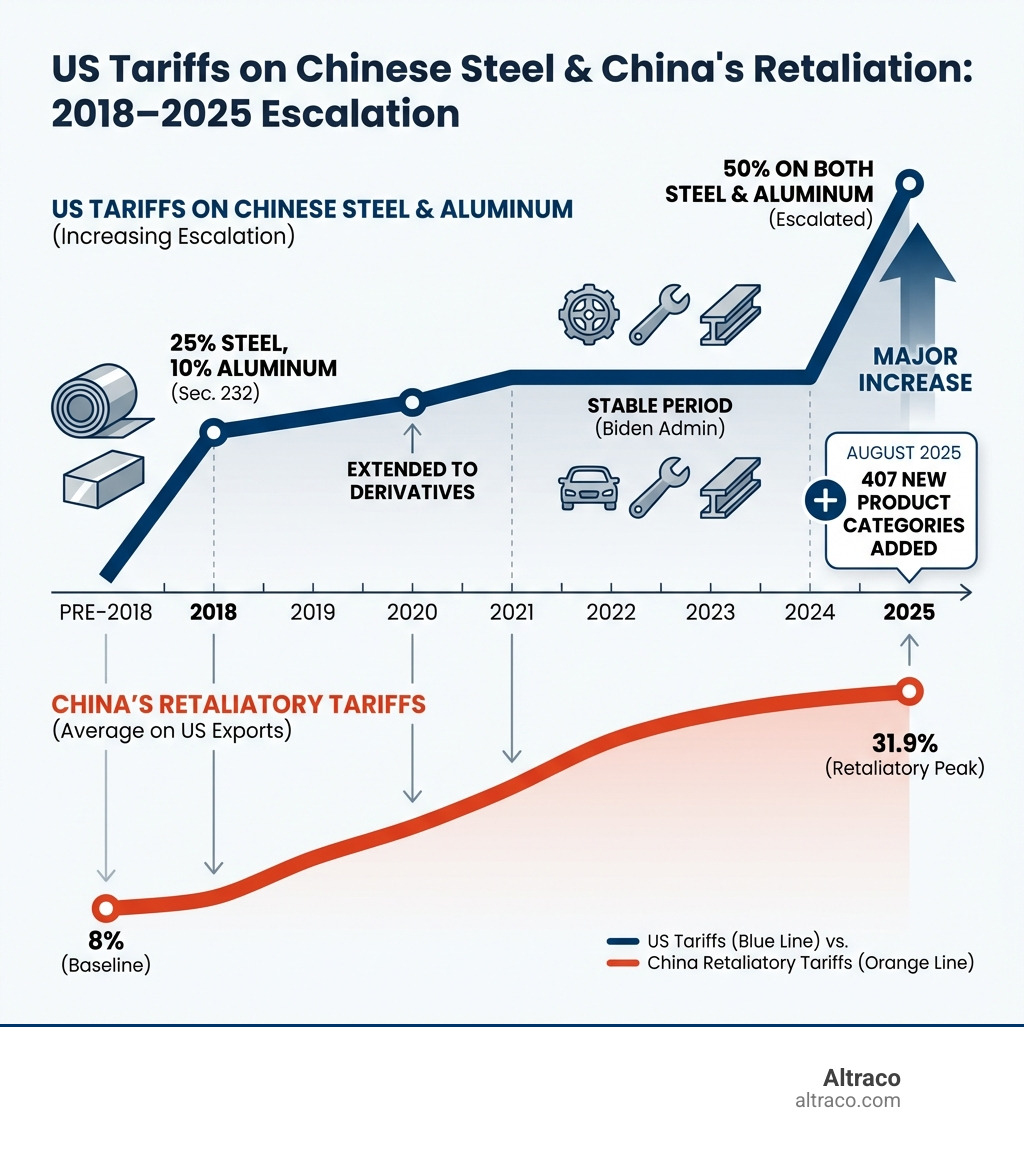
- 2018: Initial 25% steel tariffs under Section 232
- 2020: Extended to derivative products
- 2025: Escalated to 50% under second Trump administration
- August 2025: Added 407 new product categories
If you’re importing steel or aluminum products from China, or finished goods that contain these materials, your costs have likely increased dramatically. These tariffs affect everything from automotive parts to sporting goods to home improvement products.
The situation is complex and constantly evolving. US-China tariffs have risen by 26.8 percentage points since January 2025 alone, reaching levels more than 15 times higher than pre-2018 rates. China has responded with retaliatory tariffs averaging 31.9% on US exports, creating a challenging environment for businesses with global supply chains.
I’m Albert Brenner, and over 40 years of contract manufacturing experience, I’ve helped Fortune 500 companies steer complex trade policies including china steel tariffs by diversifying their manufacturing across countries like Mexico, Vietnam, and China. At Altraco, we’ve successfully managed these challenges since 1980, helping businesses maintain cost-efficiency and reliability despite shifting tariff landscapes.
China steel tariffs further reading:
The Current State of US Tariffs on Steel and Aluminum
When we talk about China steel tariffs, it’s crucial to understand the immediate landscape. The trade environment has seen significant shifts, particularly in 2025, leading to unprecedented tariff levels on steel and aluminum imports. These measures, primarily enacted under Section 232 of the Trade Expansion Act of 1962, are justified by national security concerns, aiming to protect domestic industries considered vital.

A pivotal moment occurred with the Proclamation of June 3, 2025, which dramatically reshaped the tariff structure. This proclamation, alongside others issued since February 10, 2025, has broadened and increased Section 232 tariffs on a wide array of steel and aluminum products, including their derivatives.
What are the current tariff rates?
As of June 4, 2025, the general tariff rate on steel and aluminum imports from most countries, including China, has been set at a staggering 50%. This is a substantial jump that impacts a vast range of products. The only notable exception to this rate is the United Kingdom, which maintains a 25% tariff, reflecting specific trade agreements. This 50% rate applies to nearly all countries from which steel and aluminum products are imported, making it a critical factor for businesses engaged in international trade.
How do these compare to previous levels?
To truly grasp the significance of the current rates, we need to look back at their origins. The initial Section 232 tariffs, implemented effective June 1, 2018, imposed a 25% tariff on steel and a 10% tariff on aluminum. While impactful at the time, these rates have now been significantly escalated. The current 50% tariff on steel and aluminum represents a dramatic increase, making the overall US tariffs on Chinese exports more than 15 times higher than they were before the US-China tariff war began in 2018. This escalation underscores a more aggressive stance in trade policy, aiming for a profound impact on import volumes and domestic production.
A Timeline of the US-China Steel Tariff Escalation
Understanding the journey of China steel tariffs requires a look back at the past few years, which have been marked by fluctuating trade policies and escalating tensions between the US and China. This timeline helps us contextualize the current environment and anticipate potential future developments.
The trade war has seen various phases, from the initial implementation of Section 232 tariffs to the broader Section 301 tariffs, and through different presidential administrations, each leaving its mark on the trade landscape.
The 2018 Origins: Section 232 and National Security
The story of the current China steel tariffs largely begins in March 2018. Under the Trump administration, Proclamation 9705 was issued, invoking Section 232 of the Trade Expansion Act of 1962. This seldom-used provision allows the President to impose tariffs on imports if the Secretary of Commerce determines that those imports threaten national security. The stated justification for these tariffs was the need to protect the domestic steel industry, deemed critical for national defense and infrastructure.
Effective June 1, 2018, the US imposed additional tariffs of 25% on imported steel and 10% on imported aluminum from nearly all countries. This move quickly drew retaliatory measures, with China imposing its own tariffs on various US products, marking the official start of what became known as the US-China trade war.
The Biden Administration: A Period of Stability and Review
Following the initial flurry of tariff actions, the Biden administration, from January 20, 2021, to January 20, 2025, saw a period of relative stability in US-China tariffs. While the fundamental tariffs remained in place, there were fewer dramatic escalations. This era was characterized by a review of existing tariffs and efforts to forge new trade relationships, such as the Joint US-EU Statement on Trade in Steel and Aluminum in October 2021.
However, stability didn’t mean inactivity. Minor increases in US tariffs on Chinese exports were observed in September 2024 and January 2025, raising the average US tariff on Chinese goods from 19.3% to 20.7%. These adjustments, while not as sweeping as those seen in 2018 or 2025, indicated a continued focus on addressing trade imbalances and protecting domestic industries.
The 2025 Escalation and the Future of China Steel Tariffs
The landscape shifted dramatically again with the onset of the second Trump administration. Beginning February 10, 2025, President Trump issued multiple proclamations that significantly broadened and increased Section 232 tariffs. These actions included the termination of agreements that had previously suspended Section 232 tariffs on imports from key partners like the European Union, Japan, and Canada, effective March 12, 2025. This meant that the 25% steel and 10% aluminum tariffs, or even higher rates, now applied to a much wider range of countries.
The most significant development was the June 3, 2025, proclamation, which increased Section 232 tariffs on subject steel and aluminum imports to 50% for all countries except the United Kingdom. This pushed average US tariffs on Chinese exports to 47.5%, covering 100% of all goods, and marking a 26.8 percentage point increase since January 20, 2025. This surge is 10 percentage points larger than the entire increase observed during the first Trump administration. For a comprehensive overview of these recent actions, you can refer to the Presidential 2025 Tariff Actions: Timeline and Status | Congress.gov.
These continuous escalations highlight the dynamic nature of trade policy and the ongoing challenges businesses face in navigating global supply chains.
Understanding the Scope of the Tariffs
When we discuss China steel tariffs, it’s not just about raw steel. The scope of these tariffs has expanded significantly over time, now encompassing a broad array of products, including many finished goods that rely on steel and aluminum components. This expansion means that businesses importing anything from basic materials to complex assemblies need to be acutely aware of the tariff implications.
Understanding which products are affected, and how government agencies manage these complex regulations, is key to compliance and strategic planning.
What Products Are Affected by the China Steel Tariffs?
Initially, Section 232 tariffs focused on primary steel and aluminum articles. However, the definition of “affected products” has broadened considerably to include “derivative products.” This means that items not traditionally thought of as raw materials, but which contain significant steel or aluminum content, are now subject to these duties.
For example, the tariffs were extended to certain derivatives of steel and aluminum articles as of February 8, 2020. More recently, in a Federal Register notice published August 19, 2025, the Bureau of Industry and Security (BIS) announced that 407 new HTSUS (Harmonized Tariff Schedule of the United States) subheadings would be added to the list of products covered by the Section 232 actions, making them subject to the 50% tariffs.
These derivative products now include a wide range of items, many of which are crucial for industries like:
- Automotive parts: Think bumper stampings, certain body stampings for tractors, and other components vital for vehicle manufacturing.
- Sporting goods: Some sporting equipment may incorporate specialized steel or aluminum components now caught in the tariff net.
- Home improvement products: Items like nails, tacks, staples, and various construction materials that fall under specific HTSUS chapters (e.g., steel derivatives classified in HTS Chapter 73 and aluminum derivatives in HTS Chapter 76) are now directly impacted.
The expansion to these derivative products means that even if you’re not importing raw steel sheets, but rather a finished good that contains significant steel, you might be facing these substantial tariffs. This makes it critical to review the specific HTSUS codes of your imported goods.
The Role of Government Agencies in Tariff Management
Navigating the complexities of China steel tariffs isn’t a solo journey. Several government agencies play crucial roles in implementing, managing, and enforcing these trade measures:
- Bureau of Industry and Security (BIS): A key player, BIS is responsible for announcing additions to the list of products covered by Section 232 actions. They also manage the Section 232 tariff exclusions process, determining which products or companies might be exempt from the tariffs under specific circumstances. They maintain detailed lists of covered derivative products, such as those found in Annex I: Derivatives of Aluminum Articles and Annex II: Derivatives of Steel Articles.
- US Customs and Border Protection (CBP): This agency is on the front lines, responsible for collecting the duties and ensuring that imports comply with all trade regulations. They issue guidance and updates, such as the CBP webpage on Section 232 Tariffs on Aluminum and Steel (cbp.gov), to help importers understand their obligations.
- Department of Commerce: This department conducts the initial investigations under Section 232 and advises the President on whether imports pose a threat to national security.
These agencies work in concert, implementing presidential proclamations and managing the complex processes for tariff inclusions and exclusions. For businesses, staying informed through their official channels is paramount.
Global Impact and Strategic Responses
The imposition and escalation of China steel tariffs have sent ripples far beyond the immediate trade lanes between the US and China. These measures have profoundly impacted global steel and aluminum markets, reshaped supply chains, and forced industries worldwide to reconsider their sourcing and manufacturing strategies.
The Ripple Effect on US Industries and Consumers
For US industries, the direct consequence of these tariffs is a significant increase in material costs. Businesses that rely heavily on imported steel and aluminum, whether as raw materials or as components within finished goods, face higher input costs. This includes sectors vital to California’s economy and beyond:
- Automotive industry: Car manufacturers and their extensive supply chains, particularly those producing automotive parts, see higher costs for steel and aluminum components. This can translate into higher prices for vehicles or reduced profit margins.
- Construction costs: Steel is a fundamental building block for infrastructure and commercial and residential construction. Increased steel costs directly contribute to higher construction expenses, potentially impacting housing affordability and infrastructure projects.
- Outdoor products manufacturing: Many outdoor products, from sporting goods to recreational equipment, use aluminum and steel for durability and performance. Manufacturers in this sector are feeling the pinch of liftd material prices.
- Home improvement products: From tools to fixtures, many home improvement items contain these metals. The tariffs can drive up the cost of manufacturing these goods, which ultimately affects consumer prices.
These increased costs are often passed on to consumers, leading to higher prices for a wide range of goods. Additionally, the economic shifts can lead to job losses in sectors unable to absorb the increased costs or compete with more affordably sourced alternatives. The trade deficit with China, which reached $375.6 billion in 2017, has been linked to significant job losses, including 2.7 million jobs between 2001 and 2011 across manufacturing and other industries.
China’s Retaliation and the Global Market
China has not stood idly by in the face of escalating US tariffs. Their response has been swift and substantial, implementing their own retaliatory tariffs on US exports. While US tariffs on Chinese exports averaged 47.5% in 2025, covering 100% of goods, China’s average tariffs on US exports reached 31.9%, also covering 100% of goods.
This tit-for-tat dynamic has had several significant consequences for the global market:
- Impact on US exports: American goods, particularly agricultural products, faced higher barriers to entry in the Chinese market due to retaliatory tariffs. For example, the pre-retaliation tariff on frozen pork was 12%, which jumped to 37% post-retaliation. Similarly, almonds saw an increase from 24% to 39%. You can find more details on these specific product tariff changes in the “Goods Covered and Tariff Levels” research. This makes US products less competitive in one of the world’s largest consumer markets.
- Shifting global trade routes: The tariffs have incentivized businesses to seek alternative sourcing and manufacturing locations to avoid the duties. This has led to a reshuffling of global supply chains, with some production moving out of China to other countries.
- Distortion of global prices: The tariffs disrupt the natural flow of trade and can lead to artificial price differences for steel and aluminum across different regions, creating inefficiencies and uncertainty in the global market.
The impacts are profound, affecting not just the immediate trade partners but also the broader international economic system. As the fb.org link highlights, China’s responses have been strategic, targeting key US export sectors.
Diversifying Supply Chains to Mitigate Tariff Risk
For businesses, especially those in California relying on global supply chains, navigating the current tariff environment requires proactive strategies. The most effective approach we’ve seen at Altraco is diversifying supply chains and exploring offshore contract manufacturing options.
With China steel tariffs making manufacturing in China significantly more expensive, many companies are seeking alternatives. We specialize in helping businesses transition their production to countries that offer both cost-effectiveness and tariff advantages:
- Contract manufacturing: By partnering with experienced contract manufacturers like us, companies can leverage established factory relationships in multiple countries. This means we can help you find manufacturers for your home improvement, sporting goods, automotive parts, and outdoor products outside of China, thus mitigating the impact of these tariffs.
- Mexico as an alternative: For many US companies, Mexico presents an attractive option for nearshoring. Its proximity to the US, favorable trade agreements, and growing manufacturing capabilities make it an excellent choice for producing goods that might otherwise face heavy tariffs from China. We have extensive experience establishing and managing manufacturing operations in Mexico.
- Vietnam as a manufacturing hub: Vietnam has emerged as another strong alternative, offering competitive labor costs and a robust manufacturing sector. For products that don’t require immediate proximity to the US market, Vietnam provides an excellent opportunity to diversify production and reduce reliance on a single country. We’ve built strong relationships with factories in Vietnam to ensure quality and efficiency for our clients.
Reducing reliance on single-source countries, particularly China for steel and aluminum-intensive products, is not just about avoiding tariffs; it’s about building supply chain resilience. This strategy ensures that your business can adapt to geopolitical shifts, trade policy changes, and unforeseen disruptions, maintaining consistent quality and on-time delivery for your products.
Frequently Asked Questions about China Steel Tariffs
We know that navigating China steel tariffs can feel like trying to solve a Rubik’s Cube blindfolded. So, let’s tackle some of the most common questions we hear, providing clear answers to help you make informed decisions.
What is the current Section 232 tariff rate on Chinese steel?
The current Section 232 tariff rate on steel imports from China, and most other countries, is 50%. This rate was established by a presidential proclamation on June 3, 2025, significantly increasing the previous 25% rate. This means that if you’re importing steel directly from China, you’re looking at an additional 50% duty on top of the product’s value. Ouch!
Do these tariffs apply to finished goods that contain steel?
Yes, the tariffs have been expanded to cover certain “derivative” products. This is a crucial point many businesses overlook. It’s not just about raw steel sheets anymore. The tariffs now apply to finished goods where steel or aluminum components are a key part, such as specific automotive parts, bumper stampings, body stampings for tractors, nails, tacks, staples, and many other items classified under specific Harmonized Tariff Schedule of the United States (HTSUS) subheadings. The Bureau of Industry and Security (BIS) maintains a list of these covered derivative products, and check if your imported goods fall under these categories. This expansion, including 407 new HTSUS subheadings added in August 2025, means that even if you’re importing a seemingly complete product, you might be facing these substantial duties if it contains tariffed steel or aluminum components.
Are there any ways to legally avoid these tariffs?
While product-specific exclusions were once common, most general exclusions were terminated as of March 12, 2025. This means that the avenues for simply applying for an exemption have significantly narrowed. However, there are still strategic ways to legally mitigate the impact of these tariffs.
The primary strategy for businesses to legally steer these tariffs is to diversify their supply chain by moving manufacturing operations for affected goods to countries not subject to the highest tariff rates. This is where our expertise at Altraco truly shines. Instead of importing finished automotive parts, sporting goods, home improvement products, or outdoor products from China and paying a 50% tariff, we can help you establish contract manufacturing relationships in countries like Mexico or Vietnam. By manufacturing in these locations, you can often avoid the hefty China steel tariffs altogether, leading to significant cost savings and more stable supply chains. It’s about working smarter, not harder, to keep your products competitive.
Conclusion
The landscape of China steel tariffs is undeniably complex and constantly in motion. From the initial Section 232 tariffs in 2018 to the dramatic escalations and expansions in 2025, businesses face unprecedented challenges in managing their global supply chains. The 50% tariff rate on steel and aluminum from China, coupled with the inclusion of hundreds of derivative products, means that ignoring these policies is simply not an option. The ripple effects are felt across US industries, from automotive and construction to sporting goods and home improvement, ultimately impacting consumers through higher prices.
At Altraco, we understand that this environment creates significant business risk. That’s why we emphasize the importance of a robust supply chain strategy that includes diversification. We’ve spent decades helping companies, including Fortune 500s, steer these exact challenges. Our expertise in offshore contract manufacturing allows us to identify and establish reliable production in countries like Mexico and Vietnam, enabling our clients to circumvent prohibitive tariffs, reduce costs, and build resilient supply chains. We’re here to simplify the complexities of global trade, ensuring your products are delivered on time, at cost-effective prices, and with the quality you expect.
Don’t let tariffs dictate your business’s future. Take control of your supply chain and explore how strategic manufacturing partnerships can transform your operations.
Learn more about navigating tariffs on Chinese imports

Al is an entrepreneur, founder, and owner of multiple businesses, including Altraco, an outsourcing and contract manufacturing company. Working across multiple continents and trusted by Fortune 500 companies, Al finds innovative solutions to traditional supply chain challenges. He is a member of Vistage Worldwide.