
What Durable Goods Manufacturing Really Means (And Why It Matters)
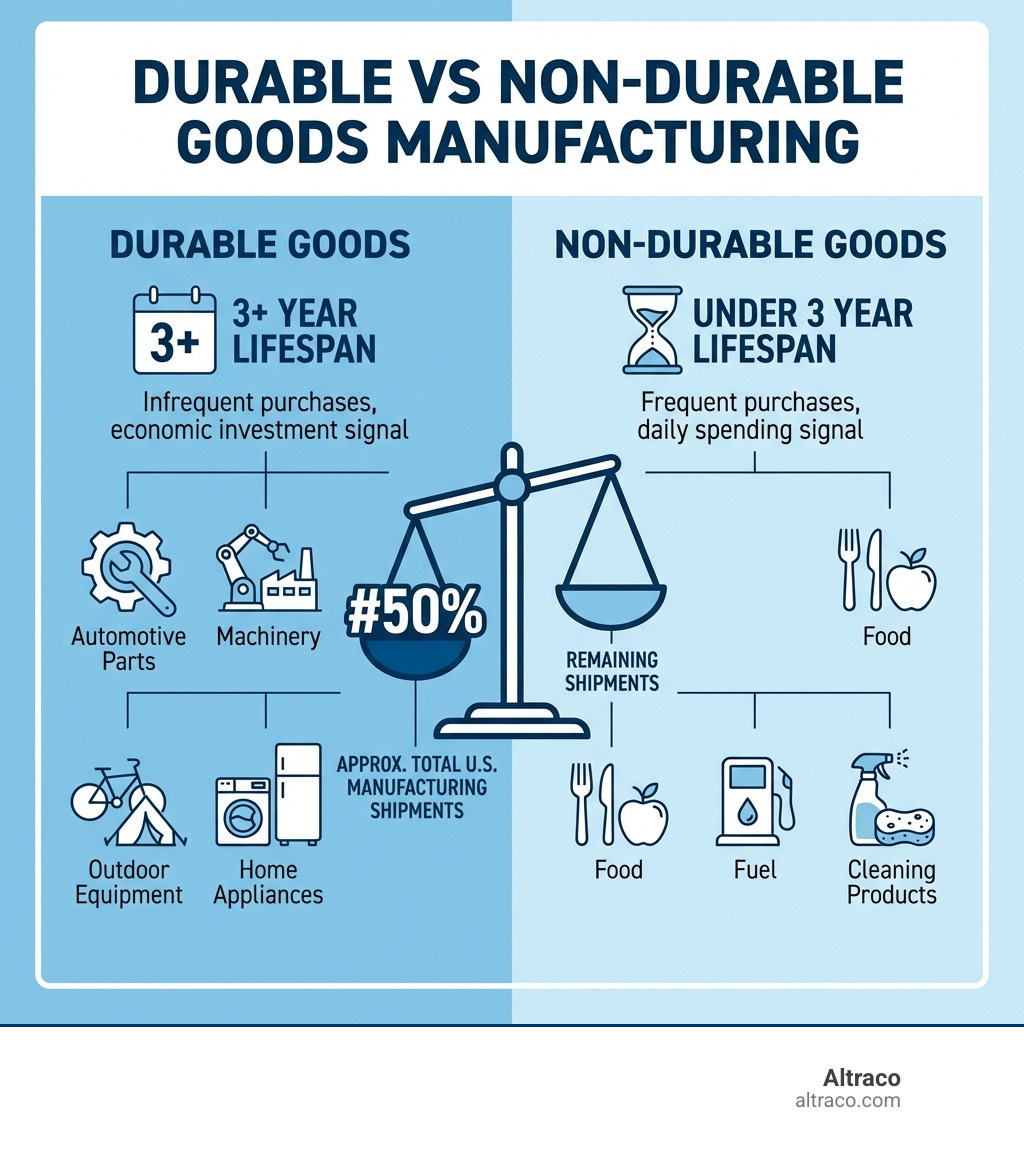
Durable goods manufacturing is the production of physical products designed to last three or more years — think automotive parts, industrial machinery, home improvement tools, and outdoor equipment.
Here’s a quick-reference breakdown:
| Feature | Durable Goods | Non-Durable Goods |
|---|---|---|
| Lifespan | 3+ years | Under 3 years |
| Purchase frequency | Infrequent | Frequent/recurring |
| Examples | Cars, appliances, machinery | Food, fuel, cleaning products |
| Economic signal | Capital investment & consumer confidence | Day-to-day spending |
When durable goods sales rise, economists pay attention. These products require significant buyer commitment — no one replaces a factory machine or an automotive part on a whim. That’s why monthly data on new orders and shipments is watched closely as a signal of broader economic health.
According to the U.S. Census Bureau’s most recent Monthly Advance Report on Durable Goods (released February 18, 2026), durable goods industries generated $308,480 million in seasonally adjusted shipments in November 2025 alone — roughly half of all U.S. manufacturing output.
This sector isn’t just big. It drives the business cycle.
I’m Albert Brenner, co-owner of Altraco, and I’ve spent over 40 years working directly in durable goods manufacturing — producing home improvement, sporting goods, automotive, and outdoor products for some of the world’s largest brands. In this guide, I’ll break down how this industry works, what the data is telling us right now, and what it means for companies that manufacture at scale.
Basic Durable goods manufacturing vocab:
- custom electronics manufacturing
- electronics contract manufacturing services
Defining the Scope of Durable Goods Manufacturing
To understand the sheer scale of this sector, we have to look at how the government classifies it. The North American Industry Classification System (NAICS) uses specific codes to group these businesses. If you are looking at Economic principles: Principles in Action, you’ll see that durable goods are defined by their utility over time. They aren’t “one and done” purchases; they are investments.

In Durable goods manufacturing, the NAICS sectors 321 through 339 cover the heavy hitters of the industrial world. We aren’t talking about perishable snacks or fast fashion here. We are talking about:
- Wood Products (321): Structural timber and wood used in long-term construction.
- Primary Metals (331): The foundries and mills that produce iron, steel, and aluminum.
- Fabricated Metals (332): Turning those metals into nuts, bolts, and structural components.
- Machinery (333): The “machines that make the machines,” including farm, construction, and industrial equipment.
- Computer and Electronic Products (334): From semiconductors to GPS systems.
- Electrical Equipment (335): Batteries, generators, and household appliances.
- Transportation Equipment (336): Automotive parts, aircraft, and ships.
- Furniture (337) & Miscellaneous (339): Medical equipment and sporting goods.
At Altraco, we focus heavily on the durable categories that keep homes running and people moving—specifically home improvement, automotive parts, and outdoor products. Because these items have a long lifespan, the manufacturing process requires a different level of quality control compared to disposable goods. If a bag of chips is stale, it’s a minor annoyance. If an automotive part fails after two years, it’s a major liability.
| Lifespan Factor | Durable Goods | Non-Durable Goods |
|---|---|---|
| Average Life | 3+ Years | Less than 3 Years |
| Replacement Reason | Obsolescence or wear | Consumption or expiration |
| Inventory Risk | High (High value, slow turn) | Low (Perishable, fast turn) |
| Economic Sensitivity | High (Delayed in recessions) | Low (Steady demand) |
Key Indicators Tracking Industry Health
How do we know if Durable goods manufacturing is healthy? We look at the data released by the Federal Reserve and the Census Bureau. These aren’t just dry numbers; they are the pulse of the American economy.
The Federal Reserve G.17 reports track three critical metrics: New Orders, Industrial Production, and Capacity Utilization.
Industrial Production Index
This index measures the real output of U.S. manufacturing. It tells us whether factories are actually making more “stuff” than they were last month. For example, in late 2025, durable manufacturing showed a resilient 3.7% growth rate compared to the previous year. This is a “real” measurement, meaning it’s adjusted for inflation to show actual volume, not just dollar amounts.
Capacity Utilization
This is a fancy way of asking, “How hard are our machines working?” If a steel mill has a capacity utilization of 80%, it means it’s running at 80% of its maximum sustainable output. When utilization in sectors like iron and steel products (NAICS 3311) climbs, it usually means demand is booming. When it drops, it’s a sign that manufacturers are bracing for a slowdown.
Maintaining high utilization requires rigorous industrial quality control. You can’t run a factory at 90% capacity if your machines are constantly breaking down or producing defects. We’ve seen that the healthiest manufacturers are the ones who balance high output with strict maintenance and quality standards.
Business Cycle Variations
Durable goods are notoriously sensitive to the business cycle. During a boom, companies buy new machinery and consumers buy new cars. During a bust, those are the first purchases to be delayed. This makes the durable sector the “canary in the coal mine” for the broader economy.
Current Trends and the Latest Data Points
As we move through 2026, the data shows a fascinating tug-of-war between different subsectors. While some areas are surging, others are correcting after the supply chain chaos of the early 2020s.
The 2025-2026 Performance
The latest Monthly Advance Report highlights some surprising winners. While farm machinery saw a decline (down 16.2% year-to-date), other sectors are on fire. Nondefense aircraft and parts surged by 33.6%, and batteries grew by 16.1%. Computers also saw a healthy 15.5% jump in shipments.
For those of us in the electronics contract manufacturing space, these numbers confirm what we’re seeing on the ground: a massive push toward electrification and advanced computing in everything from home tools to automotive components.
Seasonally Adjusted vs. Non-Seasonally Adjusted
When you read these reports, you’ll see “Seasonally Adjusted” (SA) and “Not Seasonally Adjusted” (NSA) data.
- Seasonally Adjusted: This smooths out predictable patterns, like the dip in production during the December holidays or the spike in construction equipment sales in the spring. It helps us see the underlying trend.
- Non-Seasonally Adjusted: This is the raw data. It’s what actually happened in the factories that month.
Replacement Cycles
Understanding the latest data also requires looking at how consumers behave. Research on durable good replacement cycles shows that people don’t just replace things when they break; they replace them when the new version is significantly better (obsolescence). This is why innovation in the home improvement and outdoor product sectors is so vital—it drives the “New Orders” metric that economists watch so closely.
Navigating the Future of Durable Goods Manufacturing
The future of Durable goods manufacturing looks bright, but it requires a strategic approach to navigate global volatility.
Projections for Durable Goods Manufacturing in 2026
Heading into 2026, the durable manufacturing sector (NAICS 31-33) is projected to maintain a steady growth rate. In the final quarter of 2025, the industry hit a 3.8% annual growth rate. We expect to see continued strength in:
- Automotive Parts: As the transition to electric vehicles continues, the demand for specialized components remains high.
- Outdoor Products: The “staycation” trend has evolved into a permanent lifestyle shift, keeping demand for high-end outdoor equipment stable.
- Business Equipment: Companies are reinvesting in automation to combat labor shortages.
However, we must account for Durable goods theory, which suggests that because these goods last a long time, a “buying spree” today can lead to a “lull” tomorrow. This is why the transit and aerospace sectors often show extreme volatility—they are characterized by massive, infrequent orders.
External Factors Impacting Durable Goods Manufacturing
No manufacturer is an island. We are all subject to external forces, from shifting trade policies to supply chain bottlenecks.
- Tariff Navigation: Tariffs remain a massive factor for any company manufacturing offshore. Recent United States Supreme Court decisions regarding tariff authority have kept the legal landscape shifting. At Altraco, we spend a significant amount of our time helping clients navigate these “trade wars” to find the most cost-effective path.
- Supply Chain Resilience: The “just-in-time” model has been replaced by “just-in-case.” Manufacturers are holding more inventory and diversifying where they build.
- Geographic Sourcing: While China remains a powerhouse, we are seeing a significant shift toward Mexico and Vietnam. Mexico, in particular, offers the advantage of “nearshoring”—shorter shipping times and more favorable trade agreements like the USMCA. Vietnam has become a go-to for high-quality sporting goods and home improvement products.
When choosing a contract manufacturer, these external factors should be at the top of your list. You need a partner who doesn’t just know how to run a lathe or a molding machine, but who understands how to get those products across a border without getting hit by surprise 25% duties.
Frequently Asked Questions about Durable Goods
What industries are included in durable goods manufacturing?
The official list includes ten primary NAICS sectors:
- 321: Wood Product Manufacturing
- 327: Non-Metallic Mineral Product Manufacturing (like glass and cement)
- 331: Primary Metal Manufacturing (steel and aluminum mills)
- 332: Fabricated Metal Product Manufacturing (valves, nuts, bolts)
- 333: Machinery Manufacturing
- 334: Computer and Electronic Product Manufacturing
- 335: Electrical Equipment, Appliance, and Component Manufacturing
- 336: Transportation Equipment Manufacturing (cars, planes, boats)
- 337: Furniture and Related Product Manufacturing
- 339: Miscellaneous Manufacturing (medical devices, sporting goods)
How does capacity utilization reflect industry health?
Think of capacity utilization as the “RPM gauge” for the economy. If utilization is too low (below 70%), it means factories are sitting idle, which usually leads to layoffs and decreased investment. If it’s too high (above 85%), it can lead to inflation as factories struggle to keep up with demand and prices rise. In sectors like iron and steel, high utilization is a sign of a building boom.
Where can I find the latest FRED and Census Bureau reports?
The most reliable data comes directly from the source. The Federal Reserve Economic Data (FRED) database is the gold standard for historical charts and production indices. For the most recent “hot off the press” data, the U.S. Census Bureau’s M3 (Manufacturers’ Shipments, Inventories, and Orders) survey provides the “Advance Report” every month. These reports are usually released around the 18th to 25th of each month.
Conclusion: Partnering for Durable Success
Durable goods manufacturing is more than just a set of economic statistics; it is the backbone of our physical world. From the automotive parts that get us to work to the outdoor products that make our weekends enjoyable, this industry requires long-term vision and uncompromising quality.
At Altraco, we take the complexity out of this massive industry. As an offshore contract and private label manufacturing partner, we help brands move their production to where it makes the most sense—whether that’s Mexico, China, or Vietnam. We don’t just find a factory; we build a supply chain.
By leveraging our decades of experience and trusted relationships, we provide:
- Significant Cost Savings: Navigating tariffs and optimizing logistics.
- Rigorous Quality Control: Ensuring your durable goods actually stay “durable.”
- Seamless Supply Chains: Taking the headache out of global shipping and customs.
If you’re ready to scale your production in the home improvement, sporting goods, automotive, or outdoor sectors, we’re here to help. Explore our contract manufacturing services and let’s build something that lasts.