Why Understanding Contract Manufacturers is Critical for Your Business
A contract manufacturer (CM) is a third-party company that produces components or finished products for another business. This partnership allows you to focus on design, innovation, and sales while outsourcing the manufacturing process. By working with a CM, companies can access specialized production capabilities, reduce capital investment, and scale operations without building their own facilities.
Key benefits include significant cost savings, scalability to meet market demand, access to specialized expertise, and faster speed to market. However, it’s also crucial to manage risks like loss of production control, intellectual property protection, and quality assurance.
For any company struggling with offshore manufacturing complexities—from navigating tariffs to ensuring supply chain reliability—choosing the right contract manufacturer is a strategic decision. This guide will walk you through how to evaluate, vet, and partner with a CM that meets your quality, timeline, and cost objectives.
As Albert Brenner, co-owner of a contract manufacturer with over 40 years of experience producing products for Fortune 500 companies in home improvement, sporting goods, and automotive, I’ve seen how the right partnership transforms business. Working with companies like Altraco, which specializes in offshore manufacturing in Mexico, China, and Vietnam, I’ve helped businesses steer global production while maintaining quality and cost efficiency.
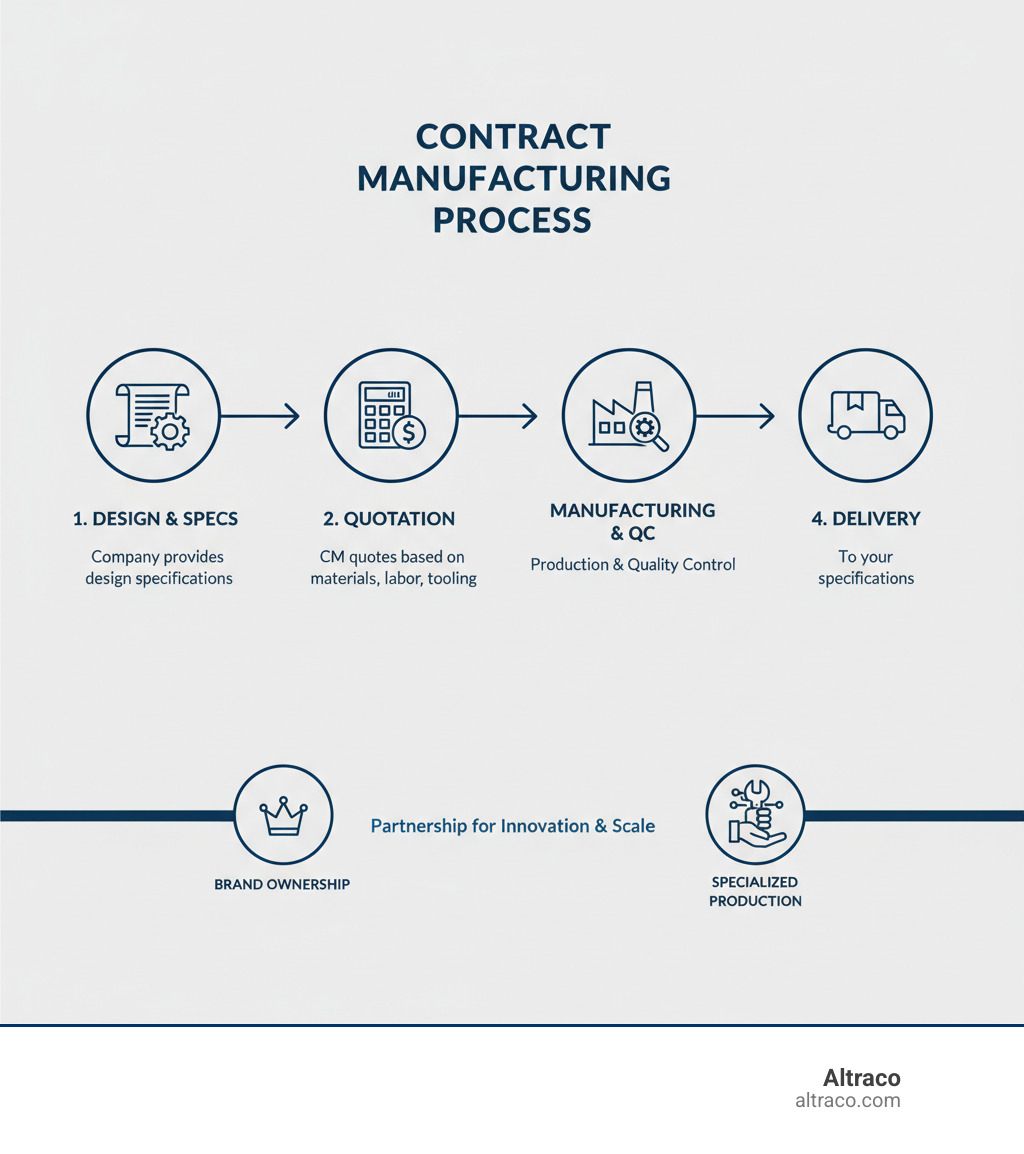
The contract manufacturing journey: Company provides design specifications → Contract manufacturer quotes based on materials, labor, and tooling costs → Manufacturing and quality control → Delivery to your specifications. Throughout this process, you maintain brand ownership while leveraging specialized production capabilities.
Understanding the Contract Manufacturing Model
Partnering with a contract manufacturer means letting an expert handle the heavy lifting of production. You focus on designing great products and building your brand, while your manufacturing partner focuses on making them. It’s a simple concept with powerful benefits and real challenges to consider.

The Business Model Explained
The contract manufacturing model is straightforward: you bring the vision, they bring the factory. You provide detailed designs, material requirements, and quality standards for your product. The CM reviews your specifications and provides a detailed quote covering tooling, materials, labor, and logistics. Once you agree on terms, they handle the entire production lifecycle—sourcing materials, manufacturing, quality control, and shipping. This is known as a turnkey supplier model, as they take your design and deliver a market-ready product. For companies working with partners in Mexico, China, or Vietnam, this streamlined approach is invaluable.
Core Benefits for Your Business
Working with a contract manufacturer offers numerous advantages for businesses of all sizes.
- Reduced Capital Investment: Avoid the multi-million dollar cost of building and equipping a manufacturing facility.
- Lower Labor Costs: Eliminate the wages, benefits, and HR overhead of a large production workforce, especially when manufacturing in cost-effective locations like Mexico or Vietnam.
- Faster Time-to-Market: Leverage established production lines and experienced teams to get your product to customers faster.
- Focus on Core Competencies: Free up your team to concentrate on innovation, marketing, and sales.
- Access to Specialized Expertise: Tap into advanced equipment and knowledge in areas like precision machining or complex molding for automotive or home improvement products.
- Scalability: Easily ramp production up or down to match market demand, which is ideal for seasonal items like sporting goods.
At Altraco, we’ve seen how integrated supply chain services amplify these benefits, especially for companies navigating offshore production.
Potential Risks and How to Mitigate Them
Contract manufacturing isn’t without challenges, but they are manageable with foresight.
- Loss of Direct Control: You can’t walk the factory floor daily. Mitigation: Establish clear communication protocols, schedule regular check-ins, and include audit rights in your contract.
- Intellectual Property (IP) Risk: Sharing proprietary designs is inherently risky. Mitigation: Use comprehensive NDAs and manufacturing agreements that clearly define IP ownership. Partner with a CM that has a reputation for integrity.
- Quality Variance: A CM might not meet your quality standards. Mitigation: Vet partners thoroughly, verify quality certifications, request samples, and implement a multi-stage inspection process.
- Communication Barriers: Language, culture, and time zones can cause misunderstandings. Mitigation: Work with a partner like Altraco that provides dedicated project managers to bridge these gaps.
- Supplier Relationship Strain: A poor relationship with your CM can disrupt your supply chain. Mitigation: Treat your CM as a partner and an extension of your team. Open communication and mutual respect are key to building strong supplier relationships.
- Capacity Constraints: A single supplier can become a bottleneck. Mitigation: Discuss capacity planning upfront and consider diversifying production for critical products.
Success in contract manufacturing requires choosing the right partner and managing the relationship thoughtfully. When you find a CM that aligns with your goals, the model works beautifully.
How to Choose the Right Contract Manufacturer
Selecting a contract manufacturer is about forging a strategic partnership. The right choice provides a reliable extension of your team that helps you scale and innovate. A poor choice can lead to quality issues, IP headaches, and supply chain disruptions. After four decades in this business, I’ve learned that treating this as a partnership decision, not just a vendor selection, is paramount.
We believe that choosing the right manufacturing partner is critical to your business success.

Key Criteria for Your Evaluation
When evaluating potential partners, look beyond the price tag. The cheapest option can become the most expensive if quality and reliability suffer.
- Technical Capabilities: Can they manufacture your product to the required precision? Verify they have the right equipment and expertise for your specific needs, whether it’s forging for automotive parts or molding for home improvement products.
- Industry Experience: A manufacturer familiar with your market (e.g., sporting goods, outdoor gear) understands its unique standards and demands.
- Scalability and Capacity: Can they grow with you? Ensure they have the flexibility to adjust production volume as your business needs change.
- Financial Stability: A financially sound partner is a reliable one. You need a manufacturer who will be around for the long haul.
- Geographic Location: Location impacts logistics and cost. Offshore locations like Mexico Manufacturing offer cost advantages, while options like Vietnam Manufacturing California can balance cost and shipping times. Altraco helps find the optimal manufacturing home for your product.
Vetting Your Potential Contract Manufacturer: A Checklist
Thorough due diligence is non-negotiable. Use this checklist to vet potential partners:
- Reputation and References: Check their track record and speak with current clients.
- Qualified Personnel: Do they employ experienced engineers and quality control specialists?
- Equipment and Technology: Is their machinery modern and well-maintained?
- Quality Control Systems: What certifications (e.g., ISO) do they hold? What is their inspection process?
- Supply Chain Management: Do they have reliable suppliers and leverage economies of scale?
- Communication Protocols: Do they provide a dedicated project manager and respond promptly?
- Financial Due Diligence: Verify their financial stability to avoid supply chain risks.
- Legal and Contractual Clarity: Are they willing to sign comprehensive NDAs and manufacturing agreements that protect your IP?
- Facility Audits: Always conduct a site visit. A confident manufacturer will welcome your inspection.
For more detailed guidance, explore our choosing a contract manufacturer: pro tips.
Differentiating Between CM, OEM, and Private Label
Understanding these terms helps you choose the right model for your business.
- Contract Manufacturing (CM): You provide the complete design and specifications. The manufacturer builds your unique product. You own the intellectual property. This offers maximum control and is ideal for innovative products.
- Original Equipment Manufacturing (OEM): The manufacturer owns a base design, which you can modify. IP ownership can be shared. This is a good middle ground, leveraging existing platforms for faster development. More info on OEM is available.
- Private Label: You select a finished product from the manufacturer’s catalog and apply your brand. This is the fastest and simplest route to market, with minimal customization. We can connect you with private label manufacturers California and beyond.
The key difference is who owns the design and how much control you have.
Navigating Quality, Legal, and Financial Complexities
Working with a contract manufacturer, especially one overseas, involves managing quality, legal, and financial variables. With the right approach and an experienced partner, these complexities become manageable steps in a successful manufacturing journey.

Ensuring Product Quality and Control
Your brand’s reputation depends on product quality. Quality control isn’t an afterthought; it’s integrated from the start.
- Establish Clear Standards: Define measurable quality benchmarks before production begins, including material specifications, acceptable tolerances, and performance criteria for your automotive parts or home improvement products.
- Conduct Regular Audits: Use pre-production, in-process, and final quality checks to ensure standards are met. These audits are your eyes and ears on the factory floor in Vietnam or Mexico.
- Create a Corrective Action Plan: Your agreement should specify how to address non-conformances, including root cause analysis to prevent recurrence.
A reputable contract manufacturer will have robust quality systems. Partner with their expertise while maintaining your oversight. For more, see our proven tips to manage quality issues in manufacturing and how to maintain quality control program.
Protecting Your Intellectual Property
Protecting your competitive advantage when working with a third party is critical, especially in countries with different legal frameworks.
- Non-Disclosure Agreements (NDAs): This is your non-negotiable first line of defense. Get a comprehensive NDA signed before sharing any proprietary information.
- Manufacturing Agreements: Your contract must be crystal clear that you own all IP—designs, tooling, and any process improvements. Ambiguity here is a major risk.
- Choose Partners with Integrity: Legal documents are crucial, but the best protection is working with a trusted partner with a proven track record. At Altraco, we’ve built our factory relationships in Mexico, China, and Vietnam on this principle.
For detailed legal insights, we recommend you visit Cooley.
Understanding Cost Implications and Tariffs
Calculating the true cost of manufacturing involves more than the per-unit price. You must consider the total landed cost.
- Upfront Costs: Factor in one-time tooling expenses for molds, dies, and jigs.
- Variable Costs: Material and labor costs fluctuate. A good CM can leverage their purchasing power to secure better rates.
- Logistics: Account for shipping, insurance, customs duties, and warehousing.
- Tariffs: This is a critical, often overlooked cost. US tariffs on imported goods can dramatically alter your project’s financial viability. A tariff on Chinese imports could make manufacturing in Mexico more attractive for your automotive parts or home improvement products.
Navigating tariffs requires a proactive strategy. At Altraco, we specialize in helping companies steer the complexities of tariffs. We build strategies around them, sometimes by shifting production from China to Mexico or sourcing components from Vietnam. This expertise turns a potential challenge into a competitive advantage.
Contract Manufacturing in Action: Industries and Examples
The beauty of contract manufacturing is its versatility. It’s not confined to one sector or product type—it spans nearly every industry you can imagine. From the smartphone in your pocket to the faucet in your kitchen, chances are a contract manufacturer played a role in bringing that product to life.
At Altraco, we’ve spent over 40 years working in specific industries where precision, durability, and smart cost management make all the difference. Our sweet spot? Home improvement products, sporting goods, automotive parts, and outdoor products—sectors where quality can’t be compromised, but neither can your bottom line.

Real-World Examples of Contract Manufacturing
Let’s talk about how contract manufacturing actually works in the real world, with products you probably interact with every day.
Take Apple, for instance. Despite being one of the world’s most valuable companies, they don’t manufacture their own iPhones or iPads. Instead, they design the products in California and partner with contract manufacturers to produce them. This lets Apple focus on what they do best—innovation, design, and creating experiences—while their manufacturing partners handle the complexities of production at scale.
The same principle applies across the industries we serve. Consider a company developing a premium kitchen faucet with intricate internal mechanisms and a flawless finish. They might partner with a contract manufacturer who specializes in precision metal casting and chrome plating. The company owns the design, controls the brand, and manages the marketing, while the CM handles the technical challenge of producing thousands of identical units that meet exacting quality standards.
In the sporting goods world, think about a brand launching an innovative bicycle component—perhaps a lightweight yet incredibly strong crank arm. They’d work with a CM experienced in advanced forging and CNC machining to produce these parts. The brand gets to bring their engineering vision to life without investing millions in specialized metalworking equipment they’d only use for this one component.
Automotive parts manufacturing tells a similar story. Even major car manufacturers routinely outsource production of specialized components—everything from electronic control modules to precision-engineered suspension parts. A contract manufacturer with expertise in aluminum die casting might produce engine components for multiple automotive brands, each with their own specifications and quality requirements. This specialization often results in better products at lower costs than if each company tried to do it in-house.
For outdoor products, imagine a company creating a new line of durable camping gear. They might need someone to handle the aluminum extrusion for tent poles, the injection molding for connectors, and the final assembly. A contract manufacturer can coordinate all these processes, ensuring components fit together perfectly and meet the durability standards outdoor enthusiasts demand.
At Altraco, we’ve built our reputation by connecting companies with the right manufacturing partners in strategic locations like Mexico, China, and Vietnam. We understand that a high-end power tool component has different requirements than an automotive sensor or a smart home device. Our role is to simplify your global supply chain, steer the tariff complexities, and ensure your products are manufactured to your exact specifications—whether that’s in Monterrey, Shenzhen, or Ho Chi Minh City.
How Startups Leverage Contract Manufacturing
Here’s where contract manufacturing becomes truly transformative: it’s the great equalizer for startups and small businesses.
Imagine you’re a startup with a brilliant idea for a bike lock or an innovative garden tool. You’ve got the design, the passion, and maybe some seed funding. What you don’t have is $5 million to build a factory. This is where a contract manufacturer changes everything.
By partnering with a CM, that startup can suddenly compete head-to-head with established Fortune 500 companies. They get access to the same advanced manufacturing capabilities, the same quality standards, and often the same factories. The only difference? They’re renting that capability instead of owning it.
This approach lets startups gain a market foothold quickly. Instead of spending two years building infrastructure, they can have their first production run in a matter of months. They can test their product with real customers, gather feedback, and iterate on the design—all without the crushing weight of fixed manufacturing costs.
The financial advantage is obvious: minimizing initial investment means more runway. That capital that would have gone to equipment and facilities can instead fund product development, marketing campaigns, or hiring a talented sales team. For a startup, this flexibility can mean the difference between success and running out of money before reaching market.
Perhaps most importantly, contract manufacturing enables rapid innovation. When you’re not locked into your own production line, you can pivot. If customer feedback suggests a design change, you can implement it in the next production run. If a new material becomes available that could improve your product, you can switch. If one product line isn’t working but another shows promise, you can shift focus without having to retool an entire factory.
We’ve seen this play out countless times with our clients. A small company with a great idea for a home improvement product can go from concept to store shelves in record time, all because they partnered with the right contract manufacturer. That’s the power of strategic outsourcing—and that’s what we help companies achieve every day at Altraco.
Frequently Asked Questions about Contract Manufacturing
Clients new to contract manufacturing often have similar questions. Here are answers to the most common ones we hear after decades of working with everyone from startups to Fortune 500 companies.
What is the difference between a contract manufacturer and a private label manufacturer?
This is a crucial distinction. A contract manufacturer builds a unique product based on your proprietary designs and specifications. You own the intellectual property. This is for creating something new, like an innovative automotive sensor or a specialized home improvement tool.
A private label manufacturer offers a pre-existing product from their catalog that you can brand as your own. Customization is minimal. This is for getting a standard product to market quickly.
The key difference is ownership of the design: with a CM, it’s yours; with private label, it’s theirs.
How are intellectual property rights protected with a contract manufacturer?
Protecting your IP is paramount. Protection is a two-pronged approach: legal and strategic.
- Legal Agreements: Start with a comprehensive Non-Disclosure Agreement (NDA) before sharing any information. Follow up with a detailed Manufacturing Agreement that explicitly states you own all designs, tooling, and processes.
- Strategic Partnership: The best defense is choosing a trustworthy partner with a reputation for integrity. For highly sensitive products, you can also split component manufacturing across different facilities so no single CM has the full design.
We work with legal experts and recommend resources like Cooley to ensure our clients’ agreements are airtight.
In which industries is contract manufacturing most common?
Contract manufacturing is prevalent in nearly every sector that requires specialized equipment or economies of scale. Key industries include:
- Electronics: (e.g., smartphones, circuit boards)
- Automotive: (e.g., engine components, interior trim)
- Medical Devices: (e.g., diagnostic equipment, surgical tools)
- Aerospace and Defense: (e.g., precision-engineered components)
At Altraco, we specialize in home improvement products, sporting goods, automotive parts, and outdoor products. We connect clients with expert manufacturers in these fields, leveraging our partner factories in Mexico, China, and Vietnam to deliver quality and cost savings.
Conclusion
After exploring contract manufacturing, one thing is clear: partnering with the right manufacturer is a strategic decision that can fundamentally transform your business. It’s not just about saving money; it’s about gaining a competitive edge.
A skilled contract manufacturer allows you to reduce capital investment, access specialized expertise, scale with market demand, and get products to market faster. Most importantly, it frees your team to focus on innovation, design, and building your brand.
However, these benefits only materialize with the right partner—one who can steer complex global supply chains, steer the shifting landscape of international tariffs, and act as a true extension of your team. The difference between success and failure in contract manufacturing is the quality of the partnership.
At Altraco, this is what we’ve built our business on for over 40 years. Based in Thousand Oaks, California, we simplify offshore manufacturing for our clients. Our expertise spans key hubs like Mexico, China, and Vietnam, and we specialize in the industries we know best: home improvement products, sporting goods, automotive parts, and outdoor equipment.
We’ve seen it all, and we’ve solved it all. We protect your IP, maintain rigorous quality control, and have the tariff navigation expertise to prevent costly surprises. Our trusted factory relationships ensure your products are made to spec, on time, and on budget.
The right manufacturing partner simplifies complexity. That’s our promise to you.
Ready to transform your manufacturing strategy? Explore our comprehensive contract manufacturing services and find what’s possible with the right partner by your side.