
Why Global Companies Turn to Manufacturing Partners
Contract Manufacturing Services are business arrangements where one company (the Original Equipment Manufacturer or OEM) hires a third-party manufacturer to produce goods according to the OEM’s specifications and designs.
Key Aspects of Contract Manufacturing Services:
- What It Is: A focused form of outsourcing centered on producing tangible goods based on your unique design
- How It Works: You provide the design; the manufacturer handles sourcing, production, quality control, and logistics
- Primary Benefits: Cost savings, access to specialized expertise, faster time-to-market, and reduced capital investment
- Common Industries: Automotive parts, sporting goods, outdoor products, home improvement, and industrial equipment
- Key Difference from Private Label: You own the design and product specifications (private label uses the manufacturer’s existing product)
For large enterprises and Fortune 500 companies, contract manufacturing offers a strategic way to manage complex global supply chains, especially amid shifting tariff landscapes and recent United States Supreme Court decisions that influence trade policy. A strong manufacturing partner turns offshore production into a competitive advantage, delivering quality products on time while often reducing overhead costs compared to domestic production.
This model has proven particularly valuable for companies manufacturing in countries like Mexico, China, and Vietnam, where established factory relationships and tariff navigation expertise can make a decisive difference in margins and reliability.
I’m Albert Brenner, co-owner of a contract manufacturing company with over 40 years of experience helping Fortune 500 companies steer offshore production in home improvement, sporting goods, automotive, and outdoor products. At Altraco, we’ve built proven factory relationships across multiple countries and developed expertise in Contract Manufacturing Services that addresses the complexities of tariffs, quality assurance, and on-time delivery that large enterprises face daily.
What Is Contract Manufacturing and How Does It Work?
Contract manufacturing is a service agreement between two companies: one that needs a product manufactured (the Original Equipment Manufacturer, or OEM) and another that offers manufacturing services. Instead of investing heavily in in-house production facilities, equipment, and staff, your company leverages the existing resources, expertise, and production capabilities of a specialized contract manufacturer. This allows you to focus on product innovation, marketing, and sales, while Altraco and its partners handle the intricate details of production.
You, the OEM, provide the designs, drawings, and prototypes for your product. Your contract manufacturing partner then employs project management teams, engineers, facilities, and established supply chains to produce your product according to agreed-upon specifications and quality standards. This process ensures that your vision for a new automotive part or a high-performance outdoor product is brought to life efficiently and reliably.
For businesses producing complex goods like automotive components or sporting equipment, contract manufacturing is a proven solution that maintains design quality while increasing production output and accommodating specialized needs. It reduces costs without requiring extensive in-house infrastructure and offers the scalability needed for dynamic markets. For a deeper dive into manufacturing terms, refer to Understanding Manufacturing Terminology in the Global Supply Chain.
The benefits are substantial, including meaningful cost savings and the flexibility to scale production without large capital investment. While there are many advantages, it’s also important to consider potential disadvantages, as outlined in historical discussions like The Benefits and Disadvantages of Contract Manufacturing.
The Step-by-Step Process
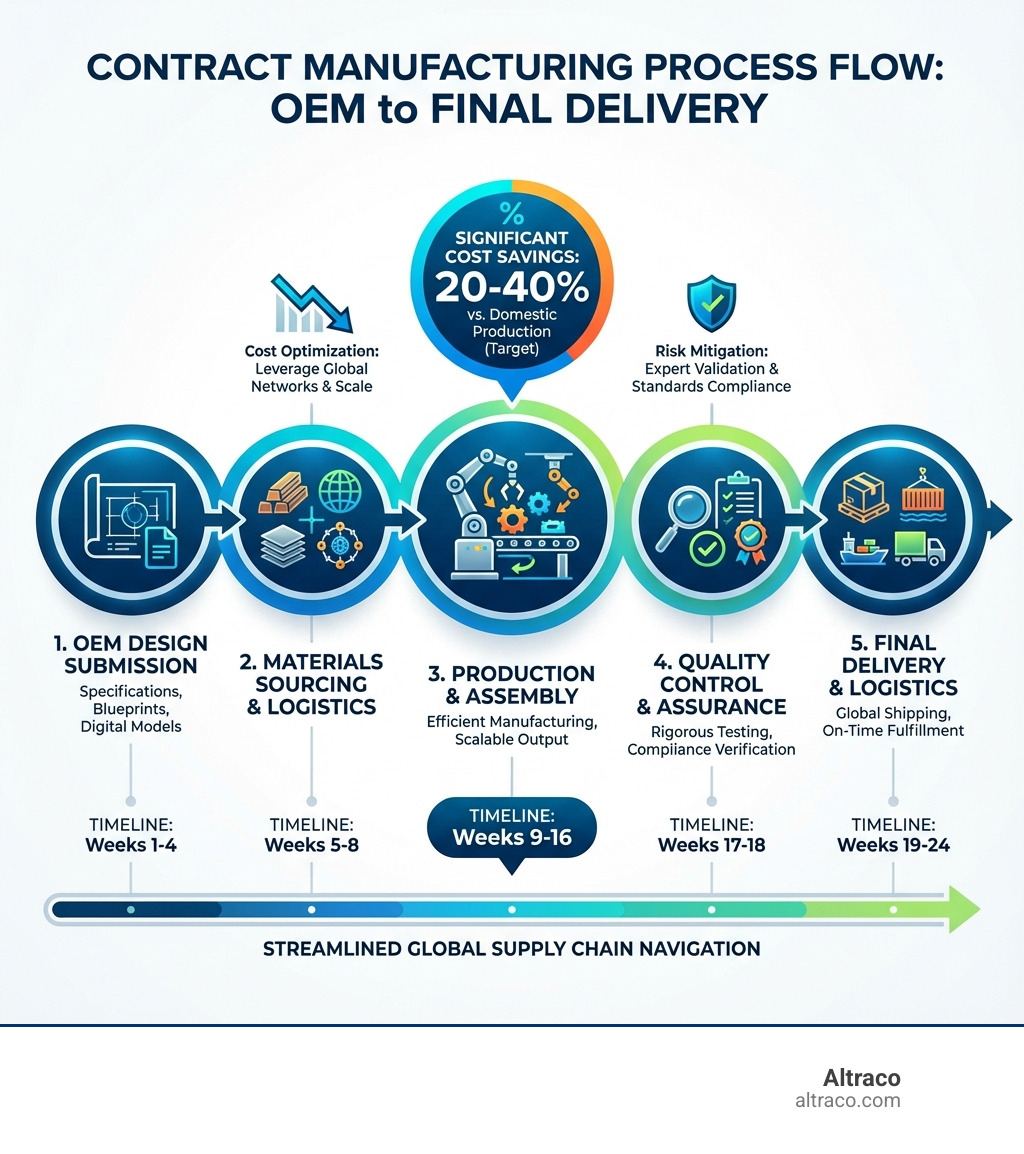
The journey of bringing a product to market through Contract Manufacturing Services is a structured process designed for efficiency and precision. Here’s how this typically works:
- Initial Consultation: You bring your product idea, designs, or existing product specifications. Together you define goals, technical requirements, quality standards, and target costs, laying the groundwork for a successful partnership.
- Design for Manufacturability (DFM): Engineers review your designs to optimize them for efficient, cost-effective manufacturing at the required quality level. This may involve material changes, design tweaks, or process adjustments that improve production without compromising performance or appearance.
- Sourcing Raw Materials: Using a network of trusted suppliers, the manufacturer sources raw materials and components. Established relationships help ensure quality, competitive pricing, and reliable delivery, even for specialized materials used in outdoor products or high-strength alloys for automotive parts.
- Production & Assembly: With optimized designs and materials in place, manufacturing begins. Depending on your product, this may include CNC machining, casting, stamping, injection molding, or precision assembly.
- Quality Control: Quality is integrated throughout the process. Rigorous Quality Control protocols guide inspections of incoming materials, in-process checks, and final product verification so every item meets your specifications and applicable industry standards.
- Packaging & Logistics: Finished and approved products are packaged to your requirements. The manufacturer manages logistics for efficient, timely delivery to your designated locations, whether that is a warehouse in California or a distribution center elsewhere in the world.
This step-by-step approach ensures a smooth transition from product concept to market-ready reality, allowing your internal teams to stay focused on your brand and customers.
The Core Benefits of Using Contract Manufacturing Services
Choosing Contract Manufacturing Services is a strategic decision that can open up significant advantages for your business. It is especially impactful for companies in home improvement, sporting goods, automotive, and outdoor products.

- Cost Savings: By utilizing a contract manufacturer, you avoid the capital expenditure required for building and maintaining your own production facilities, purchasing machinery, and hiring a large manufacturing workforce. Partners in Mexico, China, and Vietnam can offer competitive labor costs and economies of scale, often reducing production expenses compared to domestic manufacturing.
- Reduced Capital Investment: You can launch new product lines without buying new CNC machines or specialized assembly lines. Contract manufacturing keeps your capital free for research and development, marketing, and expanding distribution networks instead of tying it up in fixed assets.
- Access to Expertise and Advanced Technology: Contract manufacturers specialize in production. They often possess highly specialized skills, state-of-the-art equipment, and advanced manufacturing technologies that might be too costly or complex to bring in-house. This includes precision machining for sporting goods and complex molding or metalworking for home improvement and automotive products.
- Focus on Core Competencies: Delegating manufacturing allows your team to concentrate on design, innovation, brand building, and customer engagement. You focus on creating the next great outdoor product, and your manufacturing partner focuses on how it is made.
- Faster Time-to-Market: Established processes and supply chains enable quicker turnaround from design to finished product. This speed is valuable in competitive markets, helping you capitalize on trends and introduce new products more rapidly.
Selecting the right partner is crucial to realizing these benefits. See Why Choosing the Right Manufacturing Partner is Critical to Your Business Success for additional considerations.
Industries That Thrive with Contract Manufacturing
While diverse industries use Contract Manufacturing Services, certain sectors with complex production needs, high-volume requirements, or specialized processes find it especially beneficial. At Altraco, the focus is on partnering with companies in:
- Automotive Parts: From intricate components to exterior accessories, precision and consistency are essential. Contract manufacturers with advanced CNC machining, casting, and finishing capabilities are indispensable for this sector.
- Sporting Goods: High-performance bicycle parts, specialized athletic equipment, and other performance products require lightweight, durable, and precisely engineered components.
- Outdoor Products: Tents, camping gear, tools, and recreational equipment often need a mix of material expertise, robust construction, and efficient assembly.
- Home Improvement: Hardware, fixtures, tools, and building components benefit from economies of scale and specialized production techniques.
- Industrial Equipment: Heavy machinery parts, specialized tools, and components for industrial applications demand high precision and durability.
Accessing specialized capabilities and scaling production efficiently is critical for these industries. There is also a growing trend toward engineered and natural materials, as explored in Why Bulk Natural Materials Are Changing Modern Manufacturing.
Distinguishing Key Manufacturing Models
When exploring external manufacturing options, terminology can be confusing. This overview clarifies the differences between Contract Manufacturing, Private Label Manufacturing, and general Outsourcing so you can make the right strategic choice for your business.
| Feature | Contract Manufacturing | Private Label Manufacturing | General Outsourcing |
|---|---|---|---|
| Design Ownership | Client (OEM) owns the design and specifications | Manufacturer owns the original product design/formula | N/A (service-based, not product-design focused) |
| Product Uniqueness | Highly customized, unique to the client’s brand | Standard product, customized only with client’s branding/packaging | N/A (focuses on delegating business functions) |
| Client Involvement | High involvement in design, specifications, quality control | Lower involvement, mainly branding and marketing | Varies depending on outsourced function (e.g., IT, customer service) |
| Focus | Production of specific goods based on client’s unique design | Selling existing products under client’s brand | Delegating non-core business activities to third parties |
| Risk/Investment | Higher initial investment in R&D/tooling, but lower production cost | Lower initial investment, faster time-to-market | Varies, but generally lower product-specific risk |
| Example | Manufacturing a new, custom-designed car bumper for an OEM | A retailer selling a manufacturer’s standard tools under its own brand | Hiring an external call center or IT support team |
Contract Manufacturing vs. Private Label
The key differentiator here is ownership of the product design.
With Contract Manufacturing, your company develops and owns the intellectual property for the product’s design, specifications, and formula. The contract manufacturer then produces that unique product exclusively for you. This allows for high customization and ensures your product stands out in the market, whether it’s a new sporting good or a unique home improvement device. You dictate details from materials to finish so the final product aligns with your brand vision.
Conversely, Private Label Manufacturing involves a manufacturer that already produces a standardized product. Your company purchases this existing product and sells it under your own brand name. While you can apply your logo and packaging, the core product design belongs to the manufacturer. This approach is often faster and requires less initial investment, making it attractive for companies looking to quickly expand product lines. However, it offers less control over product uniqueness and differentiation. For more on this, explore the private labeling situation and The Growing Opportunity in Private Label Manufacturing.
Contract Manufacturing vs. General Outsourcing
Outsourcing is a broad business practice where a company delegates non-core business processes or functions to a third-party provider. This can include services like IT support, customer service, accounting, or marketing. The focus is on obtaining a service or function from an external source.
Contract Manufacturing, by contrast, is a specific type of outsourcing focused on the physical production of tangible goods. When you engage in Contract Manufacturing Services, the manufacturer takes responsibility for making your products to your specifications. So, while contract manufacturing is under the outsourcing umbrella, it is distinct in its emphasis on production and supply chain execution. For companies facing international trade complexities, understanding how specialized production fits into broader supply chain strategies is key, as discussed in Outsourced Manufacturing: The Guide to Navigating US Tariffs.
How to Choose the Right Manufacturing Partner
Selecting the ideal contract manufacturing partner is one of the most critical decisions your company will make. It is not just about finding someone to make your products; it is about finding a strategic ally who understands your vision, meets your quality standards, and helps you manage the complexities of global production.

A rigorous vetting process is essential. You should look for technical capabilities that align with your product’s needs, whether that is high-precision CNC machining for automotive components or durable molding and metalwork for outdoor gear. Production capacity matters as well; the right partner can scale with your demand, from initial runs to mass production, without compromising quality or lead times. Clear, consistent communication is non-negotiable, particularly with overseas operations. Building Strong Supplier Relationships and applying Proven Tips to Improve Quality in Overseas Manufacturing are central to long-term success.
What to Look for in a Contract Manufacturing Services Partner
When evaluating potential partners for Contract Manufacturing Services, look beyond initial price quotes. Key criteria include:
- Industry Experience: A proven track record in your specific industry (home improvement, sporting goods, automotive, outdoor products) leads to a better understanding of product requirements, challenges, and applicable regulations.
- Quality Management Systems (QMS): Certifications like ISO 9001 (general quality management) indicate a commitment to consistent quality and adherence to international standards. Robust inspection and testing capabilities are essential.
- Scalability and Flexibility: The partner should handle both small pilot runs and larger production volumes, adapting to changing market demand without excessive cost or delay.
- Financial Stability: A financially stable partner minimizes the risk of supply chain disruption and can invest in continuous improvement.
- Location & Logistics: The geographical location of facilities matters. Mexico, China, and Vietnam offer strategic advantages, but logistics infrastructure, proximity to ports, and transit times to your distribution centers must also be considered.
For deeper guidance on selection, see Choosing a Contract Manufacturer: Pro Tips.
Essential Elements of a Manufacturing Agreement
A well-drafted contract manufacturing agreement clearly defines responsibilities, expectations, and safeguards for both parties. It should cover:
- Intellectual Property (IP) Protection: Clearly state that your company retains all rights to your designs and related IP.
- Non-Disclosure Agreements (NDAs): Put NDAs in place before sharing sensitive information to protect designs, processes, and trade secrets.
- Quality Standards and Specifications: Detail all quality metrics, inspection procedures, acceptable defect rates, and testing protocols so expectations are unambiguous.
- Pricing & Payment Terms: Include a breakdown of manufacturing costs, payment schedules, and any provisions for price adjustments tied to material costs or order volume.
- Lead Times & Delivery Schedules: Establish timelines for production, shipping, and delivery, along with any remedies for delays and provisions for urgent orders.
- Liability and Indemnification: Define responsibilities in case of product defects, recalls, or other liabilities, which is especially important for safety-critical items like automotive parts or outdoor equipment.
These elements form the legal and operational framework for a secure and productive contract manufacturing partnership.
Modern Trends and the Future of Manufacturing
The landscape of manufacturing continues to evolve, driven by global economics, technological advancements, and geopolitical shifts. Companies that use Contract Manufacturing Services are reassessing where and how they produce goods to remain competitive and resilient.
One major trend is the strategic re-evaluation of Global Sourcing. While China remains a major manufacturing hub, many organizations are diversifying their footprint. Nearshoring to Mexico has grown, offering geographical proximity to the US market, reduced lead times, and favorable trade frameworks. Insights in Why Mexico Manufacturing Is Changing Global Supply Chains highlight these benefits. Vietnam is also an important option, combining competitive costs with an expanding industrial base.
Supply Chain Resilience is now a top priority after recent global disruptions. Companies look for partners who can offer diversified production locations and robust logistics to mitigate risk. Building trusted factory relationships across multiple countries supports this resilience.
At the same time, Tariff Mitigation remains critical. Shifting trade policies and tariffs, including changes influenced by recent United States Supreme Court decisions, can significantly affect total landed cost and profitability. Expertise in navigating these complexities, such as how to Navigate Section 301 Tariffs, helps companies select strategic manufacturing locations and sourcing options that minimize tariff exposure.
The Role of Technology in Contract Manufacturing Services
Technology is reshaping modern manufacturing and enhancing the value of Contract Manufacturing Services.
- Industry 4.0: Digitalization and automation are changing factories into smart facilities where machines communicate, adjust processes, and predict maintenance needs.
- Automation: Automated systems and robotics handle repetitive tasks, precision assembly, and heavy materials, increasing speed and consistency while improving safety and reducing labor costs. More details on relevant equipment can be found under Automation Equipment.
- CNC Machining: Computer Numerical Control (CNC) machining is central to precision manufacturing for complex automotive parts, sporting goods, and home improvement components. It delivers accurate, repeatable production from digital designs; see CNC Machining for a technical overview.
- 3D Printing (Additive Manufacturing): Once primarily for prototyping, 3D printing now supports low-volume production, complex geometries, and custom tooling, offering flexibility and speed.
- IoT-enabled Monitoring: Internet of Things (IoT) sensors on production lines collect real-time data, enabling proactive problem-solving, predictive maintenance, and ongoing process optimization.
These technological advancements support higher quality, faster production cycles, and greater cost efficiency in contract manufacturing, strengthening offshore production strategies.
Frequently Asked Questions about Contract Manufacturing
Companies exploring Contract Manufacturing Services often raise similar questions. Here are some of the most common, with concise answers.
What are the biggest risks of contract manufacturing?
Key risks include:
- Loss of Direct Control: Day-to-day production operations are handled by a third party, which can reduce direct oversight unless communication and reporting are clearly defined.
- Intellectual Property (IP) Risks: Sharing designs and specifications always carries a risk of IP leakage or unauthorized use, making robust NDAs and contracts essential.
- Quality Variations: Without a strong quality management system and regular inspections, product quality may be inconsistent.
- Communication Barriers: Language, cultural differences, and time zones can cause misunderstandings or delays if not managed proactively.
These risks highlight the need for careful partner selection and solid contractual agreements. For a deeper discussion, see Supply Chain Globalization: Is It Worth the Risk?.
How do you ensure quality when working with an overseas manufacturer?
Ensuring quality with overseas manufacturers requires a structured approach:
- Rigorous Vetting Process: Build relationships with factory partners based on thorough background checks, facility audits, and verification of certifications such as ISO 9001.
- On-Site Audits and Inspections: Conduct regular, and sometimes unannounced, on-site audits and inspections throughout the production cycle via local teams in manufacturing regions like Mexico, China, and Vietnam.
- Clear Quality Standards in the Contract: Specify quality requirements, testing protocols, and acceptable defect rates in the manufacturing agreement.
- Third-Party Inspections: Use independent inspection agencies to provide unbiased quality assessments before shipment when needed.
- Robust Maintain Quality Control Program: Implement and monitor comprehensive quality control programs from raw material inspection to final product testing.
Can a contract manufacturer help with product development?
Yes. Many contract manufacturers offer meaningful support during product development, which can streamline the path from concept to market.
- Design for Manufacturability (DFM) Feedback: Engineers review your designs and suggest modifications that improve manufacturability, reduce cost, and support consistent quality without sacrificing performance.
- Prototyping: Factories can produce prototypes so you can test designs, validate function, and refine details before committing to mass production.
- Material Selection Expertise: Experience with a wide range of metals, plastics, and composites helps identify optimal materials for durability, cost, performance, and compliance with standards.
Collaborating with a contract manufacturer early helps avoid costly revisions and accelerates launch timelines. This is explored further in From Idea to Impact: Why New Product Introduction Matters.
Partner with Experts to Simplify Your Global Supply Chain
In today’s interconnected yet complex global economy, leveraging Contract Manufacturing Services is more than a cost-saving measure—it is a strategic imperative. For companies in home improvement, sporting goods, automotive, and outdoor products, managing international production demands deep expertise, trusted relationships, and a strong grasp of global trade dynamics.
Altraco specializes in this role as an offshore contract and private label manufacturing partner. Based in Thousand Oaks, CA, with access to key hubs such as Los Angeles and Long Beach, Altraco brings decades of experience, carefully built factory relationships in Mexico, China, and Vietnam, and the ability to establish relationships in other countries when needed. Combined with tariff navigation expertise, this allows clients to align production locations with cost, lead time, and regulatory objectives.
By partnering with Altraco, your company can simplify its global supply chain and benefit from cost-efficient, high-quality, on-time production while mitigating the inherent risks of offshore manufacturing. With the right International Sourcing Services, your business can open up significant growth opportunities and concentrate on what it does best: innovation and customer satisfaction.