
Why Current Tariff Rates Are Reshaping Global Supply Chains Right Now
Current tariff rates on U.S. imports have shifted dramatically since early 2025, and if you source products internationally, you need to know exactly where things stand.
Here is a quick snapshot of the key rates in effect right now:
| Product / Category | Rate | Origin / Notes |
|---|---|---|
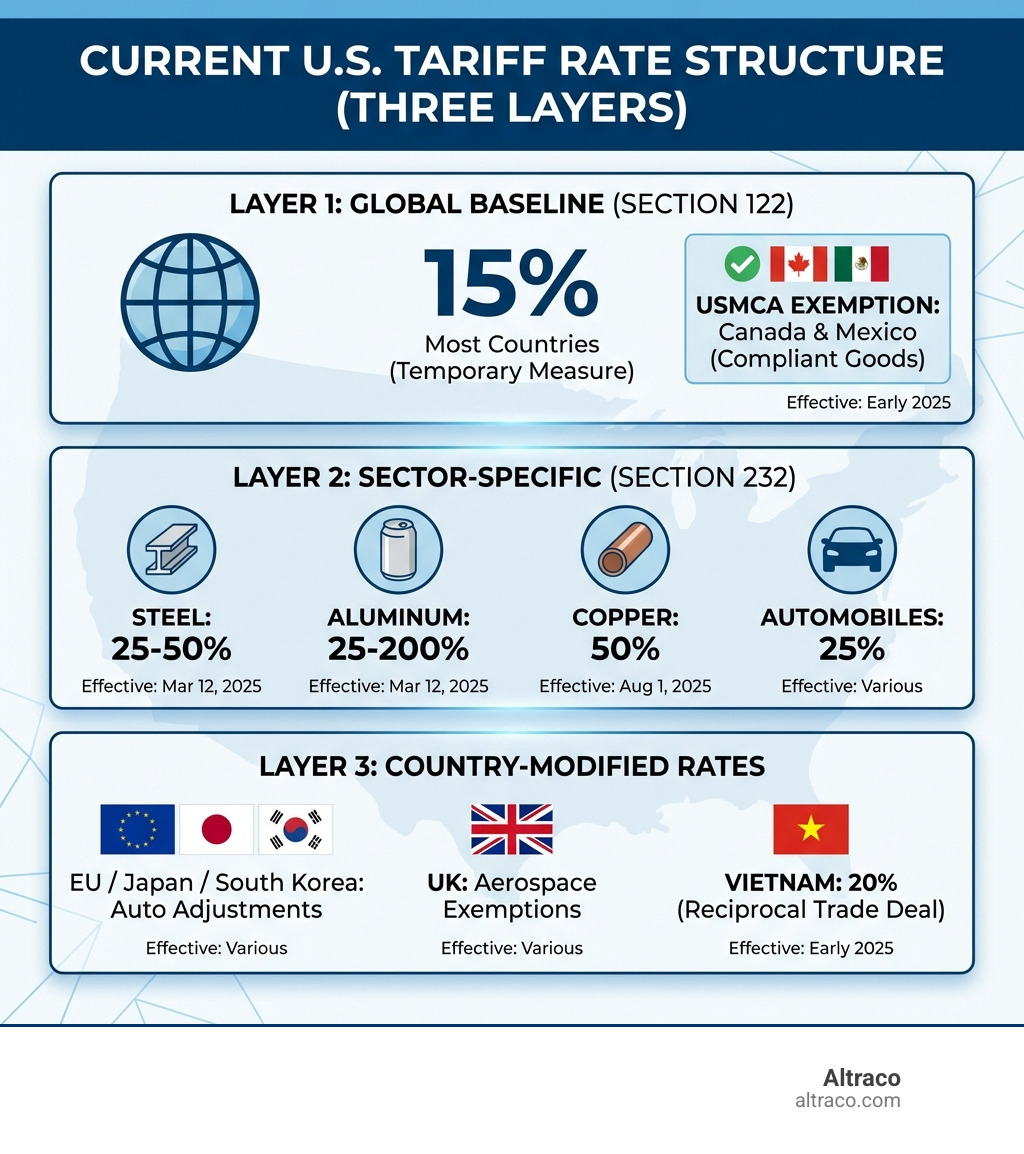
| Global baseline (Section 122) | 15% | Most countries; excludes USMCA-compliant goods |
| Steel articles | 25% (UK) / 50% (all others) | Effective March 12, 2025 |
| Aluminum articles | 25% (UK) / 200% (Russia) / 50% (others) | Effective March 12, 2025 |
| Automobiles | 25% general | Modified for EU, Japan, South Korea |
| Copper semi-finished products | 50% | Effective August 1, 2025 |
| Semiconductors & equipment | 25% | Effective January 15, 2026 |
| USMCA-compliant goods (Canada/Mexico) | Exempt from 15% baseline | Must meet CUSMA compliance rules |
| Agricultural products (over access commitments) | 25% | Effective March 4, 2025 |
The short version: the U.S. now applies a 15% global baseline tariff under Section 122 of the U.S. Trade Act — a temporary measure valid for up to 150 days. On top of that, sector-specific duties under Section 232 (steel, aluminum, autos, copper) remain fully in effect and were not affected by the U.S. Supreme Court’s ruling that struck down tariffs imposed under the International Emergency Economic Powers Act (IEEPA). These two layers often stack, making the actual rate higher than either number suggests on its own.
For large enterprises managing offshore manufacturing — especially in home improvement, automotive parts, sporting goods, or outdoor products — the complexity here is real and the cost impact is significant.
I’m Albert Brenner, co-owner of Altraco, a contract manufacturing firm with over 40 years of experience helping Fortune 500 companies navigate current tariff rates and offshore sourcing across countries including Mexico, China, and Vietnam. In this guide, I’ll break down exactly what rates apply, which exemptions matter, and how to think clearly about your supply chain strategy.
The 2025 Global Baseline: Understanding the 15% Current Tariff Rates
The trade landscape was thrown into a bit of a whirlwind recently following a significant U.S. Supreme Court ruling. This decision essentially struck down the use of the International Emergency Economic Powers Act (IEEPA) as a mechanism for imposing broad tariffs. However, the response was swift. To maintain the “America First” trade stance, the administration pivoted to Section 122 of the U.S. Trade Act of 1974.
The Legal Basis for Temporary Global Duties
Under Section 122, the President has the authority to impose temporary import surcharges to address “fundamental international payments problems.” Currently, this has manifested as a 15% baseline tariff on most global imports.
It is important to note the “temporary” nature of this specific rule: Section 122 duties are legally limited to a duration of 150 days. For these rates to continue beyond that window, Congress must step in and provide an extension. While 150 days might seem short, in global logistics and contract manufacturing, five months of a 15% surcharge can drastically alter a project’s bottom line. For more detailed insights, you can review the White House Fact Sheet on Global Import Duties or consult our guide to navigating US tariffs.
How USMCA Impacts Current Tariff Rates
If you are manufacturing in North America, there is a silver lining. Goods that are compliant with the Canada-United States-Mexico Agreement (CUSMA/USMCA) are generally exempt from this 15% global baseline. This exemption is a massive win for companies utilizing Mexican contract manufacturing for automotive parts or home improvement goods.
However, “compliance” is the keyword here. To dodge the 15% rate, your products must meet specific rules of origin. If a product is merely assembled in Mexico using primarily non-North American components, it might not qualify for the exemption. We often help our clients audit their supply chains to ensure they are truly navigating US tariffs effectively by maximizing USMCA benefits.
Sector-Specific Duties: Steel, Aluminum, and Copper
While the 15% baseline is the “new” kid on the block, the Section 232 tariffs—enacted for national security reasons—never went away. These duties target the raw materials essential for infrastructure, home improvement, and automotive manufacturing.
Calculating Stacking for Current Tariff Rates
One of the most confusing aspects of current tariff rates is the “stacking” effect. For products like steel or aluminum derivatives, the tariff isn’t always applied to the full invoice value. Instead, the specific Section 232 duty is often calculated based on the “known value of the metal content.”
The remaining value of the product (the labor, the plastic components, the packaging) is then subject to the 15% global baseline or other reciprocal tariffs. This requires a granular breakdown of your Bill of Materials (BOM) to ensure you aren’t overpaying. This methodology is outlined in HTSUS Subchapter III, Chapter 99.
Specific Rates for UK, Russia, and Global Partners
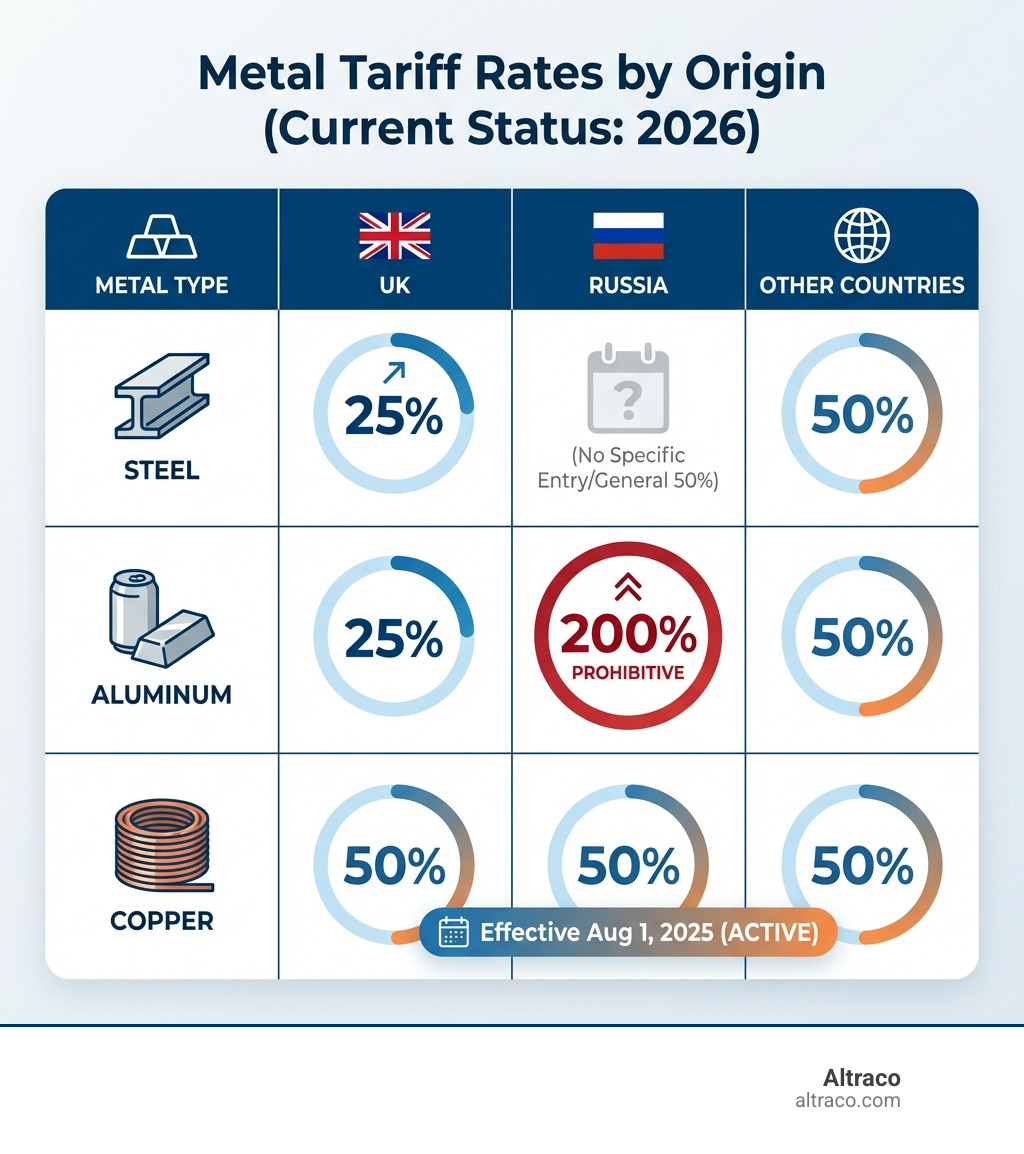
The origin of your metal matters—a lot. Here is how the rates break down as of March 12, 2025:
- Steel Articles: UK-origin products face a 25% rate, while most other global partners are hit with a 50% duty.
- Aluminum Articles: The UK remains at 25%. However, Russian-origin aluminum is subject to a massive 200% “prohibitive” tariff. All other countries generally face a 50% rate.
- Copper: Beginning August 1, 2025, semi-finished copper products and derivatives will be subject to a 50% tariff.
These high rates on raw materials are a primary reason many of our clients are looking toward Altraco to help them source finished automotive parts or outdoor products from “aligned” partners where these costs can be mitigated. You can also find more technical details in the WTO Agreement on Civil Aircraft.
Navigating Tariffs for Automotive and Semiconductor Industries
The automotive and tech sectors are currently under the microscope. If you are importing brake rotors, suspension components, or electronic controllers for sporting goods, the current tariff rates are likely your top concern.
Modified Rates for EU, Japan, and South Korea
Automobiles generally face a 25% tariff, but there’s a complex “Column 1” calculation for our strategic partners in the EU, Japan, and South Korea. The goal is to ensure the total duty doesn’t exceed a certain threshold while remaining reciprocal.
The formula typically works like this:
- If the standard “Column 1” duty is already 15% or higher, the additional tariff is 0%.
- If the “Column 1” duty is less than 15%, the new tariff is calculated as 15% minus the Column 1 rate.
This ensures a level playing field for imports from these regions, particularly for high-value automotive supply chains. For those sourcing from China, the situation is different, as Section 301 tariffs often apply on top of these numbers. You can stay updated on the current China tariff landscape and the Section 301 tariffs through our dedicated resources.
Semiconductor and Manufacturing Equipment Outlook
Mark your calendars for January 15, 2026. This is when the 25% tariff on semiconductors and semiconductor manufacturing equipment is set to take effect.
There are “carve-outs” for specific uses, such as equipment destined for U.S. data centers, research and development (R&D) facilities, and certain startups. Consumer electronics and electronics used in sporting goods (like fitness trackers or GPS units) may also see specific exemptions depending on the final implementation. However, for most industrial and automotive applications, a 25% hike is on the horizon.
Country-Specific Exemptions and Trade Agreements
The U.S. has been busy negotiating “Reciprocal Trade” deals. These agreements often trade lower current tariff rates for commitments from other countries to buy U.S. goods (like Boeing jets or agricultural products).
Aerospace and Defense Exemptions
National security is a recurring theme in trade policy. Consequently, there are significant exemptions for the aerospace industry. The UK, EU, and Japan have established frameworks that allow many aerospace-related components to bypass the heaviest duties. This is vital for the production of commercial aircraft and defense equipment. You can verify specific codes in the Official U.S. Harmonized Tariff Schedule.
Emerging Deals with Vietnam and Southeast Asia
At Altraco, we’ve seen a massive surge in interest in Southeast Asian manufacturing. Recent negotiations have yielded some specific “deals”:
- Vietnam: A framework agreement has set tariffs at 20% for many goods, a significant improvement over the potential 50% rates threatened for non-aligned partners.
- Indonesia: A 19% rate has been established, often paired with “transshipment” penalties to ensure goods aren’t just passing through from China.
- Malaysia & Philippines: Negotiations are ongoing, with rates expected to settle between 19% and 20%.
For companies manufacturing outdoor power equipment or home improvement tools, these regions offer a compelling alternative to China, especially when paired with Altraco’s strategies to navigate tariffs.
Frequently Asked Questions about Current Tariffs
What is the current global baseline tariff rate?
The current global baseline is 15%, imposed under Section 122 of the U.S. Trade Act. This is a temporary measure (150 days) that applies to most countries, though USMCA-compliant goods from Canada and Mexico are exempt.
How do tariffs affect automotive parts from Japan and the EU?
Automotive parts from these regions often benefit from modified rates. Instead of a flat 25%, the rate is often adjusted so the total duty (including the standard Column 1 rate) equals 15%. This helps maintain the flow of machinery for the home improvement and automotive sectors.
When do the new semiconductor tariffs take effect?
The 25% tariff on semiconductors and their manufacturing equipment is scheduled to take effect on January 15, 2026. While there are exemptions for data centers and R&D, most general-use chips will be affected.
Conclusion
Navigating current tariff rates is no longer a once-a-year task for procurement teams; it’s a daily requirement for business survival. With rates shifting between 15% and 200% based on a product’s origin and material content, the “set it and forget it” approach to supply chains is officially dead.
At Altraco, we specialize in simplifying these complexities. Whether you are looking to move production to Mexico to leverage USMCA exemptions, or you’re exploring the emerging trade deals in Vietnam and Indonesia for your sporting goods or home improvement products, we have the boots on the ground to make it happen.
We don’t just find you a factory; we find you a strategic advantage by managing the outsourced manufacturing process from start to finish, ensuring your quality stays high while your tariff exposure stays low.
Ready to see how these current tariff rates impact your specific product line? Let’s talk. We’ve been helping companies like yours find the “path of least resistance” in global trade for four decades, and we’re ready to help you navigate the road ahead.

Al is an entrepreneur, founder, and owner of multiple businesses, including Altraco, an outsourcing and contract manufacturing company. Working across multiple continents and trusted by Fortune 500 companies, Al finds innovative solutions to traditional supply chain challenges. He is a member of Vistage Worldwide.