
Why Manufacturing Cost Efficiency Matters More Than Ever
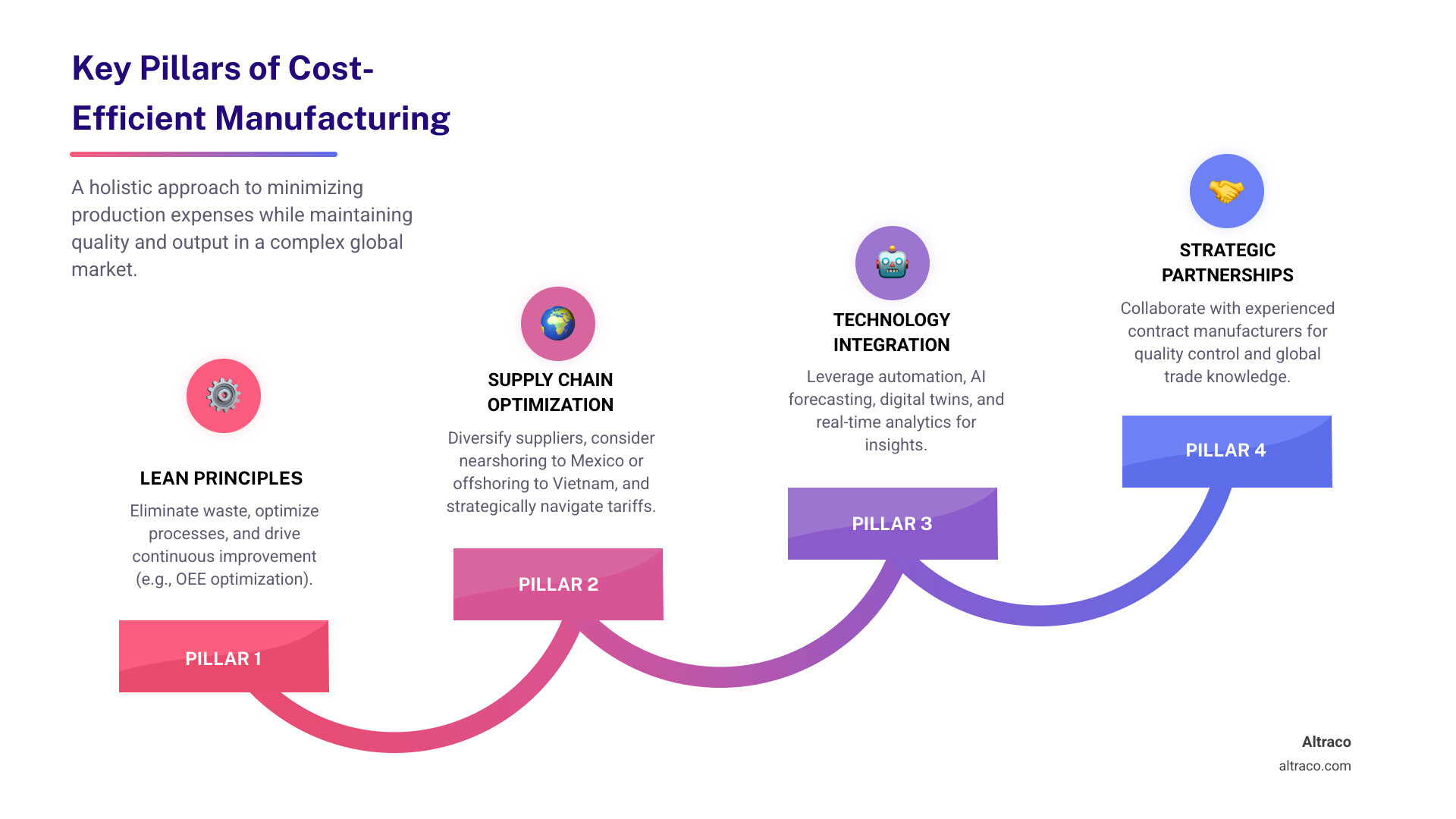
Cost efficient manufacturing is the strategic approach to minimizing production expenses while maintaining or improving product quality and output. For large enterprises navigating today’s volatile global market, achieving true cost efficiency requires more than simple budget cuts—it demands a holistic strategy that combines lean principles, supply chain optimization, smart technology adoption, and strategic manufacturing partnerships.
Quick Answer: Key Strategies for Cost-Efficient Manufacturing
- Implement Lean Manufacturing – Eliminate waste and optimize processes (15-30% cost reduction potential)
- Optimize Your Supply Chain – Nearshore to Mexico or offshore to Vietnam, diversify suppliers, and steer tariffs strategically
- Leverage Technology & Data – Deploy AI, automation, and digital lean tools for real-time insights
- Design for Manufacturability – Reduce costs at the product design stage through smart material selection and part standardization
- Partner Strategically – Work with experienced contract manufacturers who understand global trade complexities
Manufacturing has entered a new era of complexity. Rising labor costs, geopolitical disruption, tariff pressures, and supply chain volatility are forcing Fortune 500 companies to rethink their entire approach to production. The COVID-19 pandemic exposed the fragility of global supply chains, while recent Supreme Court decisions on tariffs have added new layers of uncertainty for companies producing automotive parts, home improvement products, sporting goods, and outdoor equipment overseas.
Traditional cost-cutting measures like simple offshoring or labor arbitrage are losing effectiveness. As one recent analysis noted, “rising wages and shipping costs, coupled with tariff barriers, are eroding the advantages of low-cost regions.” Meanwhile, the ISM Manufacturing PMI has lingered in contraction since early 2023, putting even more pressure on executives to find sustainable ways to reduce costs without sacrificing quality or resilience.
The answer isn’t to retreat from global manufacturing—it’s to approach it more strategically. Companies that combine lean manufacturing principles with smart supply chain decisions and digital capabilities are achieving remarkable results, with research showing cost reductions of 15-30% and significant profit increases by improving metrics like Overall Equipment Effectiveness (OEE).
I’m Albert Brenner, and over 40 years of building a contract manufacturing firm, I’ve helped Fortune 500 companies achieve cost efficient manufacturing through strategic partnerships in Mexico, China, and Vietnam while expertly navigating the complexities of tariffs and global trade. My experience spans home improvement, sporting goods, automotive parts, and outdoor products—industries where every percentage point of cost reduction directly impacts competitiveness.
Cost efficient manufacturing vocab explained:
Laying the Foundation: Core Principles of Manufacturing Cost Reduction
This section covers the fundamental concepts and methodologies that underpin any successful cost reduction effort, moving beyond simple cuts to strategic optimization.
Understanding Fundamental Costs for Cost-Efficient Manufacturing
To start on a journey of cost efficient manufacturing, we must first understand the landscape of our expenses. Without a clear picture of where our money goes, any cost-cutting effort will be a shot in the dark. Manufacturing costs fall into several key categories, and a thorough audit of these is always our first step.
We analyze:
- Direct Costs: Expenses directly tied to producing a product, such as raw materials and direct labor for automotive parts or outdoor gear.
- Indirect Costs: Expenses related to manufacturing but not traceable to a specific product, like factory utilities, maintenance, or quality control staff.
- Labor: This includes wages, benefits, and training. With manufacturing labor costs increasing 4.2% last year, this is a critical area for optimization.
- Raw Materials: The cost of components and raw goods. These are often the first and most substantial cost buckets companies address.
- Overhead: Costs like rent, insurance, and administrative salaries that aren’t direct labor or materials. These are often neglected but can be significant.
- Cost of Goods Sold (COGS): The direct cost of producing goods sold. For manufacturers, COGS is typically much larger than SG&A, making it the most significant target for reduction.
- SG&A: Selling, General, and Administrative expenses (marketing, sales). They often present smaller savings opportunities compared to COGS.

Understanding this breakdown is crucial for identifying where inefficiencies lie. With supply chain and manufacturing costs being a top priority for 65% of executives, a careful audit helps target efforts for the greatest return. Our More info about Added Value Engineering services can help you gain this clarity.
Lean vs. Theory of Constraints (TOC)
When we talk about cost efficient manufacturing, two powerful methodologies often come to mind: Lean Manufacturing and the Theory of Constraints (TOC). We believe the best approach is to combine them for maximum impact.
Lean Manufacturing focuses on eliminating waste—any activity that does not add value from the customer’s perspective. It’s about “spending less” by doing more with fewer resources. Lean techniques like value stream mapping help visualize and streamline production flows, reducing unnecessary steps and the “Six Big Losses” in manufacturing. Companies implementing lean typically see a 5% to 20% reduction in costs in the first year alone.
Theory of Constraints (TOC), on the other hand, is about “making more.” It helps us identify and eliminate bottlenecks, or “constraints,” that limit our overall production. The constraint is the most important limiting factor that stands in the way of achieving a goal. Increasing throughput by 10% (assuming proportional increases in direct and selling costs) can increase profitability by 35%.
Here’s a simplified comparison:
| Feature | Lean Manufacturing (Spend Less) | Theory of Constraints (Make More) |
|---|---|---|
| Primary Goal | Eliminate waste, reduce non-value-added activities | Identify and exploit the system’s constraint to maximize throughput |
| Focus | Processes, resources, efficiency | Bottlenecks, flow, system capacity |
| Key Question | How can we do this with fewer resources? | How can we produce more with existing resources? |
| Impact | Cost reduction, quality improvement, lead time reduction | Increased output, revenue growth, improved delivery performance |
| Example Tool | Value Stream Mapping | Bottleneck analysis, Five Focusing Steps |
By combining both approaches – using Lean to eliminate waste and TOC to maximize output at the constraint – we can achieve truly transformative results. Improving OEE by 10% (reducing Direct Labor costs by 10%) can increase profitability by 25%. Doing both (improving OEE and increasing throughput) results in an amazing 62% increase in profit. This synergistic approach is at the heart of our strategy for cost efficient manufacturing.
Defining Your Cost Reduction Strategy
A successful journey to cost efficient manufacturing requires a formal, well-defined strategy. We can’t just randomly cut costs; we need a roadmap.
Our strategy typically involves:
- Setting Baselines: Before we can improve, we need to know where we stand. This means a thorough audit of all manufacturing costs over a set period. We identify current performance levels, cost drivers, and key metrics.
- Prioritizing Initiatives: Not all cost-saving opportunities are equal. We focus on areas that will yield the biggest impact. This often starts with a “Top Losses Analysis.” This means identifying the largest sources of lost production time or material waste. For example, in automotive parts manufacturing, frequent equipment breakdowns on a critical machine might be a top loss.
- Continuous Improvement Culture: Cost reduction isn’t a one-time event; it’s an ongoing journey. We foster a culture where every employee is empowered to identify and suggest improvements. This iterative process ensures that we’re always finding new ways to optimize.
This strategic approach helps us allocate resources effectively and ensures that our efforts are aligned with our overall business goals.
Tactical Execution: Driving Efficiency on the Factory Floor
This section details the practical, on-the-ground actions managers can take to identify and eliminate inefficiencies within their own facilities.
Auditing for Inefficiency
The first step in driving efficiency is to thoroughly understand our current operations. We conduct comprehensive audits to pinpoint areas of waste and inefficiency:
- Facility Audits: These are deep dives into our physical plants, assessing everything from workflow layout to energy consumption. We look for redundant roles, underused space, and bottlenecks in material flow.
- Process Audits: We examine specific manufacturing processes step-by-step, looking for unnecessary steps, delays, or reworks. This is where value stream mapping proves invaluable, helping us visualize the entire process for home improvement goods or outdoor products.
- Regular Gemba Walks: A Gemba walk involves going to the factory floor to observe processes, engage with employees, and identify problems firsthand. This practice ensures business efficiency, helps identify problems before they occur, and saves money long-term.
Through these audits, we can effectively identify the “Seven Wastes” (Muda) of Lean Manufacturing: Defects, Overproduction, Waiting, Non-Used Talent, Transportation, Inventory, and Motion. Eliminating these wastes directly contributes to cost efficient manufacturing.
Implementing Tactical Changes for Cost-Efficient Manufacturing
Once we’ve identified inefficiencies, we put practical measures in place:
- Predictive Maintenance: Instead of waiting for equipment to break down, we implement predictive maintenance. This uses data and sensors to identify potential defects before they become major problems. Proactively scheduling maintenance reduces costly interruptions in the production of automotive parts or sporting goods.
- Energy Optimization: With energy prices outpacing inflation, we conduct regular energy audits and invest in energy-saving technologies like LED lighting. Optimizing energy usage leads to long-term cost savings.
- Waste Minimization: We focus on optimizing part shapes and nesting in design to minimize material waste. Recycling manufacturing waste not only avoids landfill fees but can also generate revenue, enhancing our cost efficient manufacturing efforts.
- Reviewing Staff Roles: While often difficult, reviewing staff wages, hours, and roles can yield significant savings. We aim to optimize workflows and scheduling based on demand forecasting, ensuring we have the right people in the right roles at the right time, while carefully managing morale.
We are committed to maintaining high quality standards while driving down costs. More info about Quality Control in Manufacturing is available to ensure product integrity. Our dedication to Industrial Quality Control ensures that efficiency never compromises quality.
Engaging Your Workforce for Higher Output
Our employees are our greatest asset, and their engagement is paramount to achieving cost efficient manufacturing.
- Winning the Shift: We implement strategies like “winning the shift,” where plant floor employees are actively engaged and motivated to meet throughput targets. This involves clear communication of goals and real-time feedback on performance.
- Real-time Dashboards (OEE, TAED): Visualizing performance on the factory floor with dashboards displaying metrics like Overall Equipment Effectiveness (OEE) and TAED (Target, Actual, Efficiency, Downtime) keeps teams motivated. This immediate feedback helps drive continuous improvement. Improving OEE by 10% can increase profitability by 25%.
- Employee Feedback Loops: We create channels for employees to provide feedback and suggestions. They are on the front lines and often have the best insights into process improvements. Encouraging feedback ensures buy-in for efficiency initiatives.
- Training & Upskilling: Investing in our workforce through effective training ensures they have the skills needed for peak performance. This reduces errors, increases efficiency, and improves morale.
Engaging our workers ensures that improvements are not just top-down directives but are acceptd and driven by those who execute the work every day.
Strategic Cost Optimization for Cost-Efficient Manufacturing
True cost efficiency extends beyond the factory floor to strategic decisions about product design, sourcing, and global logistics.
Optimizing Product Design, Materials, and Tooling
The smartest savings often start in the design phase. We believe in “designing with manufacturing in mind” from the very beginning.
- Design for Manufacturability (DFM): This principle guides us to simplify product designs and choose cost-effective materials and processes. For automotive parts or outdoor products, DFM can prevent costly reworks and modifications by designing with manufacturing in mind.
- Material Selection: Choosing materials should be based on long-term performance and durability, not just the cheapest upfront price. We help clients select materials that balance cost and performance, preventing failures that lead to returns and reputation issues.
- Part Standardization: Custom components can be costly. By standardizing parts and using off-the-shelf components where possible, we simplify assembly, reduce stock issues, and lower production time, making procurement and inventory management simpler.
- Prototyping & Testing: Skipping prototyping might save time short-term but can cost a fortune. We use low-volume production or rapid prototyping for early testing. This allows us to refine designs and catch issues before full-scale production.
Our Cost-Value Engineering: Complete Guide provides deeper insights into optimizing these aspects.
Rebuilding the Supply Chain for Resilience and Savings
In today’s global landscape, a resilient and cost efficient manufacturing supply chain is non-negotiable.
- Supplier Negotiation: Effective negotiation and strong supplier relationships can yield tremendous savings. We negotiate preferred contracts for guaranteed volumes and explore regional suppliers to reduce distribution costs and ensure favorable terms.
- Diversifying the Supplier Base: Diversifying the supplier base in the supply chain is an important management strategy to reduce dependence on specific regions. By expanding the supplier network, we reduce risks, increase flexibility, and optimize costs. This is crucial given recent geopolitical shifts.
- Nearshoring to Mexico: For US-based clients, nearshoring to Mexico offers a compelling balance of lower labor costs and a skilled workforce, especially for automotive parts and home improvement products. Mexico’s proximity provides faster shipping and more responsive supply chains, reducing logistics costs. Why Mexico Manufacturing is Changing Global Supply Chains details these benefits.
- Offshoring to Vietnam: Vietnam also presents a strong option for offshoring, offering competitive manufacturing costs and growing capabilities, particularly for certain outdoor products and sporting goods. We help clients establish robust manufacturing relationships in Vietnam.
Conventional cost-cutting measures like offshoring and labor arbitrage are becoming less effective due to rising wages, shipping costs, and tariffs. Reshoring and nearshoring are accelerating, driven by the need for more control and tariff protection. We help our clients make informed decisions about their manufacturing footprint, whether it’s manufacturing partner California or via global sourcing.
Navigating Tariffs with an Experienced Manufacturing Partner
Tariffs represent a significant and often unpredictable cost in global manufacturing.
- Tariff Impact: Tariffs can significantly impact industrial earnings. Recent United States Supreme Court decisions have added complexity, making expert navigation of regulations like Current China Tariffs essential.
- Reshoring vs. Offshoring: The decision to reshore or offshore needs careful consideration of labor costs, logistics, tariffs, and supply chain resilience. While reshoring has increased, our expertise helps clients weigh the Pros and Cons of Tariffs for their specific products.
- Vetting Partners: Working with an experienced contract manufacturing partner like Altraco is crucial. We bring decades of experience, trusted factory relationships in countries like Mexico, China, and Vietnam, and deep expertise in tariff navigation. We act as your guide through the complexities of global trade, ensuring quality, on-time products, and significant cost savings.
- Altraco’s Expertise: We specialize in guiding clients through these intricate decisions for automotive parts, home improvement, sporting goods, and outdoor products. Our Tariff Guide for Business provides valuable insights. We help you choose the right partner and strategy, ensuring your manufacturing operations remain cost efficient manufacturing and competitive. Our Choosing a Contract Manufacturer: Pro Tips offers further guidance.
The Future is Now: Leveraging Technology and Data
The next frontier of cost savings is driven by data, automation, and intelligent systems that transform traditional operations.
The Role of Automation and AI in Manufacturing
Investing in technology is no longer optional; it’s a necessity for cost efficient manufacturing.
- Robotics: With over 1.7 million robots being installed worldwide in the next three years and prices falling, robotics streamline processes, reduce labor costs, and maintain high quality control. Collaborative robots (cobots) can work safely alongside humans, improving both safety and productivity.
- AI-driven Forecasting: AI can significantly improve demand forecasting, reducing unnecessary inventory (one manufacturer saw a 50% improvement in forecast accuracy). This helps avoid overproduction and stockouts. AI also helps manage long-tail suppliers more efficiently.
- Digital Twins: These virtual models of physical products or processes allow us to simulate scenarios, identify bottlenecks, and optimize processes without disrupting actual production. This is invaluable for complex automotive parts manufacturing.
- Internet of Things (IoT): The Internet of Things involves integrating sensors into machinery for real-time data collection. This data powers predictive maintenance and provides real-time monitoring of production lines to identify and address inefficiencies immediately.
- Predictive Analytics: By analyzing historical and real-time data, we can predict potential issues, optimize maintenance schedules, and improve quality control. This proactive approach saves significant costs by preventing breakdowns and defects.
97% of manufacturing CEOs report that they have deployed AI or soon will, with 60% already seeing ROI from their AI initiatives. This technology investment is critical for long-term savings and a competitive edge.
From Lean to Digital Lean
The combination of traditional lean manufacturing principles with digital technologies creates “digital lean,” a powerful approach that amplifies benefits and drives deeper cost reductions.
- Data Intelligence: Digital lean leverages vast amounts of data from the factory floor and supply chain. This data is analyzed to provide real-time insights, enabling data-driven decision-making.
- Real-time Analytics: Advanced analytics software transforms raw data into actionable insights, allowing us to monitor production, detect anomalies, and optimize processes in real-time. This is essential for continuous improvement.
- 30% Cost Reduction Potential: Traditional lean typically produces a 15% reduction in key operations costs. Digital lean adds a 100% improvement on top of that, for a 30% total cost reduction. This is achieved by integrating digital capabilities like AI and digital twins into traditional production systems. We also explore Six Sigma in Supply Chain Management to further refine processes.
Digital lean is not just about adopting new tools; it’s about changing our operations to achieve new levels of performance and efficiency.
Measuring Success with Key Performance Indicators (KPIs)
To ensure our cost efficient manufacturing efforts are successful, we must constantly measure our progress. We use a suite of Key Performance Indicators (KPIs) to track and optimize our operations:
- Overall Equipment Effectiveness (OEE): This is a gold standard metric combining availability, performance, and quality into a single percentage. It tells us how effectively our equipment is being used. Improving OEE by 10% can increase profitability by 25%.
- Cost Per Unit: A fundamental indicator of manufacturing efficiency, this KPI tracks the total cost to produce a single unit of product. We monitor this closely to ensure our cost reduction strategies are effective.
- First Pass Yield (FPY): This measures the percentage of products that pass inspection the first time through a process without needing rework. A high FPY indicates an efficient and high-quality process, reducing scrap and rework costs.
- Labor Efficiency: This KPI assesses how effectively our workforce is used, often measured by output per labor hour. Optimizing labor efficiency involves effective scheduling, training, and automation.
These KPIs provide us with a clear, quantitative understanding of our performance, allowing us to make informed decisions and continuously improve. For comprehensive tracking and optimization, we often recommend our clients use More info about Supplier Scorecards to evaluate partner performance.
Frequently Asked Questions about Cost-Efficient Manufacturing
What is the difference between manufacturing efficiency and productivity?
This is a common question. Manufacturing Efficiency focuses on how well resources are used (doing things right), such as reducing scrap material. Manufacturing Productivity is a broader measure of output volume over time (doing the right things), like increasing units produced per hour. While distinct, both are crucial for profitability, and we help clients optimize both.
How can I reduce costs without sacrificing product quality?
Reducing costs without compromising quality is the ultimate goal of cost efficient manufacturing. Our approach focuses on smart optimization rather than cutting corners:
- Eliminate Waste, Not Quality: We focus on eliminating the seven wastes of lean manufacturing (defects, overproduction, waiting, etc.). These wastes add cost but no value.
- Optimize Processes: Streamlining production processes through methods like value stream mapping reduces inefficiencies and errors, leading to higher quality at a lower cost.
- Smart Design (DFM): Implementing Design for Manufacturability (DFM) ensures products are designed for easy and cost-effective production from the outset.
- Strong Quality Control: Robust quality control systems, from material inspection to final testing, are non-negotiable to prevent costly reworks and returns.
- Strong Supplier Relationships: Partnering with reliable suppliers for raw materials ensures consistent quality, preventing issues down the line.
By focusing on these areas, we achieve cost reductions that improve, rather than detract from, product quality.
What is the first step to creating a cost reduction plan?
The very first step to creating an effective cost efficient manufacturing plan is to conduct a thorough audit of all your current costs. This means:
- Understand Your Cost Structure: Break down all expenses into direct costs (labor, raw materials), indirect costs (utilities, maintenance), and overhead.
- Gather Data: Collect comprehensive financial data over a meaningful period to identify trends and anomalies.
- Establish a Baseline: This audit will give you a clear baseline against which to measure future improvements.
- Identify Key Areas: Pinpoint the largest areas of expenditure and the most significant sources of waste. These are your primary targets for intervention.
This foundational analysis ensures that your cost reduction efforts are strategic, data-driven, and focused on areas with the highest potential impact.
Conclusion
Our journey through cost efficient manufacturing reveals that sustainable cost reduction requires strategic change, not simple cuts. A holistic approach integrating Lean principles, supply chain optimization, and technology is key.
We’ve seen how foundational principles, tactical factory-floor actions, and strategic design choices create savings. Critically, rebuilding the supply chain through smart sourcing in Mexico or Vietnam and navigating complex tariffs demands an experienced partner.
The future is digital, with “digital lean” promising up to a 30% cost reduction. Measuring success with KPIs like OEE ensures we stay on track.
For Fortune 500 companies, navigating global complexities requires a partner who understands international manufacturing. Altraco simplifies these challenges. With decades of experience, trusted factory relationships in Mexico, China, and Vietnam, and tariff navigation expertise, we are your strategic partner in achieving sustainable cost efficient manufacturing and delivering quality, on-time products.
Explore Altraco’s Integrated Supply Chain Services and let us help you open up the full potential of your manufacturing operations.

Al is an entrepreneur, founder, and owner of multiple businesses, including Altraco, an outsourcing and contract manufacturing company. Working across multiple continents and trusted by Fortune 500 companies, Al finds innovative solutions to traditional supply chain challenges. He is a member of Vistage Worldwide.